DOI: https://doi.org/10.56669/HHUN5169
This manuscript was originally presented at the ACRI, ATRI, WorldVeg, and FFTC workshop titled “Pest and Disease Management Strategies for Sustainable Agriculture,” held in Taichung, Taiwan, on May 5–6, 2026.
ABSTRACT
With the formulation of the "Revised Plant Protection Act" and the "Green Food System Strategy," there is growing momentum in Japan to promote IPM (Integrated Pest Management) more than ever before. However, the registration and dissemination of natural enemy pesticides and microbial pesticides, which are the means to achieve this, are not necessarily accelerating. One reason for this is that natural enemy pesticides are more expensive than chemical pesticides, have less stable effects, and require expertise in their use, which may be why their use in agriculture has not progressed. Another reason is that in Japan, natural enemies are sometimes considered pesticides under the Agricultural Chemicals Control Act. This means that in order to import, propagate, and sell natural enemies in agriculture, data on their effectiveness and safety must be collected and submitted, and registration with the Minister of Agriculture, Forestry and Fisheries must be obtained, based on the same system as for chemical pesticides. The costs associated with new registration and maintenance are reflected in the product price, which tends to drive up the price of natural enemy pesticides. Unlike chemical pesticides, which provide consistent results through standardized application, the effectiveness of natural enemy pesticides tends to vary depending on environmental conditions. Therefore, it is desirable to promote the use of natural enemy pesticides not merely through sales, but with technical support from experienced individuals. However, Japan has traditionally lacked such personnel and organizations. Some production areas are beginning to learn from successful production areas that have successfully incorporated IPM into their operations and are generating profits, and are working together as a community to acquire the necessary IPM technologies and provide mutual support.
INTRODUCTION
Like Taiwan and other East Asian countries, Japanese agriculture, conducted under warm and humid climate conditions, is constantly plagued by a variety of pests and diseases, and it is no exaggeration to say that it is a continuous battle against them. In recent years, with the decline in the agricultural population and the aging of farmers, the importance of pesticides, the simplest and most reliable means of control, has become more important than ever in order to maintain productivity. However, due to problems such as rapid climate change, the increase in invasive pests and diseases due to global logistics, and the development of resistance to pesticides, the limitations of relying solely on chemical pesticides as in the past are beginning to be recognized, and the need to promote integrated pest management (IPM), which combines multiple control methods such as biological control in a harmonious manner, is starting to be acknowledged.
Reflecting this situation, when the Plant Protection Act was amended (2022), for the first time in Japanese law, the definition of IPM and basic guidelines for its promotion were clearly defined. The basic guidelines specifically outline the cooperation and division of responsibilities between the national and prefectural governments to promote IPM, and the government is to take the lead in creating conditions that make it easier for farmers to implement.
Furthermore, the "Strategy for sustainable food systems MIDORI" was formulated in 2021, modeled after the EU's comprehensive food strategy "Farm to Fork," and set 14 key performance indicators (KPIs) related to reducing environmental risks, including achieving zero carbon dioxide emissions for agriculture as a whole by 2050, a 50% reduction in chemical pesticides (risk-based), and expanding the proportion of organic farming to 25% of cultivated land. The Green Food System Strategy also calls for increased productivity, and the practical application of effective pest control materials as alternatives to chemical pesticides is urgently needed to achieve these goals.
Definition of Biopesticides
There is no international definition of biopesticides ("Biopesticides," "Biological pesticides," etc.). Based on the International Code of Conduct for Pesticide Management (FAO/WHO, 2017) created by the FAO/WHO, the category generally includes microbials, botanicals (plant extracts), and semiochemicals (signaling substances). In this article, following the pesticide registration system in Japan, the term "biopesticide" will be used to refer to natural enemies and microbial control materials (including BT agents), while the term "biopesticides, etc." will be used to refer to information including pheromones, attractants, and plant extracts.
History and Registration Status of Biopesticides in Japan
Figure 1 shows the trend in the number of newly registered biological pesticides and other pesticide formulations in Japan. In compiling the data, I used the Pesticide Registration Information Provision System (Ministry of Agriculture, Forestry and Fisheries, https://pestcide.maff.go.jp), Registered and Expired Pesticide Information (Pesticide Inspection Department, Food and Agricultural Materials Inspection Center (FAMIC), https://www.acis.famic.go.jp/toroku/), as well as the Pesticide Handbook and JPP-NET published and provided by the Japan Plant Protection Association. The data was classified into categories such as natural enemies, entomopathogenic microorganisms, BT agents, microbial fungicides/herbicides/plant growth regulators and attenuated viruses (hereinafter referred to as "microbial fungicides, etc."), and pheromone agents/attractants, and then organized according to the main use of the formulation.
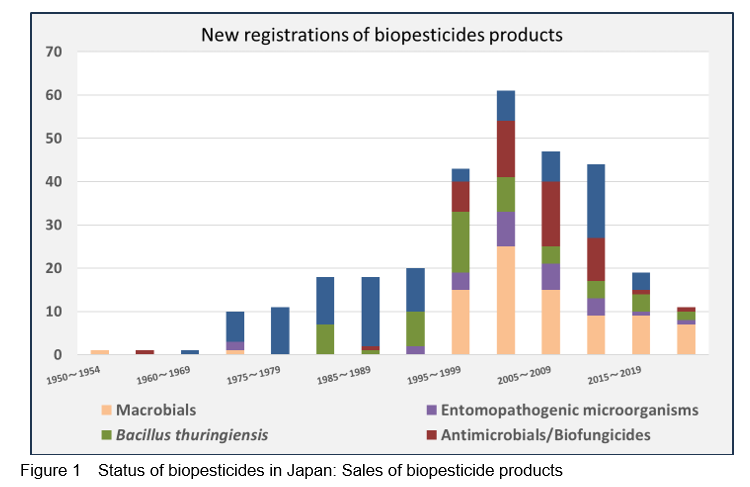
The history of registration of biological pesticides in Japan began in 1951 with the registration of a parasitic wasp, which parasitizes the red wax scale Ceroplastes rubens. Next, in disease control, a live Trichoderma fungus that has antagonistic effects against Pythium sp., the pathogen of damping-off disease in legumes, was registered. Furthermore, regarding insect pathogenic microorganisms, the first registered product was in 1974, which contained a cytoplasmic polyhedra virus as the active ingredient against the pine moth. The development of sex pheromone-based formulations began with a mass-attracting agent registered in 1977. From the late 1970s to the 1980s, there was a noticeable increase in the registration of formulations aimed at mass attraction and killing. This reflects the situation at the time when fruit fly eradication projects were being carried out in the southwestern islands (Kocha, 1986; Ministry of Agriculture, Forestry and Fisheries, 1993). In the late 1980s, the registration of communication disruption agents progressed, and from 2010 to 2014, the number of new registrations reached a record high of 17.
The first registration of BT formulations was in 1981, but due to discussions about their safety for humans, there were hardly any new registrations until 1994 (Ito et al., 1991; Maruyama, 2004). After these discussions, their safety was proven, and there are currently 26 registered drugs. From the late 1990s to the early 2010s, the number of new registrations exceeded 40 every five years. During this period, the government provided support for research and development, and guidelines were established for safety assessment of microbial pesticides and for preparing necessary documents for registration applications. Researchers and manufacturers were actively working towards new registrations (Ministry of Agriculture, Forestry and Fisheries, 1997; Okada, 2004; Fujita, 2015). In the last 10 years, natural enemy organisms have accounted for the majority of new registrations, with registrations of predatory mite formulations being particularly prominent.
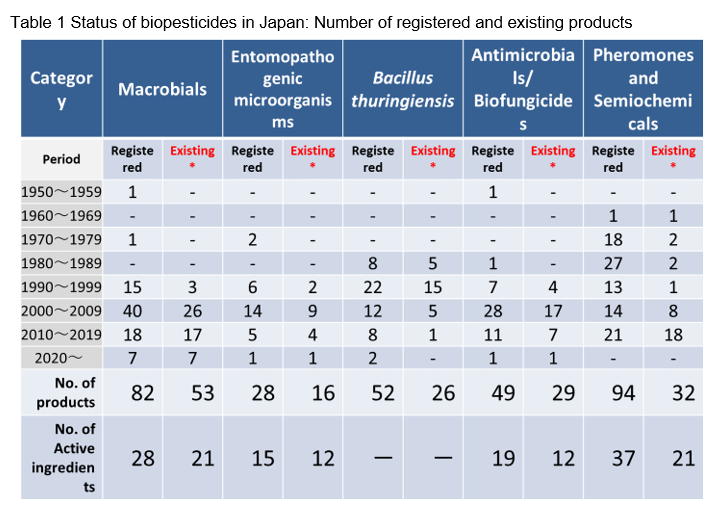
Table 1 shows the number of newly registered biopesticides, registered active ingredients, and current registration numbers and active ingredients in Japan. Figure 1 shows its trend broken down by category and by 10-year periods. As of August 1, 2024, 21 components and 53 formulations of natural enemies, 13 components and 29 formulations of entomopathogenic microorganisms, 26 formulations of BT agents, and 21 components and 32 formulations of pheromone/attractant agents are registered. Currently registered biopesticides are mainly those registered after 2000, with many formulations registered before that having expired due to economic reasons or the switch to newly registered formulations. In contrast, a large proportion of BT agents have been registered since the 1980s (Fujii, 2024). Looking at the trends over the past 10 years, categorized into insecticides (natural enemy pesticides, entomopathogenic microorganisms, BT agents), pheromone agents, and microbial fungicides, the insecticide category has grown by approximately 1.5 times, while microbial fungicides have decreased to about two-thirds, and pheromone agents have remained relatively stable, resulting in no significant overall change (Figure 2). Consequently, the proportion of biological pesticides in the total value of pesticide shipments has remained almost unchanged at 1% over the past 10 years (Figure 3).
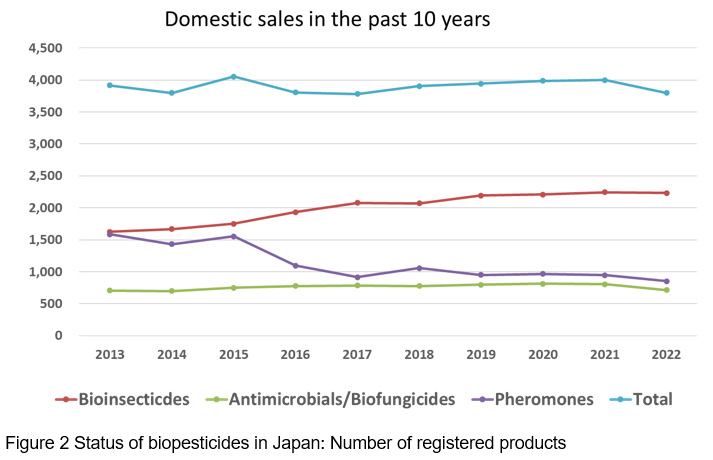
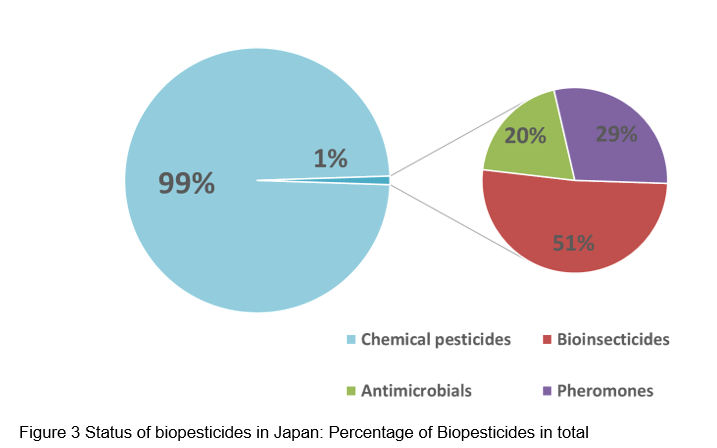
Thus, while there have been periods of temporary activity, the registration of biological pesticides in Japan has generally been stagnant. However, with the promotion of IPM based on the revision of the Plant Protection Act and the formulation of the Green Food System Strategy, a dramatic increase in the number of registered biological pesticides and their shipment value is expected (Fujii, 2024).
The History of Natural Enemy Use in Japanese Agriculture
We have reviewed the use of biological pesticides and the like from the perspective of pesticide registration, but if we take a broader view of the trends in biological control in Japan, it will look like this.
Early biological control methods, known as classical biological control, involved collecting natural enemies from the country of origin of invasive pests and releasing them into the agricultural fields. The first successful example was the introduction of Vedalia ladybugs from Taiwan in 1911 to control the cottony cushion scale insects, giving this method a history of over 100 years. Basically, the expectation was that a single release would establish a population that would gradually expand its habitat and provide widespread and permanent control of the pest population. Therefore, most Examples did not involve formulation or repeated releases, and thus did not require pesticide registration. There have been notable successes with fruit tree and tea pests such as scale insects, aphids, whiteflies, and gall wasps in Japan (Furuhashi, 2013).
On the other hand, methods such as inoculation and mass release of natural enemy formulations cultured indoors did not progress in practical use due to the high cost of formulations and the poor establishment of released insects. However, in the 1990s, bumblebees were put into practical use to rationalize fruit setting management in greenhouse cultivation of strawberries and fruit vegetables, and the use of natural enemy formulations against spider mites and whiteflies progressed to protect pollinating insects. While introducing natural enemy formulations alone can lead to increased production costs, introducing them in conjunction with pollinating insects can shorten the time required for pollination, and when converted into cost savings, this can lead to an overall improvement in business profitability. It is thought that a favorable factor was that natural enemies could be more easily established in the enclosed space of a greenhouse compared to the open environment of an orchard.
Furthermore, the significant development of resistance to acaricides, the resulting scarcity of effective acaricides, and the soaring prices of those acaricides have relatively increased the practicality of natural enemy formulations. Similarly, in the 2010s, a significant decrease in pesticide susceptibility was observed in whiteflies, which transmit viral diseases to tomatoes and bell peppers, leading to the development and practical application of natural enemy formulations. Thus, expectations and acceptance of natural enemy pesticides in agriculture have certainly increased compared to the past. However, unlike chemical pesticides, natural enemy formulations do not guarantee effectiveness with uniform application, and if used by farmers who are not proficient in the application techniques, they may not be effective. Therefore, the expansion of natural enemy formulation use is not necessarily a one-way trend, and in some cases, when a new, effective chemical insecticide is registered, natural enemy formulations are quickly replaced by it, and farmers revert to chemical control.
Reasons for the Difficulty in Expanding the Use of Biological Pesticides and Other Related Products, and Countermeasures
Taking natural enemy formulations as an example, the main reasons why farmers find them more difficult to use than chemical pesticides can be considered as follows:
1) Difficulty in Timing of Application
When pests have already reached high densities, the rate of predation and parasitism cannot keep up, and no visible effect is obtained. Conversely, if applied before pest emergence or when densities are very low, the natural enemies will disperse without establishing themselves due to a lack of food or hosts.
2) Effects of Pesticides
If components of pesticides sprayed to control other pests remain, the treated natural enemies may die or their activity may be suppressed, resulting in insufficient effectiveness. Therefore, when using natural enemies, it is necessary to select and combine pesticides that have minimal impact on natural enemies for the control of other pests.
3) The difficulty of providing the environment where natural enemies can thrive.
Under extreme temperature and humidity conditions, natural enemies may not be able to survive, and no effect may be obtained. Also, some natural enemies are affected by direct sunlight and wind and rain, so physical structures that provide hiding places may be necessary.
If biological pesticides are used without sufficient consideration of these conditions, the desired results will not be achieved, leading to farmers abandoning their use. Therefore, it is considered to be desirable that the promotion of biological pesticides not only involve sales but also include technical guidance from advisors and consultants. In Japan, the development of such organizations and the training of personnel are insufficient, and this remains a challenge for the future.
Technical Measures to Expand the Applicable Conditions for Natural Enemies
Developing technologies that allow biological pesticides and similar products to be used in the same way as chemical pesticides, without requiring special knowledge or skills, is also important. For example, conventional mite formulations used in Japan contain alternative food sources. This aims to prevent starvation of released individuals by providing them with food even when the mite density at the time of release is zero or extremely low, thereby suppressing their movement and dispersal from the release site. While this alone can be expected to have a certain effect on promoting establishment, in recent years, technologies have been developed and are being put into practical use that, in addition to providing habitats and spawning sites at the same time as release, supporting the survival and reproduction of released individuals and providing immediate suppressive effects when the density of pests such as spider mites begins to rise. This technology, called a banker sheet, is expected to improve the establishment of released natural enemies and ensure their effectiveness. Such technical improvements may lower the barrier to using natural enemies and dispel the image among farmers that natural enemies are difficult to use.
System development and human resource development for widespread adoption
Technical improvements to enhance the stability of their effects are crucial for expanding the use of biopesticides and similar products. Alongside this, efforts to increase the number of registered biopesticides and broaden the options available to farmers are also necessary. In Japan, natural enemy formulations are defined as pesticides, and registration is required for their import and sale. While some items, such as toxicity tests and crop residue tests, are exempted for registration applications, the submission of test data is essentially equivalent to that required for chemical pesticides. The complexity of the registration process is a deterrent for pesticide manufacturers in developing biopesticides. Relaxing registration requirements would reduce development costs for manufacturers, leading to lower sales prices for formulations and ultimately expanding the use of biopesticides in production.
CONCLUSION
The Green Food System Strategy aims to significantly reduce reliance on chemical pesticides and fertilizers, increase the area of organic farming, and improve agricultural productivity. Generally, reducing chemical pesticides and fertilizers often leads to a decrease in yield, and it seems that this is a difficult goal to achieve simultaneously with current technology. Therefore, this strategy aims to achieve both through innovation. Taking natural enemy pesticides as an example, this innovation would involve developing formulations and application technologies that can stably exhibit effects equivalent to those of chemical pesticides. Alternatively, a breakthrough might involve developing and putting into practical use novel pest control technologies that utilize physical information such as light, sound, and substrate vibration. In any case, it is necessary to abandon the notion that yields and quality will naturally decline because chemical pesticides have been reduced, and instead focus on technological development and the establishment of dissemination systems.
ACKNOWLEDGMENTS
I would like to express my sincere gratitude to Mr. Tastuya Fujii of the Plant Protection Division, Ministry of Agriculture, Forestry and Fisheries, for providing charts and graphs regarding the registration status of biological pesticides and shipment values by category. Thanks are also due to Dr. Hidenari Kishimoto and Masatoshi Toyama of National Agriculture and Food Research Organization (NARO) for providing useful information on development trends of natural enemy formulations. Furthermore, I would like to express my deep gratitude to Mr. Funaki of the Japan Plant Protection Association for his advice on the structure of this report.
REFERENCES
T. Kocha, 1986 Plant Protection 40: 120-126.
Ministry of Agriculture, Forestry and Fisheries, 1993 lant Protection Station Pest Information 42: 1-3
T. Ito et al. 1991 Plant Protection 45: 510-514
T. Maruyama, 2004 Plant Protection 58: 468-473
Ministry of Agriculture, Forestry and Fisheries, 1997; Regarding the handling of test results related to safety evaluations for registration applications of microbial pesticides.
M. Okada, 2004 JPPA Symposium Abstracts of the lectures: 1-7
S. Fujita, 2015 JPPA Symposium Abstracts of the lectures: 1-12
T. Fujii 2024 Plant Protection 78: 606-615.
K. Furuhashi 2013 Plant Protection 67: 313-318.

Registration Status, Prevalence, and Registration Procedures for Biological Pesticides (Insects, Fungi, Bacteria, Pheromones) in Japan
DOI: https://doi.org/10.56669/HHUN5169
This manuscript was originally presented at the ACRI, ATRI, WorldVeg, and FFTC workshop titled “Pest and Disease Management Strategies for Sustainable Agriculture,” held in Taichung, Taiwan, on May 5–6, 2026.
ABSTRACT
With the formulation of the "Revised Plant Protection Act" and the "Green Food System Strategy," there is growing momentum in Japan to promote IPM (Integrated Pest Management) more than ever before. However, the registration and dissemination of natural enemy pesticides and microbial pesticides, which are the means to achieve this, are not necessarily accelerating. One reason for this is that natural enemy pesticides are more expensive than chemical pesticides, have less stable effects, and require expertise in their use, which may be why their use in agriculture has not progressed. Another reason is that in Japan, natural enemies are sometimes considered pesticides under the Agricultural Chemicals Control Act. This means that in order to import, propagate, and sell natural enemies in agriculture, data on their effectiveness and safety must be collected and submitted, and registration with the Minister of Agriculture, Forestry and Fisheries must be obtained, based on the same system as for chemical pesticides. The costs associated with new registration and maintenance are reflected in the product price, which tends to drive up the price of natural enemy pesticides. Unlike chemical pesticides, which provide consistent results through standardized application, the effectiveness of natural enemy pesticides tends to vary depending on environmental conditions. Therefore, it is desirable to promote the use of natural enemy pesticides not merely through sales, but with technical support from experienced individuals. However, Japan has traditionally lacked such personnel and organizations. Some production areas are beginning to learn from successful production areas that have successfully incorporated IPM into their operations and are generating profits, and are working together as a community to acquire the necessary IPM technologies and provide mutual support.
INTRODUCTION
Like Taiwan and other East Asian countries, Japanese agriculture, conducted under warm and humid climate conditions, is constantly plagued by a variety of pests and diseases, and it is no exaggeration to say that it is a continuous battle against them. In recent years, with the decline in the agricultural population and the aging of farmers, the importance of pesticides, the simplest and most reliable means of control, has become more important than ever in order to maintain productivity. However, due to problems such as rapid climate change, the increase in invasive pests and diseases due to global logistics, and the development of resistance to pesticides, the limitations of relying solely on chemical pesticides as in the past are beginning to be recognized, and the need to promote integrated pest management (IPM), which combines multiple control methods such as biological control in a harmonious manner, is starting to be acknowledged.
Reflecting this situation, when the Plant Protection Act was amended (2022), for the first time in Japanese law, the definition of IPM and basic guidelines for its promotion were clearly defined. The basic guidelines specifically outline the cooperation and division of responsibilities between the national and prefectural governments to promote IPM, and the government is to take the lead in creating conditions that make it easier for farmers to implement.
Furthermore, the "Strategy for sustainable food systems MIDORI" was formulated in 2021, modeled after the EU's comprehensive food strategy "Farm to Fork," and set 14 key performance indicators (KPIs) related to reducing environmental risks, including achieving zero carbon dioxide emissions for agriculture as a whole by 2050, a 50% reduction in chemical pesticides (risk-based), and expanding the proportion of organic farming to 25% of cultivated land. The Green Food System Strategy also calls for increased productivity, and the practical application of effective pest control materials as alternatives to chemical pesticides is urgently needed to achieve these goals.
Definition of Biopesticides
There is no international definition of biopesticides ("Biopesticides," "Biological pesticides," etc.). Based on the International Code of Conduct for Pesticide Management (FAO/WHO, 2017) created by the FAO/WHO, the category generally includes microbials, botanicals (plant extracts), and semiochemicals (signaling substances). In this article, following the pesticide registration system in Japan, the term "biopesticide" will be used to refer to natural enemies and microbial control materials (including BT agents), while the term "biopesticides, etc." will be used to refer to information including pheromones, attractants, and plant extracts.
History and Registration Status of Biopesticides in Japan
Figure 1 shows the trend in the number of newly registered biological pesticides and other pesticide formulations in Japan. In compiling the data, I used the Pesticide Registration Information Provision System (Ministry of Agriculture, Forestry and Fisheries, https://pestcide.maff.go.jp), Registered and Expired Pesticide Information (Pesticide Inspection Department, Food and Agricultural Materials Inspection Center (FAMIC), https://www.acis.famic.go.jp/toroku/), as well as the Pesticide Handbook and JPP-NET published and provided by the Japan Plant Protection Association. The data was classified into categories such as natural enemies, entomopathogenic microorganisms, BT agents, microbial fungicides/herbicides/plant growth regulators and attenuated viruses (hereinafter referred to as "microbial fungicides, etc."), and pheromone agents/attractants, and then organized according to the main use of the formulation.
The history of registration of biological pesticides in Japan began in 1951 with the registration of a parasitic wasp, which parasitizes the red wax scale Ceroplastes rubens. Next, in disease control, a live Trichoderma fungus that has antagonistic effects against Pythium sp., the pathogen of damping-off disease in legumes, was registered. Furthermore, regarding insect pathogenic microorganisms, the first registered product was in 1974, which contained a cytoplasmic polyhedra virus as the active ingredient against the pine moth. The development of sex pheromone-based formulations began with a mass-attracting agent registered in 1977. From the late 1970s to the 1980s, there was a noticeable increase in the registration of formulations aimed at mass attraction and killing. This reflects the situation at the time when fruit fly eradication projects were being carried out in the southwestern islands (Kocha, 1986; Ministry of Agriculture, Forestry and Fisheries, 1993). In the late 1980s, the registration of communication disruption agents progressed, and from 2010 to 2014, the number of new registrations reached a record high of 17.
The first registration of BT formulations was in 1981, but due to discussions about their safety for humans, there were hardly any new registrations until 1994 (Ito et al., 1991; Maruyama, 2004). After these discussions, their safety was proven, and there are currently 26 registered drugs. From the late 1990s to the early 2010s, the number of new registrations exceeded 40 every five years. During this period, the government provided support for research and development, and guidelines were established for safety assessment of microbial pesticides and for preparing necessary documents for registration applications. Researchers and manufacturers were actively working towards new registrations (Ministry of Agriculture, Forestry and Fisheries, 1997; Okada, 2004; Fujita, 2015). In the last 10 years, natural enemy organisms have accounted for the majority of new registrations, with registrations of predatory mite formulations being particularly prominent.
Table 1 shows the number of newly registered biopesticides, registered active ingredients, and current registration numbers and active ingredients in Japan. Figure 1 shows its trend broken down by category and by 10-year periods. As of August 1, 2024, 21 components and 53 formulations of natural enemies, 13 components and 29 formulations of entomopathogenic microorganisms, 26 formulations of BT agents, and 21 components and 32 formulations of pheromone/attractant agents are registered. Currently registered biopesticides are mainly those registered after 2000, with many formulations registered before that having expired due to economic reasons or the switch to newly registered formulations. In contrast, a large proportion of BT agents have been registered since the 1980s (Fujii, 2024). Looking at the trends over the past 10 years, categorized into insecticides (natural enemy pesticides, entomopathogenic microorganisms, BT agents), pheromone agents, and microbial fungicides, the insecticide category has grown by approximately 1.5 times, while microbial fungicides have decreased to about two-thirds, and pheromone agents have remained relatively stable, resulting in no significant overall change (Figure 2). Consequently, the proportion of biological pesticides in the total value of pesticide shipments has remained almost unchanged at 1% over the past 10 years (Figure 3).
Thus, while there have been periods of temporary activity, the registration of biological pesticides in Japan has generally been stagnant. However, with the promotion of IPM based on the revision of the Plant Protection Act and the formulation of the Green Food System Strategy, a dramatic increase in the number of registered biological pesticides and their shipment value is expected (Fujii, 2024).
The History of Natural Enemy Use in Japanese Agriculture
We have reviewed the use of biological pesticides and the like from the perspective of pesticide registration, but if we take a broader view of the trends in biological control in Japan, it will look like this.
Early biological control methods, known as classical biological control, involved collecting natural enemies from the country of origin of invasive pests and releasing them into the agricultural fields. The first successful example was the introduction of Vedalia ladybugs from Taiwan in 1911 to control the cottony cushion scale insects, giving this method a history of over 100 years. Basically, the expectation was that a single release would establish a population that would gradually expand its habitat and provide widespread and permanent control of the pest population. Therefore, most Examples did not involve formulation or repeated releases, and thus did not require pesticide registration. There have been notable successes with fruit tree and tea pests such as scale insects, aphids, whiteflies, and gall wasps in Japan (Furuhashi, 2013).
On the other hand, methods such as inoculation and mass release of natural enemy formulations cultured indoors did not progress in practical use due to the high cost of formulations and the poor establishment of released insects. However, in the 1990s, bumblebees were put into practical use to rationalize fruit setting management in greenhouse cultivation of strawberries and fruit vegetables, and the use of natural enemy formulations against spider mites and whiteflies progressed to protect pollinating insects. While introducing natural enemy formulations alone can lead to increased production costs, introducing them in conjunction with pollinating insects can shorten the time required for pollination, and when converted into cost savings, this can lead to an overall improvement in business profitability. It is thought that a favorable factor was that natural enemies could be more easily established in the enclosed space of a greenhouse compared to the open environment of an orchard.
Furthermore, the significant development of resistance to acaricides, the resulting scarcity of effective acaricides, and the soaring prices of those acaricides have relatively increased the practicality of natural enemy formulations. Similarly, in the 2010s, a significant decrease in pesticide susceptibility was observed in whiteflies, which transmit viral diseases to tomatoes and bell peppers, leading to the development and practical application of natural enemy formulations. Thus, expectations and acceptance of natural enemy pesticides in agriculture have certainly increased compared to the past. However, unlike chemical pesticides, natural enemy formulations do not guarantee effectiveness with uniform application, and if used by farmers who are not proficient in the application techniques, they may not be effective. Therefore, the expansion of natural enemy formulation use is not necessarily a one-way trend, and in some cases, when a new, effective chemical insecticide is registered, natural enemy formulations are quickly replaced by it, and farmers revert to chemical control.
Reasons for the Difficulty in Expanding the Use of Biological Pesticides and Other Related Products, and Countermeasures
Taking natural enemy formulations as an example, the main reasons why farmers find them more difficult to use than chemical pesticides can be considered as follows:
1) Difficulty in Timing of Application
When pests have already reached high densities, the rate of predation and parasitism cannot keep up, and no visible effect is obtained. Conversely, if applied before pest emergence or when densities are very low, the natural enemies will disperse without establishing themselves due to a lack of food or hosts.
2) Effects of Pesticides
If components of pesticides sprayed to control other pests remain, the treated natural enemies may die or their activity may be suppressed, resulting in insufficient effectiveness. Therefore, when using natural enemies, it is necessary to select and combine pesticides that have minimal impact on natural enemies for the control of other pests.
3) The difficulty of providing the environment where natural enemies can thrive.
Under extreme temperature and humidity conditions, natural enemies may not be able to survive, and no effect may be obtained. Also, some natural enemies are affected by direct sunlight and wind and rain, so physical structures that provide hiding places may be necessary.
If biological pesticides are used without sufficient consideration of these conditions, the desired results will not be achieved, leading to farmers abandoning their use. Therefore, it is considered to be desirable that the promotion of biological pesticides not only involve sales but also include technical guidance from advisors and consultants. In Japan, the development of such organizations and the training of personnel are insufficient, and this remains a challenge for the future.
Technical Measures to Expand the Applicable Conditions for Natural Enemies
Developing technologies that allow biological pesticides and similar products to be used in the same way as chemical pesticides, without requiring special knowledge or skills, is also important. For example, conventional mite formulations used in Japan contain alternative food sources. This aims to prevent starvation of released individuals by providing them with food even when the mite density at the time of release is zero or extremely low, thereby suppressing their movement and dispersal from the release site. While this alone can be expected to have a certain effect on promoting establishment, in recent years, technologies have been developed and are being put into practical use that, in addition to providing habitats and spawning sites at the same time as release, supporting the survival and reproduction of released individuals and providing immediate suppressive effects when the density of pests such as spider mites begins to rise. This technology, called a banker sheet, is expected to improve the establishment of released natural enemies and ensure their effectiveness. Such technical improvements may lower the barrier to using natural enemies and dispel the image among farmers that natural enemies are difficult to use.
System development and human resource development for widespread adoption
Technical improvements to enhance the stability of their effects are crucial for expanding the use of biopesticides and similar products. Alongside this, efforts to increase the number of registered biopesticides and broaden the options available to farmers are also necessary. In Japan, natural enemy formulations are defined as pesticides, and registration is required for their import and sale. While some items, such as toxicity tests and crop residue tests, are exempted for registration applications, the submission of test data is essentially equivalent to that required for chemical pesticides. The complexity of the registration process is a deterrent for pesticide manufacturers in developing biopesticides. Relaxing registration requirements would reduce development costs for manufacturers, leading to lower sales prices for formulations and ultimately expanding the use of biopesticides in production.
CONCLUSION
The Green Food System Strategy aims to significantly reduce reliance on chemical pesticides and fertilizers, increase the area of organic farming, and improve agricultural productivity. Generally, reducing chemical pesticides and fertilizers often leads to a decrease in yield, and it seems that this is a difficult goal to achieve simultaneously with current technology. Therefore, this strategy aims to achieve both through innovation. Taking natural enemy pesticides as an example, this innovation would involve developing formulations and application technologies that can stably exhibit effects equivalent to those of chemical pesticides. Alternatively, a breakthrough might involve developing and putting into practical use novel pest control technologies that utilize physical information such as light, sound, and substrate vibration. In any case, it is necessary to abandon the notion that yields and quality will naturally decline because chemical pesticides have been reduced, and instead focus on technological development and the establishment of dissemination systems.
ACKNOWLEDGMENTS
I would like to express my sincere gratitude to Mr. Tastuya Fujii of the Plant Protection Division, Ministry of Agriculture, Forestry and Fisheries, for providing charts and graphs regarding the registration status of biological pesticides and shipment values by category. Thanks are also due to Dr. Hidenari Kishimoto and Masatoshi Toyama of National Agriculture and Food Research Organization (NARO) for providing useful information on development trends of natural enemy formulations. Furthermore, I would like to express my deep gratitude to Mr. Funaki of the Japan Plant Protection Association for his advice on the structure of this report.
REFERENCES
T. Kocha, 1986 Plant Protection 40: 120-126.
Ministry of Agriculture, Forestry and Fisheries, 1993 lant Protection Station Pest Information 42: 1-3
T. Ito et al. 1991 Plant Protection 45: 510-514
T. Maruyama, 2004 Plant Protection 58: 468-473
Ministry of Agriculture, Forestry and Fisheries, 1997; Regarding the handling of test results related to safety evaluations for registration applications of microbial pesticides.
M. Okada, 2004 JPPA Symposium Abstracts of the lectures: 1-7
S. Fujita, 2015 JPPA Symposium Abstracts of the lectures: 1-12
T. Fujii 2024 Plant Protection 78: 606-615.
K. Furuhashi 2013 Plant Protection 67: 313-318.