DOI: https://doi.org/10.56669/GXPW1305
This manuscript was originally presented at the ACRI, ATRI, WorldVeg, and FFTC workshop titled “Pest and Disease Management Strategies for Sustainable Agriculture,” held in Taichung, Taiwan, on May 5–6, 2026.
ABSTRACT
Entomopathogenic fungi (EPF) represent a sustainable alternative to chemical pesticides due to their specialized ability to infect and eliminate insect pests. This study focuses on the development of an indigenous fungal isolate, Purpureocillium takamizusanense, recovered from infected lychee stink bugs (Tessaratoma papillosa). The isolate demonstrates high virulence against both adults and nymphs, inducing a “zombie-like” state where infected insects remain firmly attached to plant shoots post-mortality. In greenhouse bioassays, the isolate demonstrated high insecticidal activity, with mortality rates reaching 86.1% in adults and 48.3% in nymphs within 28 days of inoculation. Field trials further validated its practical potential, where a wettable powder (WP) formulation achieved over 50% control efficacy. Beyond its primary host, the isolate exhibits a broad host range against various agricultural pests. To facilitate commercialization, a mass-production system was established using solid-state fermentation, featuring a streamlined technique for harvesting conidial powder without a traditional drying step. The resulting product maintains a shelf life exceeding six months at room temperature. Importantly, the technology has been successfully transferred to the industry, paving the way for the registration and commercial distribution of this biopesticide. This research underscores the synergy between technological innovation and indigenous biological resources in advancing sustainable agriculture and regulatory-compliant pest management in Taiwan.
Keywords: Entomopathogenic fungus, Purpureocillium takamizusanense, lychee stink bug (Tessaratoma papillosa), mass-production, biopesticide
INTRODUCTION
Entomopathogenic fungi (EPF) possess a remarkable ability to infect and kill insects. These fungi are widely distributed and can have either restricted or broad host ranges, each exhibiting different biocontrol potentials against arthropod pests. The process by which EPF kill insects begins with the adhesion of spores to the insect's exoskeleton. When environmental conditions, such as temperature and humidity, are suitable, the spores germinate, forming appressoria that exert strong mechanical pressure on the cuticle. This mechanical action, combined with the production of lytic enzymes, leads to the disintegration of the insect’s exoskeleton (Skinner et al., 2014; Lacey et al., 2015). Once the fungal hyphae penetrate the insect’s hemocoel, they begin to grow and proliferate. The destruction of the insect’s body results from both mechanical damage to internal organs caused by the developing hyphae and nutrient depletion (Mascarin and Jaronski, 2016; Fan et al., 2017). This dual mechanism of action highlights the effectiveness of EPF as biological control agents, showcasing their potential to sustainably manage insect populations.
Currently, over 1,000 species of EPF from more than 100 genera are recognized and are being explored for their potential commercialization as biopesticides. These fungi infect a wide range of insect orders, and their use in biocontrol has increased significantly in recent years (Shah et al., 2009). Notably, species belonging to the Ascomycota and Entomophthoromycota phyla are among the most commonly encountered in nature. Within Ascomycota, several genera, such as Metarhizium, Beauveria, Isaria, Ophiocordyceps, Cordyceps, Torubiella, Pochonia, Lecanicillium, and Hirsutella, along with species like Paecilomyces variotii and Purpureocillium lilacinum, have been documented in the literature (Tkaczuk et al., 2015; Jaihan et al., 2016).
Due to their high insecticidal efficacy, these fungi are increasingly used as biopesticides, offering a safer alternative to conventional chemical insecticides. EPF are often regarded as superior to synthetic options because they are safe for humans, environmentally sustainable, and target-specific. Additionally, they tend to be more cost-effective over time, produce fewer residual effects, and help combat resistance issues (Sharma et al., 2023). The application of EPF not only supports organic farming practices but also contributes to more sustainable agricultural methods.
In Taiwan, the push for pesticide reduction and Integrated Pest Management (IPM) has intensified the search for effective indigenous biocontrol agents. While global commercial strains exist, their efficacy is often compromised by Taiwan’s unique subtropical climate, characterized by high temperatures and humidity. Furthermore, the lychee stink bug (Tessaratoma papillosa Drury) has emerged as a significant threat to fruit production in recent years, necessitating a locally-adapted solution. Purpureocillium takamizusanense isolate TCTeb01, a native fungus was discovered in Taiwan.
Therefore, the primary objective of this study is to evaluate and develop a native entomopathogenic fungal isolate, specifically Purpureocillium takamizusanense TCTeb01. The investigation encompasses its biological characterization, optimization of mass production protocols, and strategies for its commercialization in Taiwan's agricultural sector.
BIOLOGICAL CHARACTERIZATION AND PATHOGENICITY OF TCTEB01
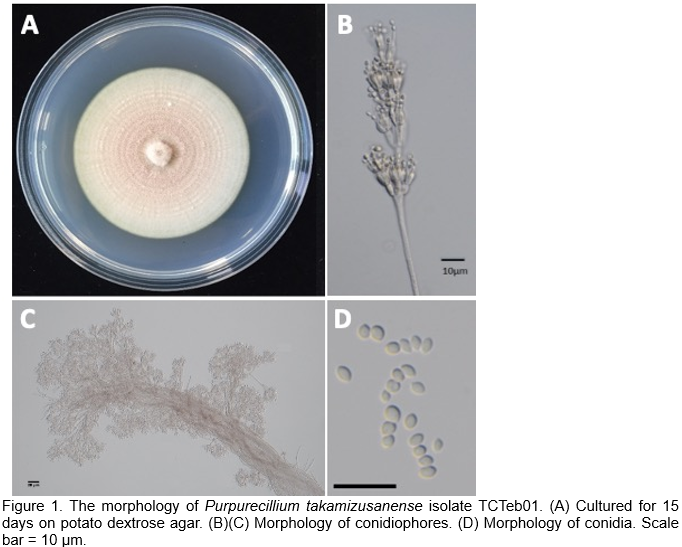
Purpureocillium takamizusanense isolate TCTeb01 was originally isolated from the lychee stink bug (Tessaratoma papillosa) in a longan orchard in Taiwan in 2018. The isolate was identified through a combination of morphological analysis and multi-locus molecular characterization, including sequences of the internal transcribed spacer (ITS) and translation elongation factor (TEF-1α) (Lo et al., 2019). TCTeb01 is characterized by the production of abundant pale purple conidia, which function as the primary infectious units (Figure 1).
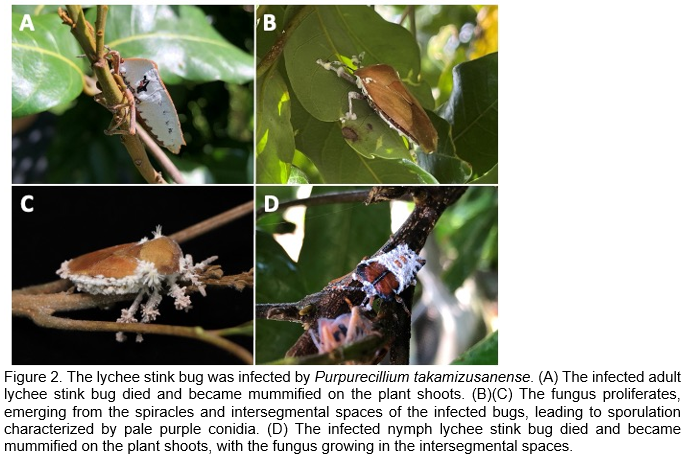
This fungal isolate is highly pathogenic to both adults and nymphs of the lychee stink bug. A distinctive feature of the infection is that diseased individuals often become mummified and remain firmly attached to plant shoots post-mortality. Under conditions of high humidity, the fungus proliferates within the host and emerges through the spiracles and intersegmental membranes, eventually leading to extensive external sporulation (Figure 2). These newly formed conidia are subsequently dispersed by wind or rain, facilitating secondary infections within the insect population.
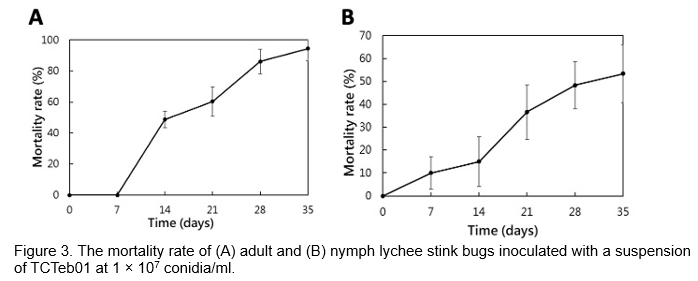
Greenhouse bioassays demonstrated the potent insecticidal activity of TCTeb01. When insects were inoculated with a conidial suspension of 1 × 10⁷ conidia/mL, adult mortality initiated at 14 days post-inoculation (dpi) and reached a significant 86.1% by 28 dpi. In comparison, nymphs exhibited a mortality rate of approximately 48.3% over the same period (Figure 3). These findings highlight the high virulence of TCTeb01 against T. papillosa and underscore its significant potential as a specialized bioinsecticide for agricultural pest management in Taiwan.
BROAD HOST RANGE AND CROSS-ORDER EFFICACY
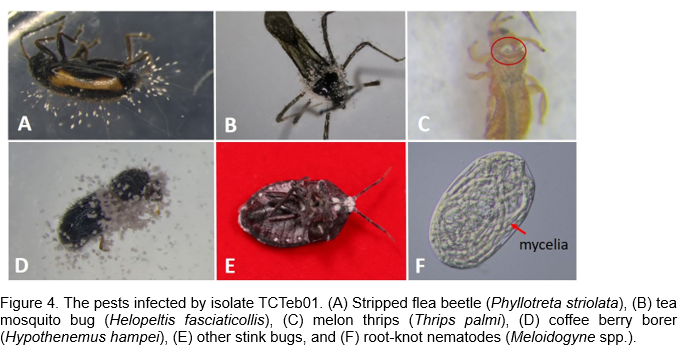
Beyond its primary host, TCTeb01 demonstrates a remarkably broad host range, exhibiting cross-order efficacy against various economically significant agricultural pests. Laboratory bioassays confirmed that TCTeb01 can successfully infect melon thrips (Thrips palmi), striped flea beetles (Phyllotreta striolata), tea mosquito bugs (Helopeltis fasciaticollis), oriental fruit flies (Bactrocera dorsalis), and coffee berry borers (Hypothenemus hampei) stripped flea beetle (Phyllotreta striolata), turnip aphid (Lipaphis erysimi), and other stink bugs. Additionally, it has demonstrated the capacity to inhibit the egg hatching of root-knot nematodes (Meloidogyne spp.), further extending its potential as a versatile biocontrol agent.
Remarkably, the isolate exhibited exceptionally high virulence against thrips and coffee berry borer. Following the application of a conidial suspension, mortality rates reached 78% within 7 days for thrips and 100% within 6 days for tea mosquito bugs. The practical potential of TCTeb01 was further validated through specialized field trials. In the blueberry field trial, a wettable powder (WP) formulation of TCTeb01 achieved a 61.3% control rate against thrips after two consecutive applications over a 14-day period. Similarly, in field trials targeting the coffee berry borers, applications of the TCTeb01 WP formulation significantly reduced adult populations and minimized damage to the coffee seeds, thereby preserving crop quality. These results indicate that TCTeb01 is a versatile biological control agent capable of managing a diverse pest complex, offering a strategic advantage for Integrated Pest Management (IPM) in various cropping systems.
BIOSAFETY ASSESSMENT ON NON-TARGET BENEFICIAL INSECTS
The primary application of TCTeb01 involves foliar spraying in longan and lychee orchards to control the lychee stink bug. Since the blossoms of these fruit trees serve as a major nectar source for honey bees, evaluating the biosafety of TCTeb01 toward beneficial insects is a critical component of its development. Laboratory toxicity assays were conducted to assess the impact of TCTeb01 on several key beneficial species, including the Western honey bee (Apis mellifera), the green lacewing (Mallada basalis), and the predatory stink bug (Eocanthecona furcellata).
Experimental results demonstrated that the direct application of TCTeb01 conidial suspensions exhibited no adverse effects on the survival or behavior of these non-target organisms. Specifically, the survival rates of adult Western honey bees and predatory stink bugs, as well as the survival rates of green lacewing eggs and larvae, showed no significant difference compared to the control group. These findings indicate that TCTeb01 is highly compatible with existing biological control agents and pollinators, supporting its integration into Integrated Pest Management (IPM) programs without disrupting the orchard's ecological balance.
PILOT PRODUCTION, FORMULATION, AND FIELD EFFICACY
Globally, various formulations of EPF, such as wettable powders (WP) and dispersal oils (OD), are commercially available. However, no EPF products in these formulations have been successfully registered in Taiwan to date. This regulatory gap, combined with the necessity for efficient mass production and stable storage, presents significant challenges for the local commercialization of EPF.
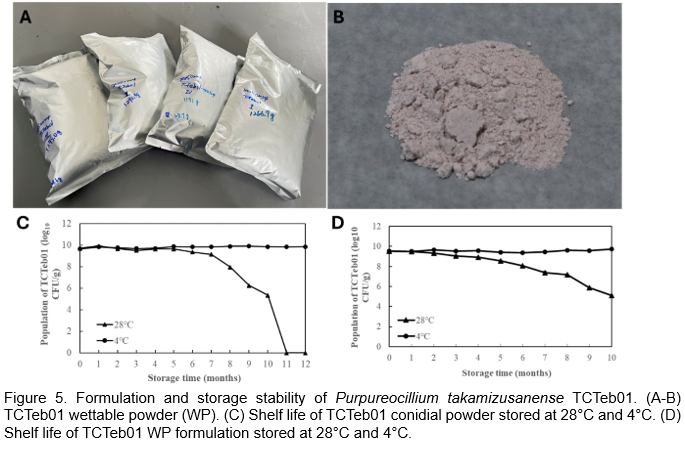
In this study, a mass production system for TCTeb01 was established using solid-state fermentation. Following a 14-day cultivation period on a rice-based substrate, high-density conidia were successfully generated. A streamlined harvesting method was developed to produce a concentrated conidial powder, which serves as the Technical Material (TC). This optimized process eliminates the need for additional drying steps, enhancing production efficiency. This conidia powder can be stored at room temperature (28°C) for at least six months without a significant loss of viability (Figure 5). Both the conidial powder and its production method have been granted a patent in Taiwan.
Finally, the conidial powder was formulated into a WP. Suitable adjuvants were screened to ensure high compatibility with TCTeb01 conidia. While the shelf life of the WP formulation is currently limited to three months at room temperature, excellent stability is maintained under low-temperature storage. Further research is currently focused on optimizing the formulation to extend its ambient stability.
The final TCTeb01 WP product was evaluated in field trials across longan and lychee orchards in central Taiwan from March to July. This period coincides with rising temperatures and peak activity of lychee stink bugs, representing the pivotal timing for population control. Across three field trials, the TCTeb01 WP demonstrated a control efficacy of approximately 60% following three applications at a 200-fold dilution. Furthermore, infected insects were observed mummified on the plant shoots, confirming the successful infection and mortality in the field.
TECHNOLOGY TRANSFER AND PATH TO COMMERCIALIZATION
In Taiwan, only one commercial bioinsecticide product based on EPF has been registered since 2018, primarily featuring Beauveria bassiana for the control of the diamondback moth (Plutella xylostella). This product, cultivated on solid substrates, requires low-temperature storage to maintain efficacy and necessitates the addition of surfactants prior to application to create a spore suspension. These limitations in formulation maturity and shelf-life stability have posed challenges for widespread market adoption and practical farmer use. Consequently, developing a mature formulation with a stable shelf life is essential for successful commercialization.
The development of EPF as bioinsecticides in Taiwan must comply with rigorous regulatory standards, including Good Laboratory Practice (GLP) for physicochemical property assessments and toxicological testing. Furthermore, obtaining an Experimental Use Permit (EUP) is mandatory for conducting formal field trials required for registration.
Currently, the TCTeb01 formulation has achieved a high level of technical maturity and storage stability. All necessary documentation for regulatory registration has been fully prepared. In a significant milestone for the project, both the TCTeb01 isolate and its mass production technology were officially authorized and transferred to a commercial pesticide company in 2026.
CONCLUSION AND FUTURE PERSPECTIVES
In summary, this study characterized the indigenous isolate Purpureocillium takamizusanense TCTeb01 and validated its potential as a biological control agent for Taiwan’s subtropical conditions. The isolate demonstrated high virulence against the lychee stink bug and exhibited cross-order efficacy against multiple pests and nematodes. By establishing a solid-state fermentation system that bypasses high-energy drying processes, the technical barriers to mass production have been significantly reduced. The successful technology transfer to the pesticide industry in 2026 confirms the commercial feasibility of this biopesticide.
Future research should prioritize enhancing the ambient stability of the WP formulation to meet commercial shelf-life standards. Additionally, further field evaluations are necessary to define TCTeb01's efficacy across diverse cropping systems and to refine its application within Integrated Pest Management (IPM) protocols. Continued development of this indigenous biological resource will be essential for reducing synthetic pesticide dependence and advancing sustainable pest management strategies in Taiwan.
REFERENCE
Fan, Y., Liu, X., Keyhani, N. O., Tang, G., Pei, Y., Zhang, W., and Tong, S. 2017. Regulatory cascade and biological activity of Beauveria bassiana oosporein that limits bacterial growth after host death. Proceedings of the National Academy of Sciences, 114(9): E1578-E1586.
Jaihan, P., Sangdee, K., and Sangdee, A. 2016. Selection of entomopathogenic fungus for biological control of chili anthracnose disease caused by Colletotrichum spp. European Journal of Plant Pathology, 146: 551-564.
Lacey, L. A., Grzywacz, D., Shapiro-Ilan, D. I., Frutos, R., Brownbridge, M., and Goettel, M. S. 2015. Insect pathogens as biological control agents: Back to the future. Journal of Invertebrate Pathology, 132: 1-41.
Lo, P. H., Yu, Y. C., 2019. First report of Purpureocillium takamizusanense as an entomopathogenic fungus infecting Tessaratoma papillosa (Drury) in Taiwan. Journal of Plant Medicine, 61(2&3): 27-30.
Mascarin, G. M., and Jaronski, S. T. 2016. The production and uses of Beauveria bassiana as a microbial insecticide. World Journal of Microbiology and Biotechnology, 32: 1-26.
Shah, F. A., Ansari, M. A., Watkins, J., Phelps, Z., Cross, J., and Butt, T. M. 2009. Biocontrol science and technology influence of commercial fungicides on the germination, growth, and virulence of four species of entomopathogenic fungi. Biocontrol Science and Technology, 19(7): 743-753.
Skinner M., Parker B. L., Kim J. S. 2014. Role of entomopathogenic fungi. In: Abrol DP (ed) Integrated pest management. Academic Press, Cambridge, pp 169-191.
Tkaczuk, C., Harasimiuk, M., Król, A., and Bereś, P. K. 2015. The effect of selected pesticides on the growth of entomopathogenic fungi Hirsutella nodulosa and Beauveria bassiana. Journal of Ecological Engineering, 16(3):177-183.

Development of Native Entomopathogenic Fungus for Agricultural Pest Control in Taiwan
DOI: https://doi.org/10.56669/GXPW1305
This manuscript was originally presented at the ACRI, ATRI, WorldVeg, and FFTC workshop titled “Pest and Disease Management Strategies for Sustainable Agriculture,” held in Taichung, Taiwan, on May 5–6, 2026.
ABSTRACT
Entomopathogenic fungi (EPF) represent a sustainable alternative to chemical pesticides due to their specialized ability to infect and eliminate insect pests. This study focuses on the development of an indigenous fungal isolate, Purpureocillium takamizusanense, recovered from infected lychee stink bugs (Tessaratoma papillosa). The isolate demonstrates high virulence against both adults and nymphs, inducing a “zombie-like” state where infected insects remain firmly attached to plant shoots post-mortality. In greenhouse bioassays, the isolate demonstrated high insecticidal activity, with mortality rates reaching 86.1% in adults and 48.3% in nymphs within 28 days of inoculation. Field trials further validated its practical potential, where a wettable powder (WP) formulation achieved over 50% control efficacy. Beyond its primary host, the isolate exhibits a broad host range against various agricultural pests. To facilitate commercialization, a mass-production system was established using solid-state fermentation, featuring a streamlined technique for harvesting conidial powder without a traditional drying step. The resulting product maintains a shelf life exceeding six months at room temperature. Importantly, the technology has been successfully transferred to the industry, paving the way for the registration and commercial distribution of this biopesticide. This research underscores the synergy between technological innovation and indigenous biological resources in advancing sustainable agriculture and regulatory-compliant pest management in Taiwan.
Keywords: Entomopathogenic fungus, Purpureocillium takamizusanense, lychee stink bug (Tessaratoma papillosa), mass-production, biopesticide
INTRODUCTION
Entomopathogenic fungi (EPF) possess a remarkable ability to infect and kill insects. These fungi are widely distributed and can have either restricted or broad host ranges, each exhibiting different biocontrol potentials against arthropod pests. The process by which EPF kill insects begins with the adhesion of spores to the insect's exoskeleton. When environmental conditions, such as temperature and humidity, are suitable, the spores germinate, forming appressoria that exert strong mechanical pressure on the cuticle. This mechanical action, combined with the production of lytic enzymes, leads to the disintegration of the insect’s exoskeleton (Skinner et al., 2014; Lacey et al., 2015). Once the fungal hyphae penetrate the insect’s hemocoel, they begin to grow and proliferate. The destruction of the insect’s body results from both mechanical damage to internal organs caused by the developing hyphae and nutrient depletion (Mascarin and Jaronski, 2016; Fan et al., 2017). This dual mechanism of action highlights the effectiveness of EPF as biological control agents, showcasing their potential to sustainably manage insect populations.
Currently, over 1,000 species of EPF from more than 100 genera are recognized and are being explored for their potential commercialization as biopesticides. These fungi infect a wide range of insect orders, and their use in biocontrol has increased significantly in recent years (Shah et al., 2009). Notably, species belonging to the Ascomycota and Entomophthoromycota phyla are among the most commonly encountered in nature. Within Ascomycota, several genera, such as Metarhizium, Beauveria, Isaria, Ophiocordyceps, Cordyceps, Torubiella, Pochonia, Lecanicillium, and Hirsutella, along with species like Paecilomyces variotii and Purpureocillium lilacinum, have been documented in the literature (Tkaczuk et al., 2015; Jaihan et al., 2016).
Due to their high insecticidal efficacy, these fungi are increasingly used as biopesticides, offering a safer alternative to conventional chemical insecticides. EPF are often regarded as superior to synthetic options because they are safe for humans, environmentally sustainable, and target-specific. Additionally, they tend to be more cost-effective over time, produce fewer residual effects, and help combat resistance issues (Sharma et al., 2023). The application of EPF not only supports organic farming practices but also contributes to more sustainable agricultural methods.
In Taiwan, the push for pesticide reduction and Integrated Pest Management (IPM) has intensified the search for effective indigenous biocontrol agents. While global commercial strains exist, their efficacy is often compromised by Taiwan’s unique subtropical climate, characterized by high temperatures and humidity. Furthermore, the lychee stink bug (Tessaratoma papillosa Drury) has emerged as a significant threat to fruit production in recent years, necessitating a locally-adapted solution. Purpureocillium takamizusanense isolate TCTeb01, a native fungus was discovered in Taiwan.
Therefore, the primary objective of this study is to evaluate and develop a native entomopathogenic fungal isolate, specifically Purpureocillium takamizusanense TCTeb01. The investigation encompasses its biological characterization, optimization of mass production protocols, and strategies for its commercialization in Taiwan's agricultural sector.
BIOLOGICAL CHARACTERIZATION AND PATHOGENICITY OF TCTEB01
Purpureocillium takamizusanense isolate TCTeb01 was originally isolated from the lychee stink bug (Tessaratoma papillosa) in a longan orchard in Taiwan in 2018. The isolate was identified through a combination of morphological analysis and multi-locus molecular characterization, including sequences of the internal transcribed spacer (ITS) and translation elongation factor (TEF-1α) (Lo et al., 2019). TCTeb01 is characterized by the production of abundant pale purple conidia, which function as the primary infectious units (Figure 1).
This fungal isolate is highly pathogenic to both adults and nymphs of the lychee stink bug. A distinctive feature of the infection is that diseased individuals often become mummified and remain firmly attached to plant shoots post-mortality. Under conditions of high humidity, the fungus proliferates within the host and emerges through the spiracles and intersegmental membranes, eventually leading to extensive external sporulation (Figure 2). These newly formed conidia are subsequently dispersed by wind or rain, facilitating secondary infections within the insect population.
Greenhouse bioassays demonstrated the potent insecticidal activity of TCTeb01. When insects were inoculated with a conidial suspension of 1 × 10⁷ conidia/mL, adult mortality initiated at 14 days post-inoculation (dpi) and reached a significant 86.1% by 28 dpi. In comparison, nymphs exhibited a mortality rate of approximately 48.3% over the same period (Figure 3). These findings highlight the high virulence of TCTeb01 against T. papillosa and underscore its significant potential as a specialized bioinsecticide for agricultural pest management in Taiwan.
BROAD HOST RANGE AND CROSS-ORDER EFFICACY
Beyond its primary host, TCTeb01 demonstrates a remarkably broad host range, exhibiting cross-order efficacy against various economically significant agricultural pests. Laboratory bioassays confirmed that TCTeb01 can successfully infect melon thrips (Thrips palmi), striped flea beetles (Phyllotreta striolata), tea mosquito bugs (Helopeltis fasciaticollis), oriental fruit flies (Bactrocera dorsalis), and coffee berry borers (Hypothenemus hampei) stripped flea beetle (Phyllotreta striolata), turnip aphid (Lipaphis erysimi), and other stink bugs. Additionally, it has demonstrated the capacity to inhibit the egg hatching of root-knot nematodes (Meloidogyne spp.), further extending its potential as a versatile biocontrol agent.
Remarkably, the isolate exhibited exceptionally high virulence against thrips and coffee berry borer. Following the application of a conidial suspension, mortality rates reached 78% within 7 days for thrips and 100% within 6 days for tea mosquito bugs. The practical potential of TCTeb01 was further validated through specialized field trials. In the blueberry field trial, a wettable powder (WP) formulation of TCTeb01 achieved a 61.3% control rate against thrips after two consecutive applications over a 14-day period. Similarly, in field trials targeting the coffee berry borers, applications of the TCTeb01 WP formulation significantly reduced adult populations and minimized damage to the coffee seeds, thereby preserving crop quality. These results indicate that TCTeb01 is a versatile biological control agent capable of managing a diverse pest complex, offering a strategic advantage for Integrated Pest Management (IPM) in various cropping systems.
BIOSAFETY ASSESSMENT ON NON-TARGET BENEFICIAL INSECTS
The primary application of TCTeb01 involves foliar spraying in longan and lychee orchards to control the lychee stink bug. Since the blossoms of these fruit trees serve as a major nectar source for honey bees, evaluating the biosafety of TCTeb01 toward beneficial insects is a critical component of its development. Laboratory toxicity assays were conducted to assess the impact of TCTeb01 on several key beneficial species, including the Western honey bee (Apis mellifera), the green lacewing (Mallada basalis), and the predatory stink bug (Eocanthecona furcellata).
Experimental results demonstrated that the direct application of TCTeb01 conidial suspensions exhibited no adverse effects on the survival or behavior of these non-target organisms. Specifically, the survival rates of adult Western honey bees and predatory stink bugs, as well as the survival rates of green lacewing eggs and larvae, showed no significant difference compared to the control group. These findings indicate that TCTeb01 is highly compatible with existing biological control agents and pollinators, supporting its integration into Integrated Pest Management (IPM) programs without disrupting the orchard's ecological balance.
PILOT PRODUCTION, FORMULATION, AND FIELD EFFICACY
Globally, various formulations of EPF, such as wettable powders (WP) and dispersal oils (OD), are commercially available. However, no EPF products in these formulations have been successfully registered in Taiwan to date. This regulatory gap, combined with the necessity for efficient mass production and stable storage, presents significant challenges for the local commercialization of EPF.
In this study, a mass production system for TCTeb01 was established using solid-state fermentation. Following a 14-day cultivation period on a rice-based substrate, high-density conidia were successfully generated. A streamlined harvesting method was developed to produce a concentrated conidial powder, which serves as the Technical Material (TC). This optimized process eliminates the need for additional drying steps, enhancing production efficiency. This conidia powder can be stored at room temperature (28°C) for at least six months without a significant loss of viability (Figure 5). Both the conidial powder and its production method have been granted a patent in Taiwan.
Finally, the conidial powder was formulated into a WP. Suitable adjuvants were screened to ensure high compatibility with TCTeb01 conidia. While the shelf life of the WP formulation is currently limited to three months at room temperature, excellent stability is maintained under low-temperature storage. Further research is currently focused on optimizing the formulation to extend its ambient stability.
The final TCTeb01 WP product was evaluated in field trials across longan and lychee orchards in central Taiwan from March to July. This period coincides with rising temperatures and peak activity of lychee stink bugs, representing the pivotal timing for population control. Across three field trials, the TCTeb01 WP demonstrated a control efficacy of approximately 60% following three applications at a 200-fold dilution. Furthermore, infected insects were observed mummified on the plant shoots, confirming the successful infection and mortality in the field.
TECHNOLOGY TRANSFER AND PATH TO COMMERCIALIZATION
In Taiwan, only one commercial bioinsecticide product based on EPF has been registered since 2018, primarily featuring Beauveria bassiana for the control of the diamondback moth (Plutella xylostella). This product, cultivated on solid substrates, requires low-temperature storage to maintain efficacy and necessitates the addition of surfactants prior to application to create a spore suspension. These limitations in formulation maturity and shelf-life stability have posed challenges for widespread market adoption and practical farmer use. Consequently, developing a mature formulation with a stable shelf life is essential for successful commercialization.
The development of EPF as bioinsecticides in Taiwan must comply with rigorous regulatory standards, including Good Laboratory Practice (GLP) for physicochemical property assessments and toxicological testing. Furthermore, obtaining an Experimental Use Permit (EUP) is mandatory for conducting formal field trials required for registration.
Currently, the TCTeb01 formulation has achieved a high level of technical maturity and storage stability. All necessary documentation for regulatory registration has been fully prepared. In a significant milestone for the project, both the TCTeb01 isolate and its mass production technology were officially authorized and transferred to a commercial pesticide company in 2026.
CONCLUSION AND FUTURE PERSPECTIVES
In summary, this study characterized the indigenous isolate Purpureocillium takamizusanense TCTeb01 and validated its potential as a biological control agent for Taiwan’s subtropical conditions. The isolate demonstrated high virulence against the lychee stink bug and exhibited cross-order efficacy against multiple pests and nematodes. By establishing a solid-state fermentation system that bypasses high-energy drying processes, the technical barriers to mass production have been significantly reduced. The successful technology transfer to the pesticide industry in 2026 confirms the commercial feasibility of this biopesticide.
Future research should prioritize enhancing the ambient stability of the WP formulation to meet commercial shelf-life standards. Additionally, further field evaluations are necessary to define TCTeb01's efficacy across diverse cropping systems and to refine its application within Integrated Pest Management (IPM) protocols. Continued development of this indigenous biological resource will be essential for reducing synthetic pesticide dependence and advancing sustainable pest management strategies in Taiwan.
REFERENCE
Fan, Y., Liu, X., Keyhani, N. O., Tang, G., Pei, Y., Zhang, W., and Tong, S. 2017. Regulatory cascade and biological activity of Beauveria bassiana oosporein that limits bacterial growth after host death. Proceedings of the National Academy of Sciences, 114(9): E1578-E1586.
Jaihan, P., Sangdee, K., and Sangdee, A. 2016. Selection of entomopathogenic fungus for biological control of chili anthracnose disease caused by Colletotrichum spp. European Journal of Plant Pathology, 146: 551-564.
Lacey, L. A., Grzywacz, D., Shapiro-Ilan, D. I., Frutos, R., Brownbridge, M., and Goettel, M. S. 2015. Insect pathogens as biological control agents: Back to the future. Journal of Invertebrate Pathology, 132: 1-41.
Lo, P. H., Yu, Y. C., 2019. First report of Purpureocillium takamizusanense as an entomopathogenic fungus infecting Tessaratoma papillosa (Drury) in Taiwan. Journal of Plant Medicine, 61(2&3): 27-30.
Mascarin, G. M., and Jaronski, S. T. 2016. The production and uses of Beauveria bassiana as a microbial insecticide. World Journal of Microbiology and Biotechnology, 32: 1-26.
Shah, F. A., Ansari, M. A., Watkins, J., Phelps, Z., Cross, J., and Butt, T. M. 2009. Biocontrol science and technology influence of commercial fungicides on the germination, growth, and virulence of four species of entomopathogenic fungi. Biocontrol Science and Technology, 19(7): 743-753.
Skinner M., Parker B. L., Kim J. S. 2014. Role of entomopathogenic fungi. In: Abrol DP (ed) Integrated pest management. Academic Press, Cambridge, pp 169-191.
Tkaczuk, C., Harasimiuk, M., Król, A., and Bereś, P. K. 2015. The effect of selected pesticides on the growth of entomopathogenic fungi Hirsutella nodulosa and Beauveria bassiana. Journal of Ecological Engineering, 16(3):177-183.