DOI: https://doi.org/10.56669/OVZQ7318
This manuscript was originally presented at the ACRI, ATRI, WorldVeg, and FFTC workshop titled “Pest and Disease Management Strategies for Sustainable Agriculture,” held in Taichung, Taiwan, on May 5–6, 2026.
ABSTRACT
Green onion production in Sanxing Township, Yilan County, Taiwan, is a critical specialty agricultural industry. However, severe outbreaks of the beet armyworm, Spodoptera exigua (Hübner), have caused significant yield losses, reducing the local annual production value from approximately NTD 500 million to less than NTD 70 million. As conventional chemical control becomes increasingly ineffective due to insecticide resistance and environmental concerns, alternative and sustainable pest management solutions are urgently required. Baculoviruses are highly specific, environmentally friendly biological control agents with strong potential for integrated pest management (IPM). Nevertheless, their practical application has long been hindered by challenges in large-scale production, high costs, and formulation constraints. To overcome these barriers, an indigenous isolate of Spodoptera exigua multiple nucleopolyhedrovirus (SeMNPV) was formulated into a water-dispersible granule (WG). This innovation enables room-temperature storage for at least nine months, significantly enhancing handling convenience and field applicability, all while maintaining high biological activity with a concentration exceeding 10⁹ occlusion bodies (OBs)/g. Furthermore, in collaboration with industry partners, automated mass production technologies were developed and validated to optimize production efficiency and consistency. The integration of this WG formulation with automated production systems provides a practical approach for overcoming long-standing commercialization barriers. Currently undergoing regulatory review for pesticide registration in Taiwan, this SeMNPV WG technology demonstrates strong potential for sustainable pest management in Asia.
Keywords: Biopesticide, Spodoptera exigua, Integrated pest management, Water-dispersible granule, Shelf-life stability, Sustainable agriculture
INTRODUCTION
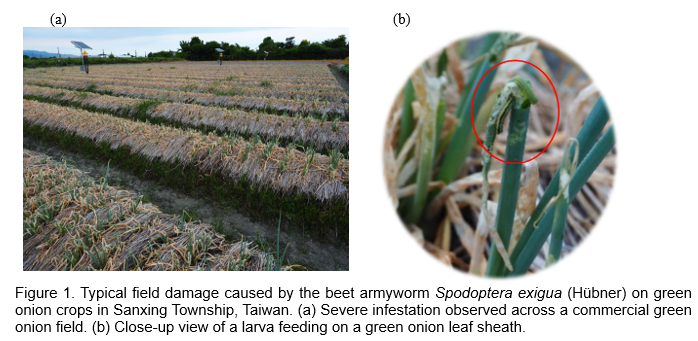
The beet armyworm, Spodoptera exigua (Hübner), is a highly polyphagous and destructive pest that causes significant economic losses to a wide range of agricultural crops across the Asian and Pacific region (Ahmad and Arif, 2010). In Taiwan, it poses a particularly severe threat to high-value specialty crops, especially the green onion production system in Sanxing Township, Yilan County, one of the most important green onion production regions in the country. Severe outbreaks of S. exigua have substantially reduced local production value (Figure 1) in recent years according to official agricultural statistics (Yilan County Government, 2022). For decades, the management of S. exigua has relied heavily on conventional chemical insecticides. However, the intensive and frequent use of these chemicals has led to the rapid development of widespread insecticide resistance in field populations, rendering many traditional treatments ineffective (Ahmad and Arif, 2010; Ishtiaq and Saleem, 2011). Similar resistance to multiple classes of insecticides has also been documented in Taiwan (Chou and Feng, 1999). Furthermore, growing public concerns regarding pesticide residues, environmental contamination, and human health risks have necessitated a shift toward alternative and sustainable pest management strategies (Council of Agriculture, 2020).
In this context, baculoviruses, particularly Spodoptera exigua multiple nucleopolyhedrovirus (SeMNPV), have emerged as highly promising biological control agents. SeMNPV is characterized by its high host specificity, environmental safety, and compatibility with integrated pest management (IPM) programs (Moscardi, 1999; Szewczyk et al., 2006; Lacey et al., 2015). Indigenous isolates of SeMNPV have previously been reported in Taiwan and demonstrated potential for biological control applications against local S. exigua populations (Tzeng, 1998). Despite these biological advantages, the widespread commercial application of viral biopesticides has long been hindered by two major technical bottlenecks. First, traditional baculovirus products are typically formulated as suspension concentrates (SC), which are sensitive to temperature fluctuations and require cold-chain storage during transportation and distribution (Ignoffo and Garcia, 1992; Burges, 1998). Second, as obligate parasites, baculoviruses must be mass-produced in vivo using live insect hosts. Conventional rearing and inoculation procedures are labor-intensive, difficult to standardize, and associated with high production costs, thereby limiting large-scale commercial application (Hunter-Fujita et al., 1998; Moscardi, 1999; Haase et al., 2015).
To address these constraints, this study presents an integrated approach combining formulation innovation with automated mass production technologies. An indigenous isolate of SeMNPV with high virulence against local S. exigua populations was developed into a water-dispersible granule (WG) formulation to improve storage stability under room-temperature conditions. Previous studies have demonstrated that formulation technologies such as microencapsulation and solid carriers can significantly improve the environmental stability and persistence of baculoviruses (Behle et al., 1997; Tamez-Guerra et al., 2000). In addition, an automated production system incorporating automated insect handling and image-based monitoring technologies was established in collaboration with industry partners to improve production efficiency and consistency. These integrated technologies provide a practical approach to overcoming longstanding barriers in baculovirus commercialization and support the development of sustainable pest management strategies in Asia.
Materials and Methods
In vivo production of SeMNPV inoculum
The production of Spodoptera exigua multiple nucleopolyhedrovirus (SeMNPV) was conducted using an in vivo propagation system in which healthy Spodoptera exigua larvae served as biological hosts. Mass rearing of the host insects was performed in an environmentally controlled insectary to ensure standardized colony quality.
For virus production, the SeMNPV inoculum was applied onto an artificial diet and fed to fourth-instar larvae. The inoculated larvae were maintained at 25°C for 5–7 days until virus-induced mortality occurred. Infected larvae were then collected, homogenized, and filtered to obtain crude viral suspensions. The concentration of occlusion bodies (OBs) in the suspension was determined using a hemocytometer under phase-contrast microscopy prior to formulation processing.
Integration of automated mass production technologies
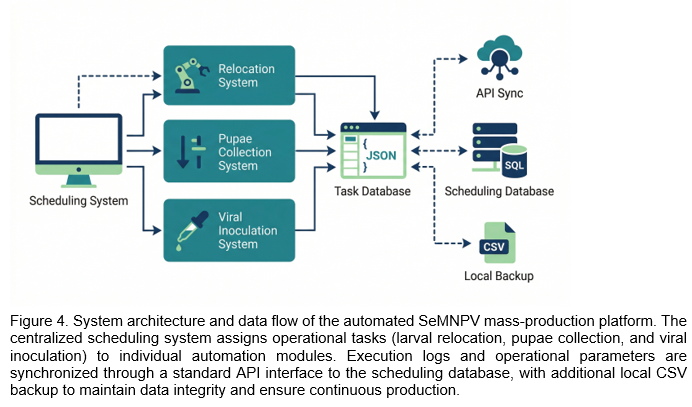
To improve the scalability and efficiency of in vivo virus production, an automated mass production system was developed in collaboration with an industry partner, BuggiPro Co., Ltd. (Taiwan). The biological standard operating procedures (SOPs) established at the Agricultural Chemicals Research Institute (ACRI) were translated into integrated automated production modules (Figure 4).
The production workflow was coordinated through a centralized scheduling system connected to a database platform, allowing continuous tracking of batch processes and execution status. The most labor-intensive step in conventional insect rearing—the transfer of larvae—was addressed through the development of an automated relocation system supported by image-recognition technology.
Additional automated subsystems were introduced for pupae collection, adult egg harvesting, and sorting of virus-infected larvae during the production process, thereby improving production consistency and operational efficiency.
Formulation of the water-dispersible granule (WG)
To improve storage stability and handling convenience of the viral suspension, a water-dispersible granule (WG) formulation was developed.
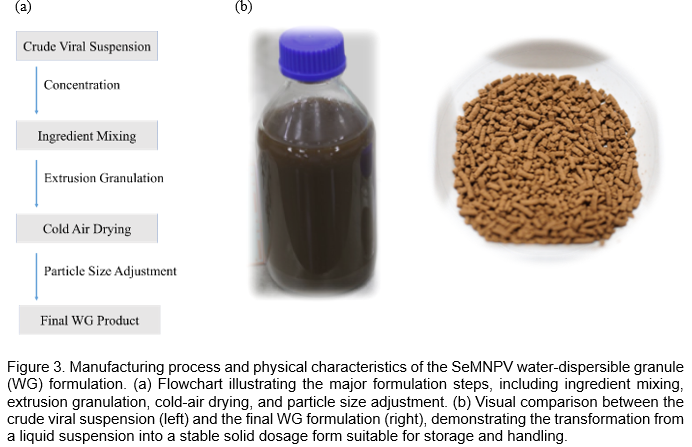
The formulation process consisted of four major steps: mixing and kneading, extrusion granulation, drying, and particle size adjustment (Figure 3). Formulation ingredients were first mixed and kneaded for approximately 60 minutes until a homogeneous dough was obtained. The mixture was then processed using an extrusion granulator equipped with a 1.0-mm mesh screen to produce uniform wet granules.
To preserve viral activity, the granules were dried using cold air at 15°C, followed by further moisture reduction under controlled environmental conditions. Finally, the dried granules were processed using an oscillating sieve for 5–10 minutes to obtain WG products with standardized particle size distribution.
Results
Virulence of the indigenous SeMNPV isolate
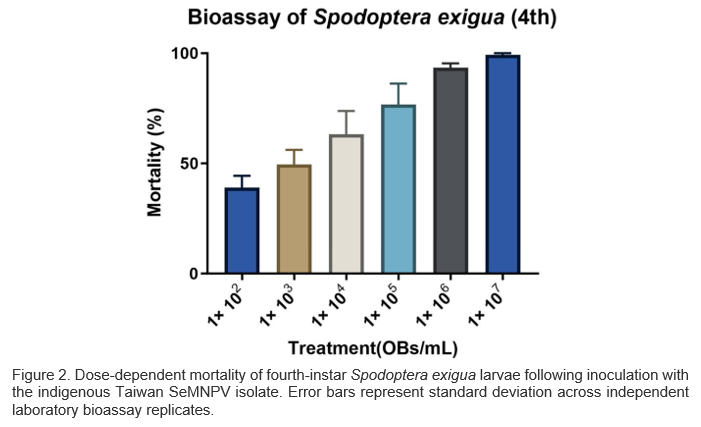
Prior to formulation development and field application, the biological efficacy of the selected indigenous Spodoptera exigua multiple nucleopolyhedrovirus (SeMNPV) isolate was evaluated against fourth-instar Spodoptera exigua larvae. Laboratory bioassays demonstrated a consistent dose-dependent mortality response across multiple production batches (Figure 2). A comparative bioassay was further conducted between the indigenous isolate and a widely used commercial viral insecticide at an equivalent concentration of 1 × 10⁶ occlusion bodies (OBs)/mL. Under identical experimental conditions, the indigenous isolate produced a mortality rate exceeding 90% within five to six days after inoculation, whereas the commercial product resulted in approximately 70% mortality. These results indicate that the indigenous isolate exhibited higher virulence than the commercial reference product and was therefore selected as the active ingredient for subsequent formulation development.
Room-temperature storage stability
To evaluate the storage stability of the SeMNPV water-dispersible granule (WG) formulation, stability tests were conducted under three temperature conditions (−20°C, 4°C, and 25°C). The initial concentration of the WG product was 7.1 × 10⁹ OBs/g. After 9 months of storage at room temperature (25°C), the formulation retained a concentration of 5.8 × 10⁹ OBs/g.
Bioassay evaluations further demonstrated that the room-temperature-stored WG formulation maintained high biological activity. Even at a 5,000-fold dilution, the formulation consistently produced approximately 90% larval mortality. After 11 months of storage, the 5,000-fold dilution treatment maintained a mortality rate of 91.5%. These results demonstrate that the WG formulation maintained high biological activity during extended storage at room temperature, reducing the need for refrigerated transport and storage.
Field efficacy of the SeMNPV WG formulation
To evaluate the practical field performance of the SeMNPV WG formulation, an initial field trial was conducted in a green onion cultivation area. Based on the Henderson–Tilton formula, the results indicated that the WG formulation applied at a 3,000-fold dilution provided effective and sustained pest control. At the end of the observation period, the 3,000-fold dilution treatment achieved a control efficacy of 90.37%, which was higher than that obtained with the standard commercial insecticide treatment (85.64%).
Multi-location field validation of the WG formulation
To further assess the stability and adaptability of the WG formulation under different environmental conditions, expanded field trials were conducted simultaneously at three geographically distinct locations, including Sanxing Township in Yilan County and Xihu Township in Changhua County. The experiments were arranged using a randomized complete block design (RCBD). Combined analysis of variance (ANOVA) across the three sites demonstrated statistically significant differences among treatments (P < 0.0001).
Despite variations in environmental conditions, pest population density, and climatic factors among locations, the SeMNPV WG treatments consistently provided effective control of S. exigua. These results indicate that the WG formulation maintained stable pest control performance across multiple field environments.
Efficiency of the automated mass production system
The integration of the automated production system substantially reduced reliance on manual labor during the in vivo manufacturing process by approximately 90%. The image-based monitoring system achieved an accuracy rate exceeding 98% in identifying larvae at the optimal developmental stages (late third to early fourth instar) for viral inoculation. The automated relocation module achieved a vacuum suction success rate of 100% and an overall transfer success rate exceeding 90%, with an average processing time of approximately 10 seconds per larva.
Following relocation, larvae were subjected to an automated viral inoculation procedure to ensure uniform infection. In the final production stage, the automated sorting system successfully differentiated healthy pupae from virus-killed larvae with a recognition accuracy of approximately 99%. These results demonstrate that the automated production system substantially improved the efficiency and consistency of the in vivo baculovirus production process.
DISCUSSION AND CONCLUSION
The widespread commercial application of baculovirus-based biopesticides has historically been constrained by two major bottlenecks: the requirement for cold-chain logistics and the high costs associated with labor-intensive in vivo production (Burges, 1998; Hunter-Fujita et al., 1998; Haase et al., 2015). The findings of this study demonstrate that integrating formulation innovation with automated manufacturing technologies provides a practical approach to addressing these long-standing challenges.
The development of the indigenous SeMNPV water-dispersible granule (WG) represents an important advancement in baculovirus formulation technology (Table 1). Traditional liquid formulations are highly susceptible to thermal degradation, which limits their storage and transportation under field conditions (Ignoffo and Garcia, 1992). By maintaining high viral infectivity and exceeding 90% pest mortality after nine months of room-temperature storage, the SeMNPV WG substantially reduces dependence on cold-chain storage. Similar formulation strategies have previously been shown to improve the environmental stability and persistence of baculovirus-based products (Behle et al., 1997; Tamez-Guerra et al., 2000). Furthermore, the multi-location field trials demonstrated that this formulation maintained stable pest control performance across diverse environmental conditions, which is an essential requirement for microbial control agents used in integrated pest management programs (Moscardi, 1999; Lacey et al., 2015). This enhanced storage stability and field performance supports the practical applicability of the formulation under field production conditions.
Table 1. Comparison of formulation characteristics and biological efficacy between a commercial SeMNPV SC product and the indigenous SeMNPV WG formulation.
|
Characteristic
|
Commercial Product (SC)
|
Indigenous SeMNPV WG
(This Study)
|
|
Virus Isolate
|
Imported isolate
|
Indigenous Taiwan isolate
|
|
Formulation Type
|
Suspension Concentrate (SC)
|
Water-Dispersible Granule (WG)
|
|
Larval Mortality
(at 10⁶ OBs/mL)
|
Approx. 70%
|
>90%
|
Equally important is the improvement in the manufacturing process. The transition from conventional manual rearing to an automated mass production system helped address the major economic bottleneck associated with in vivo viral production (Hunter-Fujita et al., 1998; Haase et al., 2015). By integrating image-based monitoring technologies with automated modules for larval relocation and pupae sorting, the system significantly improved the daily processing capacity while reducing manual labor requirements by approximately 90%. Such improvements in production efficiency are critical for bridging the gap between laboratory-scale research and industrial-scale commercialization of baculovirus-based insecticides (Haase et al., 2015).
In conclusion, this study provides a feasible pathway for improving the mass production and practical application of viral biopesticides. The SeMNPV WG formulation is currently undergoing regulatory review for pesticide registration in Taiwan and represents a promising biological control option for Spodoptera exigua. By providing a host-specific and environmentally compatible alternative to conventional chemical insecticides, this integrated technology supports the development of integrated pest management (IPM) programs and contributes to sustainable pest management strategies in Asia (Moscardi, 1999; Lacey et al., 2015).
REFERENCES
Ahmad, M., and Arif, M. I. 2010. Resistance of Spodoptera exigua to insecticides in Asia. Crop Prot., 29, 593–602.
Behle, R. W., Tamez-Guerra, P., and McGuire, M. R. 1997. Field activity and storage stability of Anagrapha falcifera nucleopolyhedrovirus formulations. Journal of Economic Entomology, 90, 1083–1089.
Burges, H. D. 1998. Formulation of microbial biopesticides: beneficial microorganisms, nematodes and seed treatments. Springer, Dordrecht.
Chou, L. Y., and Feng, H. T. 1999. Insecticide resistance in Spodoptera exigua populations in Taiwan. Plant Protection Bulletin, 41, 115–126.
Council of Agriculture. 2020. Policy framework for promoting biopesticide development in Taiwan. Council of Agriculture, Executive Yuan, Taipei, Taiwan.
Haase, S., Sciocco-Cap, A., and Romanowski, V. 2015. Baculovirus insecticides in Latin America: Historical overview, current status and future perspectives. Viruses, 7, 2230–2267.
Hunter-Fujita, F. R., Entwistle, P. F., Evans, H. F., and Crook, N. E. 1998. Insect viruses and pest management. Wiley, Chichester.
Ignoffo, C. M., and Garcia, C. 1992. Stability of baculoviruses in the environment. Environ. Entomol., 21, 422–427.
Ishtiaq, M., and Saleem, M. A. 2011. Generating susceptible strains of Spodoptera exigua against insecticides for resistance monitoring. Crop Prot., 30, 116–121.
Lacey, L. A., Grzywacz, D., Shapiro-Ilan, D. I., Frutos, R., Brownbridge, M., and Goettel, M. S. 2015. Insect pathogens as biological control agents: back to the future. J. Invertebr. Pathol. 132: 1–41.
Moscardi, F. 1999. Assessment of the application of baculoviruses for control of Lepidoptera. Annu. Rev. Entomol. 44: 257–289.
Szewczyk, B., Hoyos-Carvajal, L., Paluszek, M., Skrzecz, I., and Lobo de Souza, M. 2006. Baculoviruses—re-emerging biopesticides. Biotechnology Advances, 24, 143–160.
Tamez-Guerra, P., McGuire, M. R., Behle, R. W., Shasha, B. S., and Galan-Wong, L. J. 2000. Assessment of microencapsulated formulations for improved stability of baculoviruses. Biological Control, 19, 43–49.
Tzeng, C. C. 1998. Studies on nuclear polyhedrosis virus of Spodoptera exigua in Taiwan. Plant Protection Bulletin, 40, 89–102.
Yilan County Government. 2022. Annual agricultural statistics report. Yilan County Government, Yilan, Taiwan.

Formulation Innovation and Automated Mass Production: Towards Practical Application of Baculovirus-Based Pest Control in Asia
DOI: https://doi.org/10.56669/OVZQ7318
This manuscript was originally presented at the ACRI, ATRI, WorldVeg, and FFTC workshop titled “Pest and Disease Management Strategies for Sustainable Agriculture,” held in Taichung, Taiwan, on May 5–6, 2026.
ABSTRACT
Green onion production in Sanxing Township, Yilan County, Taiwan, is a critical specialty agricultural industry. However, severe outbreaks of the beet armyworm, Spodoptera exigua (Hübner), have caused significant yield losses, reducing the local annual production value from approximately NTD 500 million to less than NTD 70 million. As conventional chemical control becomes increasingly ineffective due to insecticide resistance and environmental concerns, alternative and sustainable pest management solutions are urgently required. Baculoviruses are highly specific, environmentally friendly biological control agents with strong potential for integrated pest management (IPM). Nevertheless, their practical application has long been hindered by challenges in large-scale production, high costs, and formulation constraints. To overcome these barriers, an indigenous isolate of Spodoptera exigua multiple nucleopolyhedrovirus (SeMNPV) was formulated into a water-dispersible granule (WG). This innovation enables room-temperature storage for at least nine months, significantly enhancing handling convenience and field applicability, all while maintaining high biological activity with a concentration exceeding 10⁹ occlusion bodies (OBs)/g. Furthermore, in collaboration with industry partners, automated mass production technologies were developed and validated to optimize production efficiency and consistency. The integration of this WG formulation with automated production systems provides a practical approach for overcoming long-standing commercialization barriers. Currently undergoing regulatory review for pesticide registration in Taiwan, this SeMNPV WG technology demonstrates strong potential for sustainable pest management in Asia.
Keywords: Biopesticide, Spodoptera exigua, Integrated pest management, Water-dispersible granule, Shelf-life stability, Sustainable agriculture
INTRODUCTION
The beet armyworm, Spodoptera exigua (Hübner), is a highly polyphagous and destructive pest that causes significant economic losses to a wide range of agricultural crops across the Asian and Pacific region (Ahmad and Arif, 2010). In Taiwan, it poses a particularly severe threat to high-value specialty crops, especially the green onion production system in Sanxing Township, Yilan County, one of the most important green onion production regions in the country. Severe outbreaks of S. exigua have substantially reduced local production value (Figure 1) in recent years according to official agricultural statistics (Yilan County Government, 2022). For decades, the management of S. exigua has relied heavily on conventional chemical insecticides. However, the intensive and frequent use of these chemicals has led to the rapid development of widespread insecticide resistance in field populations, rendering many traditional treatments ineffective (Ahmad and Arif, 2010; Ishtiaq and Saleem, 2011). Similar resistance to multiple classes of insecticides has also been documented in Taiwan (Chou and Feng, 1999). Furthermore, growing public concerns regarding pesticide residues, environmental contamination, and human health risks have necessitated a shift toward alternative and sustainable pest management strategies (Council of Agriculture, 2020).
In this context, baculoviruses, particularly Spodoptera exigua multiple nucleopolyhedrovirus (SeMNPV), have emerged as highly promising biological control agents. SeMNPV is characterized by its high host specificity, environmental safety, and compatibility with integrated pest management (IPM) programs (Moscardi, 1999; Szewczyk et al., 2006; Lacey et al., 2015). Indigenous isolates of SeMNPV have previously been reported in Taiwan and demonstrated potential for biological control applications against local S. exigua populations (Tzeng, 1998). Despite these biological advantages, the widespread commercial application of viral biopesticides has long been hindered by two major technical bottlenecks. First, traditional baculovirus products are typically formulated as suspension concentrates (SC), which are sensitive to temperature fluctuations and require cold-chain storage during transportation and distribution (Ignoffo and Garcia, 1992; Burges, 1998). Second, as obligate parasites, baculoviruses must be mass-produced in vivo using live insect hosts. Conventional rearing and inoculation procedures are labor-intensive, difficult to standardize, and associated with high production costs, thereby limiting large-scale commercial application (Hunter-Fujita et al., 1998; Moscardi, 1999; Haase et al., 2015).
To address these constraints, this study presents an integrated approach combining formulation innovation with automated mass production technologies. An indigenous isolate of SeMNPV with high virulence against local S. exigua populations was developed into a water-dispersible granule (WG) formulation to improve storage stability under room-temperature conditions. Previous studies have demonstrated that formulation technologies such as microencapsulation and solid carriers can significantly improve the environmental stability and persistence of baculoviruses (Behle et al., 1997; Tamez-Guerra et al., 2000). In addition, an automated production system incorporating automated insect handling and image-based monitoring technologies was established in collaboration with industry partners to improve production efficiency and consistency. These integrated technologies provide a practical approach to overcoming longstanding barriers in baculovirus commercialization and support the development of sustainable pest management strategies in Asia.
Materials and Methods
In vivo production of SeMNPV inoculum
The production of Spodoptera exigua multiple nucleopolyhedrovirus (SeMNPV) was conducted using an in vivo propagation system in which healthy Spodoptera exigua larvae served as biological hosts. Mass rearing of the host insects was performed in an environmentally controlled insectary to ensure standardized colony quality.
For virus production, the SeMNPV inoculum was applied onto an artificial diet and fed to fourth-instar larvae. The inoculated larvae were maintained at 25°C for 5–7 days until virus-induced mortality occurred. Infected larvae were then collected, homogenized, and filtered to obtain crude viral suspensions. The concentration of occlusion bodies (OBs) in the suspension was determined using a hemocytometer under phase-contrast microscopy prior to formulation processing.
Integration of automated mass production technologies
To improve the scalability and efficiency of in vivo virus production, an automated mass production system was developed in collaboration with an industry partner, BuggiPro Co., Ltd. (Taiwan). The biological standard operating procedures (SOPs) established at the Agricultural Chemicals Research Institute (ACRI) were translated into integrated automated production modules (Figure 4).
The production workflow was coordinated through a centralized scheduling system connected to a database platform, allowing continuous tracking of batch processes and execution status. The most labor-intensive step in conventional insect rearing—the transfer of larvae—was addressed through the development of an automated relocation system supported by image-recognition technology.
Additional automated subsystems were introduced for pupae collection, adult egg harvesting, and sorting of virus-infected larvae during the production process, thereby improving production consistency and operational efficiency.
Formulation of the water-dispersible granule (WG)
To improve storage stability and handling convenience of the viral suspension, a water-dispersible granule (WG) formulation was developed.
The formulation process consisted of four major steps: mixing and kneading, extrusion granulation, drying, and particle size adjustment (Figure 3). Formulation ingredients were first mixed and kneaded for approximately 60 minutes until a homogeneous dough was obtained. The mixture was then processed using an extrusion granulator equipped with a 1.0-mm mesh screen to produce uniform wet granules.
To preserve viral activity, the granules were dried using cold air at 15°C, followed by further moisture reduction under controlled environmental conditions. Finally, the dried granules were processed using an oscillating sieve for 5–10 minutes to obtain WG products with standardized particle size distribution.
Results
Virulence of the indigenous SeMNPV isolate
Prior to formulation development and field application, the biological efficacy of the selected indigenous Spodoptera exigua multiple nucleopolyhedrovirus (SeMNPV) isolate was evaluated against fourth-instar Spodoptera exigua larvae. Laboratory bioassays demonstrated a consistent dose-dependent mortality response across multiple production batches (Figure 2). A comparative bioassay was further conducted between the indigenous isolate and a widely used commercial viral insecticide at an equivalent concentration of 1 × 10⁶ occlusion bodies (OBs)/mL. Under identical experimental conditions, the indigenous isolate produced a mortality rate exceeding 90% within five to six days after inoculation, whereas the commercial product resulted in approximately 70% mortality. These results indicate that the indigenous isolate exhibited higher virulence than the commercial reference product and was therefore selected as the active ingredient for subsequent formulation development.
Room-temperature storage stability
To evaluate the storage stability of the SeMNPV water-dispersible granule (WG) formulation, stability tests were conducted under three temperature conditions (−20°C, 4°C, and 25°C). The initial concentration of the WG product was 7.1 × 10⁹ OBs/g. After 9 months of storage at room temperature (25°C), the formulation retained a concentration of 5.8 × 10⁹ OBs/g.
Bioassay evaluations further demonstrated that the room-temperature-stored WG formulation maintained high biological activity. Even at a 5,000-fold dilution, the formulation consistently produced approximately 90% larval mortality. After 11 months of storage, the 5,000-fold dilution treatment maintained a mortality rate of 91.5%. These results demonstrate that the WG formulation maintained high biological activity during extended storage at room temperature, reducing the need for refrigerated transport and storage.
Field efficacy of the SeMNPV WG formulation
To evaluate the practical field performance of the SeMNPV WG formulation, an initial field trial was conducted in a green onion cultivation area. Based on the Henderson–Tilton formula, the results indicated that the WG formulation applied at a 3,000-fold dilution provided effective and sustained pest control. At the end of the observation period, the 3,000-fold dilution treatment achieved a control efficacy of 90.37%, which was higher than that obtained with the standard commercial insecticide treatment (85.64%).
Multi-location field validation of the WG formulation
To further assess the stability and adaptability of the WG formulation under different environmental conditions, expanded field trials were conducted simultaneously at three geographically distinct locations, including Sanxing Township in Yilan County and Xihu Township in Changhua County. The experiments were arranged using a randomized complete block design (RCBD). Combined analysis of variance (ANOVA) across the three sites demonstrated statistically significant differences among treatments (P < 0.0001).
Despite variations in environmental conditions, pest population density, and climatic factors among locations, the SeMNPV WG treatments consistently provided effective control of S. exigua. These results indicate that the WG formulation maintained stable pest control performance across multiple field environments.
Efficiency of the automated mass production system
The integration of the automated production system substantially reduced reliance on manual labor during the in vivo manufacturing process by approximately 90%. The image-based monitoring system achieved an accuracy rate exceeding 98% in identifying larvae at the optimal developmental stages (late third to early fourth instar) for viral inoculation. The automated relocation module achieved a vacuum suction success rate of 100% and an overall transfer success rate exceeding 90%, with an average processing time of approximately 10 seconds per larva.
Following relocation, larvae were subjected to an automated viral inoculation procedure to ensure uniform infection. In the final production stage, the automated sorting system successfully differentiated healthy pupae from virus-killed larvae with a recognition accuracy of approximately 99%. These results demonstrate that the automated production system substantially improved the efficiency and consistency of the in vivo baculovirus production process.
DISCUSSION AND CONCLUSION
The widespread commercial application of baculovirus-based biopesticides has historically been constrained by two major bottlenecks: the requirement for cold-chain logistics and the high costs associated with labor-intensive in vivo production (Burges, 1998; Hunter-Fujita et al., 1998; Haase et al., 2015). The findings of this study demonstrate that integrating formulation innovation with automated manufacturing technologies provides a practical approach to addressing these long-standing challenges.
The development of the indigenous SeMNPV water-dispersible granule (WG) represents an important advancement in baculovirus formulation technology (Table 1). Traditional liquid formulations are highly susceptible to thermal degradation, which limits their storage and transportation under field conditions (Ignoffo and Garcia, 1992). By maintaining high viral infectivity and exceeding 90% pest mortality after nine months of room-temperature storage, the SeMNPV WG substantially reduces dependence on cold-chain storage. Similar formulation strategies have previously been shown to improve the environmental stability and persistence of baculovirus-based products (Behle et al., 1997; Tamez-Guerra et al., 2000). Furthermore, the multi-location field trials demonstrated that this formulation maintained stable pest control performance across diverse environmental conditions, which is an essential requirement for microbial control agents used in integrated pest management programs (Moscardi, 1999; Lacey et al., 2015). This enhanced storage stability and field performance supports the practical applicability of the formulation under field production conditions.
Table 1. Comparison of formulation characteristics and biological efficacy between a commercial SeMNPV SC product and the indigenous SeMNPV WG formulation.
Characteristic
Commercial Product (SC)
Indigenous SeMNPV WG
(This Study)
Virus Isolate
Imported isolate
Indigenous Taiwan isolate
Formulation Type
Suspension Concentrate (SC)
Water-Dispersible Granule (WG)
Larval Mortality
(at 10⁶ OBs/mL)
Approx. 70%
>90%
Equally important is the improvement in the manufacturing process. The transition from conventional manual rearing to an automated mass production system helped address the major economic bottleneck associated with in vivo viral production (Hunter-Fujita et al., 1998; Haase et al., 2015). By integrating image-based monitoring technologies with automated modules for larval relocation and pupae sorting, the system significantly improved the daily processing capacity while reducing manual labor requirements by approximately 90%. Such improvements in production efficiency are critical for bridging the gap between laboratory-scale research and industrial-scale commercialization of baculovirus-based insecticides (Haase et al., 2015).
In conclusion, this study provides a feasible pathway for improving the mass production and practical application of viral biopesticides. The SeMNPV WG formulation is currently undergoing regulatory review for pesticide registration in Taiwan and represents a promising biological control option for Spodoptera exigua. By providing a host-specific and environmentally compatible alternative to conventional chemical insecticides, this integrated technology supports the development of integrated pest management (IPM) programs and contributes to sustainable pest management strategies in Asia (Moscardi, 1999; Lacey et al., 2015).
REFERENCES
Ahmad, M., and Arif, M. I. 2010. Resistance of Spodoptera exigua to insecticides in Asia. Crop Prot., 29, 593–602.
Behle, R. W., Tamez-Guerra, P., and McGuire, M. R. 1997. Field activity and storage stability of Anagrapha falcifera nucleopolyhedrovirus formulations. Journal of Economic Entomology, 90, 1083–1089.
Burges, H. D. 1998. Formulation of microbial biopesticides: beneficial microorganisms, nematodes and seed treatments. Springer, Dordrecht.
Chou, L. Y., and Feng, H. T. 1999. Insecticide resistance in Spodoptera exigua populations in Taiwan. Plant Protection Bulletin, 41, 115–126.
Council of Agriculture. 2020. Policy framework for promoting biopesticide development in Taiwan. Council of Agriculture, Executive Yuan, Taipei, Taiwan.
Haase, S., Sciocco-Cap, A., and Romanowski, V. 2015. Baculovirus insecticides in Latin America: Historical overview, current status and future perspectives. Viruses, 7, 2230–2267.
Hunter-Fujita, F. R., Entwistle, P. F., Evans, H. F., and Crook, N. E. 1998. Insect viruses and pest management. Wiley, Chichester.
Ignoffo, C. M., and Garcia, C. 1992. Stability of baculoviruses in the environment. Environ. Entomol., 21, 422–427.
Ishtiaq, M., and Saleem, M. A. 2011. Generating susceptible strains of Spodoptera exigua against insecticides for resistance monitoring. Crop Prot., 30, 116–121.
Lacey, L. A., Grzywacz, D., Shapiro-Ilan, D. I., Frutos, R., Brownbridge, M., and Goettel, M. S. 2015. Insect pathogens as biological control agents: back to the future. J. Invertebr. Pathol. 132: 1–41.
Moscardi, F. 1999. Assessment of the application of baculoviruses for control of Lepidoptera. Annu. Rev. Entomol. 44: 257–289.
Szewczyk, B., Hoyos-Carvajal, L., Paluszek, M., Skrzecz, I., and Lobo de Souza, M. 2006. Baculoviruses—re-emerging biopesticides. Biotechnology Advances, 24, 143–160.
Tamez-Guerra, P., McGuire, M. R., Behle, R. W., Shasha, B. S., and Galan-Wong, L. J. 2000. Assessment of microencapsulated formulations for improved stability of baculoviruses. Biological Control, 19, 43–49.
Tzeng, C. C. 1998. Studies on nuclear polyhedrosis virus of Spodoptera exigua in Taiwan. Plant Protection Bulletin, 40, 89–102.
Yilan County Government. 2022. Annual agricultural statistics report. Yilan County Government, Yilan, Taiwan.