DOI: https://doi.org/10.56669/UCIK1102
This manuscript was originally presented at the ACRI, ATRI, WorldVeg, and FFTC workshop titled “Pest and Disease Management Strategies for Sustainable Agriculture,” held in Taichung, Taiwan, on May 5–6, 2026.
ABSTRACT
Biologicals, including biocontrol agents, biostimulants, biofertilizers, and other bio-inputs, are increasingly regarded as essential to sustainable agriculture and a key component of integrated pest management (IPM) systems. However, despite their ecological and economic advantages, the large-scale adoption of biologicals remains limited, particularly in developing regions. This gap is driven by a combination of scientific, regulatory, market, and adoption-related constraints, including variable field performance, fragmented research and development efforts, limited commercialization pathways, and low farmer awareness. Addressing these challenges requires a shift from isolated innovation efforts towards consortium-based collaboration and coordinated, system-level approaches. We develop a conceptual framework that positions biologicals within a consortium-based innovation platform. By pooling expertise, resources, and networks, consortia can accelerate technology validation, harmonize regulatory pathways, and foster market integration, enabling scale. The framework is operationalized through an in-depth case study of the World Vegetable Center Biologicals Consortium, building on lessons from its breeding consortium model. The consortium provides a structured collaboration that can address critical bottlenecks across the biologicals value chain. The consortium model demonstrates how partnerships among public research organizations, private sector actors, and development stakeholders can enhance technology validation, accelerate deployment, and strengthen adaptive capacity across diverse agroecological contexts. Our analysis shows that collaboration is not ancillary but foundational to scaling biologicals. We conclude by outlining design principles for consortium-based approaches and their implications for policy, research investment, and the scaling of sustainable pest management solutions under increasing environmental and market pressures.
Keywords: Bio-inputs, integrated pest management (IPM), consortium-based innovation, public–private partnerships, technology validation, sustainable intensification
INTRODUCTION
Agricultural production systems are increasingly challenged by rising pest and disease pressures driven by climate variability, intensified cropping systems, and the global movement of arthropod pests and pathogens (Bebber et al., 2013; Deutsch et al., 2018; Parsa et al., 2014). These dynamics have contributed to greater reliance on synthetic pesticides, often applied at high frequency and intensity, leading to well-documented consequences including the development of resistance in pest populations, disruption of beneficial organisms, environmental contamination, and risks to human health (Pimentel, 2005; Sparks & Nauen, 2015; Schreinemachers et al., 2017). In parallel, tightening regulatory frameworks and market demands for reduced pesticide residues are further constraining the long-term viability of chemical-dependent pest management strategies (Pretty & Bharucha, 2015).
Biologicals, including biocontrol agents, biostimulants, and biofertilizers, have emerged as key components of sustainable agriculture and are central to integrated pest management (IPM) systems. Among these, biological control offers a particularly compelling pathway for managing pest populations while maintaining ecological balance (van Lenteren et al., 2018). Advances in microbial technologies, mass production systems, and formulation science have expanded the range and applicability of biological control agents across diverse cropping systems (Glare et al., 2012). Despite these advances, however, the adoption and scaling of biological control remain uneven, particularly in smallholder-dominated systems in developing regions (Parsa et al., 2014).
This gap between potential and practice reflects a set of interconnected constraints that extend beyond the technical performance of biologicals. Variable field efficacy under heterogeneous agroecological conditions, fragmented research and development efforts, complex and often poorly harmonized regulatory frameworks, weak commercialization pathways, and limited farmer awareness collectively hinder the transition from innovation to widespread use (Barratt et al., 2018; Jaffee, 2017). These constraints are not isolated but are embedded within broader systemic inefficiencies across the biologicals value chain.
Recent discourse has increasingly recognized that overcoming these barriers requires a shift from technology-centric approaches toward integrated, system-level strategies. In the context of developing and developed countries, collaborative, multi-stakeholder models that bring together research, private sector, policymakers, and farmers are gaining attention as mechanisms to accelerate innovation, streamline validation processes, and facilitate market integration (Hall et al., 2003; Sulaiman et al., 2010; Devaux et al., 2018).However, there remains limited empirical and conceptual articulation of how such collaborative ecosystems function in practice and how they can be designed to effectively support the scaling of biological control.
We address this gap by advancing a systems-oriented perspective on biological control, positioning it within a consortium-based innovation framework. Specifically, the study develops a conceptual model for collaborative ecosystems in biologicals and examines its application through the case of the World Vegetable Center Biologicals Consortium. By integrating conceptual analysis with an empirical case study, we aim to generate actionable insights into how structured collaboration can overcome critical bottlenecks, enhance technology validation, and enable the scaling of sustainable pest management solutions across diverse agroecological contexts.
CONCEPTUAL FRAMEWORK: COLLABORATIVE ECOSYSTEMS IN BIOLOGICAL CONTROL
Biological control is best understood not as a standalone technology but as a complex innovation system involving multiple actors, processes, and institutional arrangements. While both chemical and biological pest control involve multi-stage development processes, chemical systems typically benefit from more standardized regulatory pathways and established industrial value chains. In contrast, biological control operates across more fragmented and less coordinated stages, including discovery, validation, regulation, production, and adoption. Each stage involves distinct stakeholders with differing capacities, incentives, and timelines, making coordination a central challenge.
From an innovation systems perspective, technologies scale through interactions among diverse actors such as research institutions, private sector firms, regulatory bodies, extension systems, and farmers (Hall et al., 2003; Klerkx & Leeuwis, 2008). These interactions enable knowledge exchange, co-development, and iterative learning, which are essential for adapting biological control solutions to varied agroecological and socio-economic contexts. However, in many regions, these linkages remain weak, resulting in fragmented efforts, misaligned regulatory processes, and limited private sector engagement. Consequently, many biological control innovations fail to progress beyond pilot stages.
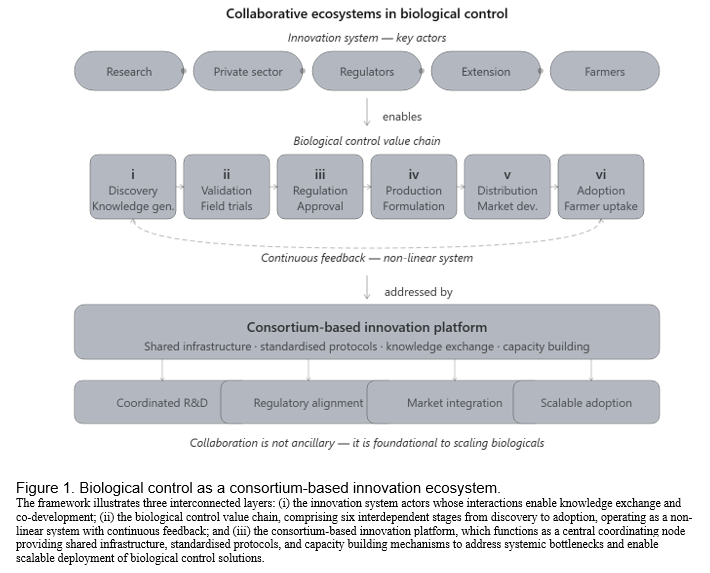
Biological control can therefore be conceptualized as an interconnected ecosystem or value chain comprising key functional components: (i) knowledge generation and discovery; (ii) technology validation through multi-location trials; (iii) regulatory approval and policy alignment; (iv) production and formulation; (v) distribution and market development; and (vi) adoption supported by feedback loops. These components are interdependent, and inefficiencies in any stage constrain overall system performance. Importantly, the system is non-linear, with continuous feedback informing adaptation and improvement.
Collaboration plays a central role in strengthening these linkages. Multi-stakeholder approaches—such as public–private partnerships, innovation platforms, and research consortia—enable the pooling of expertise, resources, and networks, reducing fragmentation and facilitating coordinated action across the value chain (Klerkx & Leeuwis, 2009). These arrangements improve the efficiency of validation processes, enhance responsiveness to user needs, and support market integration. They also enable risk-sharing, which is critical in biological control where uncertainty in performance and market acceptance can limit private investment.
Building on this, a consortium-based innovation platform is proposed as an operational model for advancing biological control. This model integrates key actors—including research institutions, industry, policymakers, and farmers—within a structured framework that supports coordinated research, validation, regulatory engagement, and scaling. Through shared infrastructure, standardized protocols, and mechanisms for knowledge exchange and capacity building, the consortium functions as a central coordinating node linking inputs, processes, and outcomes. Such a framework provides a practical basis for addressing systemic bottlenecks and enabling the scalable deployment of biological control solutions across diverse contexts.
CONSTRAINTS TO BIOLOGICAL CONTROL DEVELOPMENT AND ADOPTION
Scientific and technical constraints
Despite substantial advances in the development of biological control agents, their performance under field conditions remains variable and often context-dependent. Unlike synthetic pesticides, which typically exhibit consistent and rapid modes of action, biological control agents are influenced by environmental factors such as temperature, humidity, and interactions with existing agroecosystems (Glare et al., 2012; van Lenteren et al., 2018). This variability can result in inconsistent efficacy across locations and seasons, limiting farmer confidence and uptake.
In addition, the development pipeline for biological control agents is often constrained by the lack of standardized protocols for efficacy evaluation and comparison across agroecological zones (Chandler et al., 2011; Glare et al., 2012). Field validation requires multi-location and multi-season trials, which are resource-intensive and time-consuming. Furthermore, integration into existing IPM systems requires careful calibration of application timing, compatibility with other control measures, and understanding of ecological interactions, all of which add layers of complexity to deployment (Barratt et al., 2018).
Regulatory and policy constraints
Regulatory frameworks for biologicals remain a significant bottleneck in many regions. While biological control agents are generally considered safer than synthetic pesticides, they are often subject to regulatory systems originally designed for chemical products, resulting in disproportionate data requirements, lengthy approval processes, and high compliance costs (Freier et al., 2016). The lack of harmonization across countries further complicates market entry, particularly for companies seeking to scale products regionally or globally.
In developing countries, regulatory capacity is frequently limited, leading to delays in product registration and uncertainty in approval pathways. This regulatory ambiguity can discourage private sector investment and slow the introduction of new biological control solutions into the market. At the same time, insufficient regulatory oversight in some contexts may allow the proliferation of low-quality or unverified products, undermining farmer trust and the credibility of biological control technologies.
Market and commercialization barriers
The commercialization of biological control products faces structural challenges across production, distribution, and market development. Scaling production while maintaining the viability and efficacy of living organisms requires specialized infrastructure, quality control systems, and technical expertise (Glare et al., 2012). These requirements can increase production costs and limit the ability of small and medium enterprises to enter the market. Distribution systems for biologicals are often underdeveloped, particularly in smallholder-dominated agricultural systems. Cold chain requirements, limited shelf life, and the need for timely delivery further complicate logistics. In addition, market demand for biological control products remains uncertain in many regions due to limited awareness, inconsistent performance, and competition from relatively cheaper synthetic pesticides (Jaffee, 2017).
The absence of strong value chain integration, linking producers, distributors, and end-users, further constrains market growth. Without reliable demand signals and effective distribution networks, private sector actors face high risks in investing in biological control product development and commercialization.
Adoption and behavioral constraints
Farmer adoption of biological control is influenced by a range of socio-economic and behavioral factors. Limited awareness and understanding of biological control principles often result in reluctance to adopt unfamiliar technologies, particularly when benefits are not immediately visible or when outcomes are perceived as uncertain (Parsa et al., 2014). Compared to chemical pesticides, which offer rapid and observable effects, biological control may require longer timeframes and more precise application strategies, which can be perceived as less reliable.
Risk aversion among farmers, especially in resource-constrained settings, further limits experimentation with new technologies. Adoption decisions are also shaped by access to extension services, availability of technical support, and peer learning networks. In many cases, weak extension systems and limited access to reliable information constrain the dissemination of best practices for biological control.
Economic considerations also play a critical role. Even where biological control is cost-effective in the long term, higher upfront costs or perceived risks can deter adoption. In the absence of clear economic incentives or supportive policies, farmers may continue to rely on familiar chemical-based approaches.
Systemic nature of constraints
Importantly, these constraints are not isolated but interconnected across the biological control value chain. Scientific uncertainties influence regulatory decisions; regulatory delays affect market entry; weak markets reduce incentives for investment; and limited adoption feeds back into low demand and constrained innovation. This interdependence underscores the need for integrated approaches that address multiple bottlenecks simultaneously rather than in isolation.
From a systems perspective, the limited scaling of biological control reflects structural inefficiencies in the coordination of actors, resources, and processes across the innovation ecosystem. Addressing these challenges requires mechanisms that can strengthen linkages, facilitate knowledge flows, and align incentives across stakeholders. In this context, collaborative models, particularly those that integrate research, development, policy engagement, and market actors, offer a promising pathway for overcoming systemic constraints and enabling the broader adoption of biological control.
COLLABORATIVE APPROACHES TO OVERCOME CONSTRAINTS
Public–private partnerships in biological control development
Public–private partnerships (PPPs) play a critical role in bridging the gap between research innovation and commercial deployment in biological control systems. Public research institutions contribute foundational knowledge, experimental infrastructure, and long-term research capacity, while private sector actors provide expertise in product development, formulation, scaling, and market access. By aligning these complementary strengths, PPPs can accelerate the translation of laboratory discoveries into field-ready and marketable solutions.
In the context of biological control, PPPs are particularly valuable in addressing the high costs and uncertainties associated with product development and validation. Joint investments in multi-location field trials, formulation optimization, and quality control systems can reduce duplication of effort and distribute risk across stakeholders. Moreover, PPPs facilitate early engagement with market actors, ensuring that research outputs are aligned with user needs and commercial realities (van Lenteren et al., 2018). However, the effectiveness of PPPs depends on clear governance structures, transparent data-sharing arrangements, and alignment of incentives among partners.
Multi-stakeholder innovation platforms
Beyond bilateral partnerships, multi-stakeholder innovation platforms provide a broader mechanism for coordinating activities across the biological control ecosystem. These platforms bring together diverse actors—including researchers, private companies, extension services, policymakers, and farmers—within structured processes of dialogue, co-design, and joint problem-solving (Kilelu et al., 2013). Such platforms enable the integration of scientific knowledge with local experience, facilitating the adaptation of biological control solutions to specific agroecological and socio-economic contexts (Devaux et al., 2009; Klerkx et al., 2012).
Innovation platforms also enhance the efficiency of knowledge exchange and reduce fragmentation by creating spaces for continuous interaction and feedback. Through iterative learning cycles, stakeholders can collectively identify constraints, test solutions, and refine technologies. This is particularly important for biological control, where performance is highly context-dependent and requires ongoing adjustment (Klerkx & Leeuwis, 2009). Furthermore, these platforms can strengthen linkages between research and extension systems, improving the dissemination of knowledge and supporting farmer adoption.
Regional and international collaboration
Biological control development and deployment often require coordination beyond national boundaries. Pests and diseases do not respect borders, and their global spread creates shared challenges across cropping systems and regions (Bebber et al., 2014). Regional and international collaboration can facilitate the harmonization of regulatory frameworks, enabling more efficient registration and movement of biological control agents (Chandler et al., 2011). It also supports the exchange of data, methodologies, and best practices, reducing duplication and accelerating innovation (Cock et al., 2016).
International research organizations and development partners play a key role in convening stakeholders and fostering cross-border collaboration. By leveraging networks that span multiple countries, these organizations can facilitate multi-location trials, comparative studies, and the scaling of successful interventions across diverse contexts. Such coordination is particularly important in regions with limited national capacity for research and regulation, where pooled resources and shared expertise can significantly enhance system performance (Hall et al., 2003).
Role of research organizations as system integrators
Research organizations, particularly those with international mandates, are uniquely positioned to act as system integrators within biological control ecosystems. Beyond their traditional roles in knowledge generation, these institutions can serve as neutral conveners that coordinate interactions among diverse stakeholders and function as innovation intermediaries bridging public and private actors (Klerkx & Leeuwis, 2009; Hall et al., 2003). Their credibility and technical capacity enable them to facilitate trust-building and ensure that research outputs are translated into practical applications.
As system integrators, research organizations can coordinate multi-location trials, standardize evaluation protocols, and generate evidence required for regulatory approval and market acceptance. They can also support capacity building through training and extension activities, enhancing the ability of farmers and local institutions to adopt and implement biological control strategies. Importantly, their involvement can help align research agendas with development priorities and market needs, ensuring that innovations are both scientifically robust and practically relevant.
Towards integrated collaborative models for scaling biological control
While each of the above collaborative approaches contributes to addressing specific constraints, their impact is most significant when integrated within a coherent framework. Biological control scaling requires coordinated action across multiple stages of the value chain, from discovery and validation to regulation, commercialization, and adoption. Fragmented or isolated interventions are unlikely to generate sustained impact.
Integrated collaborative models—such as consortium-based platforms—provide a mechanism for aligning these activities within a single, coordinated system. By bringing together diverse stakeholders under shared objectives and governance structures, such models can simultaneously address scientific, regulatory, market, and adoption challenges. They enable continuous feedback across system components, support adaptive management, and create conditions for scaling innovations beyond pilot contexts.
In this regard, consortium-based approaches represent an evolution from traditional project-based collaborations toward more structured and sustained forms of engagement. They offer a practical pathway for operationalizing the conceptual framework outlined in Section 2 and for addressing the systemic constraints identified in Section 3. The following section examines the application of this model through the World Vegetable Center Biologicals Consortium, providing empirical insights into its design, implementation, and emerging outcomes.
CASE STUDY: WORLD VEGETABLE CENTER BIOLOGICAL CONTROLS CONSORTIUM
Rationale for a consortium-based approach
The World Vegetable Center (WorldVeg) Biologicals Consortium represents a structured, multi-stakeholder platform designed to accelerate the development, validation, and scaling of biological control solutions. Building on WorldVeg’s experience with collaborative breeding initiatives, the consortium extends this model to biological inputs, recognizing that scaling biological control requires coordinated action across research, industry, policy, and farming systems.
The consortium was formally launched through an inaugural event that brought together stakeholders from research institutions, private sector companies, government agencies, and farming communities to co-develop strategies for advancing biologicals within sustainable agricultural systems. This platform was explicitly designed to address systemic bottlenecks—particularly the disconnect between laboratory innovation and field-level adoption—by fostering structured dialogue, knowledge exchange, and joint problem-solving.
Structure and governance
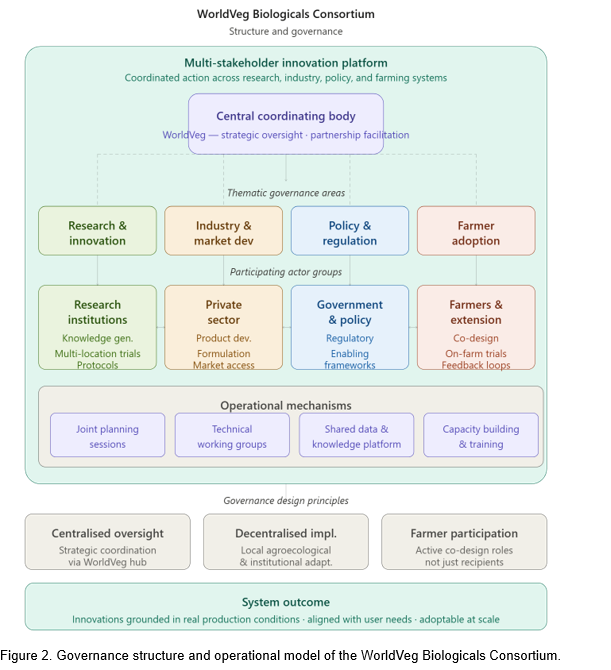
The diagram illustrates the multi-stakeholder innovation platform convened by the World Vegetable Center as a central coordinating body. Governance is organised across four thematic areas each engaging a corresponding actor group comprising research institutions, private sector firms, government agencies, and farming communities.
The consortium is structured as a multi-stakeholder innovation platform comprising research institutions, private sector actors, government agencies, development partners, and farmers. Governance is organized around thematic areas—including research and innovation, industry and market development, policy and regulation, and farmer adoption—enabling targeted engagement while maintaining system-wide coordination.
A central coordinating body, anchored within WorldVeg, provides strategic oversight, facilitates partnerships, and ensures alignment across activities. At the same time, implementation is decentralized, allowing partners to adapt activities to local agroecological and institutional contexts. Mechanisms such as joint planning sessions, technical working groups, and shared platforms for data and knowledge exchange support transparency and continuous learning.
Farmers are integrated as active participants within the governance structure, contributing to co-design processes, on-farm validation, and feedback mechanisms. This inclusion ensures that innovations are grounded in real production conditions and aligned with user needs, thereby strengthening the relevance and adoption potential of biological control solutions.
Operational model and activities
The consortium operationalizes collaboration through coordinated activities spanning the biological control value chain. These include joint research initiatives, multi-location field validation trials, technical training programs, and industry-led product development efforts. Planned activities include training on microbial identification, strain evaluation, formulation, and regulatory processes, as well as collaborative project calls that bring together multiple partners to co-develop integrated pest management (IPM) solutions.
A central feature of the operational model is the integration of research and application. For example, coordinated field trials are designed to generate independent, science-based data that can support farmer adoption, industry development, and regulatory approval processes. In parallel, efforts to build an integrated R&D pipeline connect microbial discovery, formulation development, and commercialization pathways, enabling a more seamless transition from laboratory research to field deployment.
The consortium also facilitates direct engagement between stakeholders through workshops, technical exchanges, and demonstration activities, creating opportunities for iterative learning and adaptation. Industry participation, including product testing and co-development, further strengthens the linkage between research outputs and market-ready solutions.
Addressing systemic constraints
Insights generated through consortium activities highlight several persistent constraints in biological control systems, including inconsistent field performance, limited coordination between research and end-users, fragmented supply chains, and regulatory bottlenecks. Farmers reported challenges such as the need for frequent application, limited technical support, and uncertainty in product performance, while industry stakeholders emphasized issues related to quality assurance, formulation capacity, and market development.
The consortium addresses these constraints through coordinated interventions. For instance, joint field validation efforts aim to improve the reliability and comparability of efficacy data across environments, while training programs enhance technical capacity among researchers and practitioners. At the same time, engagement with policymakers supports the development of regulatory frameworks better suited to biological products, including efforts toward streamlined approval processes and clearer data requirements.
Importantly, the consortium also creates space for integrating farmer knowledge into innovation processes. Farmer-led discussions identified practical solutions such as demonstration farms, farmer-to-farmer learning, and locally adapted IPM strategies, reinforcing the importance of participatory approaches in addressing adoption barriers.
Outcomes and emerging impacts
As a consortium-based innovation platform, the WorldVeg Biologicals Consortium is generating outcomes across multiple levels. At the technical level, coordinated research and validation activities are improving the quality and robustness of biological control data. Institutionally, the consortium is strengthening collaboration and trust among stakeholders, enabling more efficient innovation processes.
At the market level, engagement with industry partners is supporting product development, testing, and positioning within emerging biologicals markets. At the adoption level, training, demonstrations, and farmer engagement are contributing to increased awareness and capacity for implementing biological control solutions.
At the system level, the consortium is fostering greater alignment across the biological control value chain, helping to bridge gaps between research, regulation, and market deployment. A key insight emerging from this experience is the need to address the “valley of death” between innovation and adoption, where many technologies fail to transition from experimental success to widespread use.
To address this challenge, the consortium has articulated a “3A” framework focused on ensuring the availability of high-quality biological products, improving accessibility through training and delivery systems, and enhancing affordability to support farmer uptake. This framework provides a practical lens for guiding future interventions and evaluating progress toward scaling biological control.
LESSONS LEARNED FROM THE CONSORTIUM APPROACH
Importance of institutional coordination
A key lesson from the consortium approach is the central role of institutional coordination in overcoming fragmentation across the biological control value chain. The absence of standardized methodologies for isolation, identification, validation, and preservation often leads to inconsistent and non-comparable results across institutions. The consortium addressed this constraint through the development of a shared protocols compendium covering the full biological control pipeline, including microbial identification (morphological and molecular), bioassays, and preservation. The compendium spans multiple biological control agents—bacterial, fungal, and parasitoids—and covers key pest and disease systems such as aphids, thrips, whiteflies, Tuta absoluta, and diseases like late blight, southern blight, bacterial wilt, and anthracnose, enabling harmonized evaluation across contexts.
This standardization has improved the reliability and comparability of data, facilitated multi-location validation, reduced duplication of effort, and strengthened collaboration among institutions. Beyond its role as a research tool, the compendium also supports capacity building through training and dissemination of best practices. Overall, the experience highlights that effective coordination requires not only aligning activities but also co-developing shared standards and technical frameworks across the innovation pipeline. Investments in such coordination infrastructure are therefore critical for enabling the efficient scaling of biological control technologies across crops, pests, and regions.
Role of trust and shared goals
Trust and shared goals are foundational to effective collaboration within biological control systems. Given the diversity of actors involved, ranging from research institutions and private sector companies to government agencies and international partners, collaboration inherently involves differences in incentives, expectations, and risk. In this context, trust is essential for enabling the exchange of knowledge, materials, and resources. The consortium demonstrates this through mechanisms such as reciprocal material sharing under formal agreements, joint publications, and sustained cross-institutional engagement, which together facilitate alignment of scientific objectives and recognition of shared contributions.
Trust is further strengthened through transparency, repeated interactions, and tangible exchanges of value. Examples include international expert engagement, which promotes knowledge exchange across networks, and private sector participation in product testing and validation, reflecting confidence in the consortium’s capacity to generate credible results. These experiences show that trust is built through structured collaboration and clear governance, while shared goals, such as advancing sustainable pest management and scaling biological control, provide the alignment needed to sustain partnerships over time. Together, these elements highlight trust and shared vision as critical design principles for effective consortium-based innovation systems.
Need for flexible governance structures
Closely linked to the role of trust is the need for governance structures that can adapt to diverse regulatory and market environments. Biological control systems operate across heterogeneous contexts, where differences in national regulations and data requirements influence the pace and feasibility of technology deployment. The consortium’s experience in providing efficacy testing services in India illustrates this dynamic, where standardized trials generate data for product optimization and registration, but their application is shaped by country-specific regulatory frameworks.
This variability requires governance systems that balance coordination with adaptability. Standardized protocols and centralized oversight ensure data quality and comparability, while decentralized implementation enables responsiveness to local conditions. At the same time, efforts to promote regulatory harmonization highlight the importance of engaging with policy processes to reduce barriers, lower transaction costs, and accelerate scaling. Overall, governance in biological control systems must function as an adaptive framework that integrates standardized scientific processes with context-specific regulatory and market realities.
Value of linking research to market pathways
Building on these institutional and governance foundations, effective scaling ultimately depends on strong linkages between research and market pathways. In many biological control systems, innovations remain at the experimental stage due to weak connections between research and commercialization. The consortium addresses this gap by engaging private sector partners in research and validation, thereby aligning scientific outputs with market needs. For example, efficacy trials in India across multiple crop–pest systems generate standardized data for product optimization and regulatory approval, reducing uncertainty and supporting industry decision-making.
Similarly, collaboration with industry in contexts such as Cambodia demonstrates how early engagement enables product adaptation, positioning, and confidence-building through field testing and feedback. These interactions reflect a shift toward demand-driven innovation, where market requirements and farmer needs are integrated into the research process. In this way, the consortium functions as a bridge between research and commercialization, providing a practical model for accelerating the scaling of biological control solutions.
IMPLICATIONS FOR SCALING BIOLOGICAL CONTROL
Policy implications
Scaling biological control requires regulatory systems that are fit-for-purpose and aligned with the biological nature of these products. Streamlining approval processes—through proportionate data requirements, risk-tiered assessment, and clear guidance—can reduce time-to-market without compromising safety. In parallel, regional harmonization of regulatory frameworks is critical to enable cross-border movement and market entry of biological control agents. Aligning data requirements and mutual recognition mechanisms can lower transaction costs for developers and accelerate deployment across similar agroecological zones. Policymakers should also support enabling policies that incentivize sustainable pest management, including integration of biological control within national IPM strategies.
Research implications
The findings highlight the need for coordinated research systems that prioritize standardization and comparability. The development and adoption of shared protocols for isolation, identification (morphological and molecular), bioassays, and field validation are essential to ensure data quality and reproducibility across institutions. In addition, multi-location and multi-season trials should be institutionalized to capture variability in performance across agroecological contexts. Embedding participatory approaches within research—through on-farm validation and farmer feedback—can further enhance relevance and accelerate adaptation of biological control technologies.
Industry implications
For the private sector, scaling biological control requires sustained investment in production systems, formulation technologies, and quality assurance to ensure product consistency and viability. Strengthening distribution networks and last-mile delivery systems is equally important, particularly for products with limited shelf life or specific handling requirements. Early engagement with research institutions and participation in collaborative platforms can reduce uncertainty by providing access to robust validation data and facilitating product optimization. Market development efforts should also focus on building farmer awareness and confidence in biological control through demonstration, training, and evidence of cost-effectiveness.
Development and donor implications
Development partners and donors play a critical role in enabling system-level transformation by supporting collaborative models that integrate research, policy, and market actors. Investments in consortium-based platforms can help overcome fragmentation by providing shared infrastructure, facilitating coordination, and enabling knowledge exchange. Given the time required for biological control technologies to progress from discovery to adoption, long-term and flexible funding mechanisms are essential. Donor support should also prioritize capacity building, regulatory strengthening, and the development of regional networks to sustain and scale biological control initiatives beyond pilot phases.
FUTURE DIRECTIONS
The advancement of biological control will depend on integrating emerging technologies, strengthening institutional frameworks, and adopting adaptive strategies that respond to evolving agricultural challenges. Digital tools—such as data platforms, decision-support systems, and precision agriculture technologies—offer opportunities to improve monitoring, evaluation, and targeted application of biological control agents. At the same time, increasing climate variability highlights the need for climate-resilient solutions, including the identification of robust agents, improved formulations, and validation across diverse agroecological contexts. Expanding multi-location trials and strengthening regional collaboration will be essential to generate the evidence needed to support adaptation and scaling.
Future efforts should also prioritize the expansion of consortium-based models across regions to accelerate the deployment of biological control. Establishing regionally adapted platforms can facilitate knowledge exchange, regulatory alignment, and cross-border collaboration, while enabling adaptation to local conditions. Advancing regulatory innovation—through harmonization, digitalization, and risk-based frameworks—will further support scaling. Ultimately, sustained investment in capacity building, institutional infrastructure, and collaborative platforms will be critical, with strong linkages among research, industry, policy, and farming communities ensuring that biological control innovations are effectively translated into widespread practice.
CONCLUSION
Biological control holds significant promise as a cornerstone of sustainable pest management and resilient agricultural systems. However, its widespread adoption has been constrained not by a lack of technical solutions, but by systemic challenges across the research, regulatory, market, and adoption landscape. Addressing these constraints requires a shift from technology-centric approaches to coordinated, multi-stakeholder systems that align actors, processes, and incentives across the biological control value chain. Through the development of a conceptual framework and its application to the World Vegetable Center Biologicals Consortium, this study demonstrates how structured collaboration can enhance innovation, improve validation processes, and facilitate pathways to scaling. The consortium model illustrates the value of integrating research institutions, private sector actors, policymakers, and farmers within a unified platform that supports knowledge exchange, standardization, and adaptive implementation. Ultimately, scaling biological control is not solely a scientific or technical challenge, but a systems challenge. Consortium-based approaches offer a practical and replicable pathway for addressing this complexity and advancing sustainable pest management solutions in diverse agroecological and institutional contexts.
REFERENCES
Barratt, B. I. P., Moran, V. C., Bigler, F., & van Lenteren, J. C. (2018). The status of biological control and recommendations for improving uptake for the future. BioControl, 63, 155–167. https://doi.org/10.1007/s10526-017-9831-y
Bebber, D. P., Holmes, T., & Gurr, S. J. (2014). The global spread of crop pests and pathogens. Global Ecology and Biogeography, 23(12), 1398–1407.
Bebber, D. P., Ramotowski, M. A. T., & Gurr, S. J. (2013). Crop pests and pathogens move polewards in a warming world. Nature Climate Change, 3, 985–988. https://doi.org/10.1038/nclimate1990
Chandler, D., Bailey, A. S., Tatchell, G. M., Davidson, G., Greaves, J., & Grant, W. P. (2011). The development, regulation and use of biopesticides for integrated pest management. Philosophical Transactions of the Royal Society B, 366(1573), 1987–1998.
Cock, M. J. W., Murphy, S. T., Kairo, M. T. K., Thompson, E., Murphy, R. J., & Francis, A. W. (2016). Trends in the classical biological control of insect pests by insects: An update of the BIOCAT database. BioControl, 61, 349–363.
Deutsch, C. A., Tewksbury, J. J., Tigchelaar, M., Battisti, D. S., Merrill, S. C., Huey, R. B., & Naylor, R. L. (2018). Increase in crop losses to insect pests in a warming climate. Science, 361(6405), 916–919. https://doi.org/10.1126/science.aat3466
Devaux, A., Torero, M., Donovan, J., & Horton, D. (2018).Agricultural innovation and inclusive value-chain development: A review. Journal of Agribusiness in Developing and Emerging Economies, 8(1), 99–123.
Freier, B., Sellmann, J., Strassemeyer, J., Schwarz, J., & Klocke, B. (2016). Pest management in Germany: Challenges and opportunities for biological control. Biological Control, 97, 1–8.
Glare, T., Caradus, J., Gelernter, W., Jackson, T., Keyhani, N., Köhl, J., Marrone, P., Morin, L., & Stewart, A. (2012). Have biopesticides come of age? Trends in Biotechnology, 30(5), 250–258. https://doi.org/10.1016/j.tibtech.2012.01.003
Hall, A., Rasheed Sulaiman, V., Clark, N., & Yoganand, B. (2003). From measuring impact to learning institutional lessons: An innovation systems perspective on improving the management of international agricultural research. Agricultural Systems, 78(2), 213–241.
Jaffee, S. (2017). The safe food imperative: Accelerating progress in low- and middle-income countries. World Bank.
Kilelu, C. W., Klerkx, L., & Leeuwis, C. (2013). Unravelling the role of innovation platforms in supporting co-evolution of innovation: Contributions and tensions in a smallholder dairy development programme. Agricultural Systems, 118, 65–77.
Klerkx, L., & Leeuwis, C. (2008). Balancing multiple interests: Embedding innovation intermediation in the agricultural knowledge infrastructure. Technovation, 28(6), 364–378.
Klerkx, L., & Leeuwis, C. (2009). Establishment and embedding of innovation brokers at different innovation system levels: Insights from the Dutch agricultural sector. Technological Forecasting and Social Change, 76(6), 849–860.
Klerkx, L., van Mierlo, B., & Leeuwis, C. (2012). Evolution of systems approaches to agricultural innovation: Concepts, analysis and interventions. In Farming Systems Research into the 21st Century (pp. 457–483). Springer.
Parsa, S., Morse, S., Bonifacio, A., Chancellor, T. C. B., Condori, B., Crespo-Pérez, V., Hobbs, S. L. A., Kroschel, J., Ba, M. N., Rebaudo, F., Sherwood, S. G., Vanek, S. J., Faye, E., Herrera, M. A., & Dangles, O. (2014). Obstacles to integrated pest management adoption in developing countries. Proceedings of the National Academy of Sciences, 111(10), 3889–3894. https://doi.org/10.1073/pnas.1312693111
Pimentel, D. (2005). Environmental and economic costs of the application of pesticides primarily in the United States. Environment, Development and Sustainability, 7, 229–252.
Pretty, J., & Bharucha, Z. P. (2015). Integrated pest management for sustainable intensification of agriculture in Asia and Africa. Insects, 6(1), 152–182.
Schreinemachers, P., Chen, H. P., Nguyen, T. T. L., Buntong, B., Bouapao, L., Gautam, S., ... & Srinivasan, R. (2017). Too much to handle? Pesticide dependence of smallholder vegetable farmers in Southeast Asia. Science of the Total Environment, 593, 470-477.
Sparks, T. C., & Nauen, R. (2015). IRAC: Mode of action classification and insecticide resistance management. Pesticide Biochemistry and Physiology, 121, 122–128.
Sulaiman, R. V., Hall, A., Suresh, N., & Reddy, T. S. (2010). Studying rural innovation management: A framework and early findings from RIU in South Asia. Agricultural Systems, 103(7), 522–532.
van Lenteren, J. C., Bolckmans, K., Köhl, J., Ravensberg, W. J., & Urbaneja, A. (2018). Biological control using invertebrates and microorganisms: Plenty of new opportunities. BioControl, 63, 39–59.

Building Collaborative Ecosystems for Biologicals: Pathways to Innovation, Adoption, and Scale in Sustainable Agriculture
DOI: https://doi.org/10.56669/UCIK1102
This manuscript was originally presented at the ACRI, ATRI, WorldVeg, and FFTC workshop titled “Pest and Disease Management Strategies for Sustainable Agriculture,” held in Taichung, Taiwan, on May 5–6, 2026.
ABSTRACT
Biologicals, including biocontrol agents, biostimulants, biofertilizers, and other bio-inputs, are increasingly regarded as essential to sustainable agriculture and a key component of integrated pest management (IPM) systems. However, despite their ecological and economic advantages, the large-scale adoption of biologicals remains limited, particularly in developing regions. This gap is driven by a combination of scientific, regulatory, market, and adoption-related constraints, including variable field performance, fragmented research and development efforts, limited commercialization pathways, and low farmer awareness. Addressing these challenges requires a shift from isolated innovation efforts towards consortium-based collaboration and coordinated, system-level approaches. We develop a conceptual framework that positions biologicals within a consortium-based innovation platform. By pooling expertise, resources, and networks, consortia can accelerate technology validation, harmonize regulatory pathways, and foster market integration, enabling scale. The framework is operationalized through an in-depth case study of the World Vegetable Center Biologicals Consortium, building on lessons from its breeding consortium model. The consortium provides a structured collaboration that can address critical bottlenecks across the biologicals value chain. The consortium model demonstrates how partnerships among public research organizations, private sector actors, and development stakeholders can enhance technology validation, accelerate deployment, and strengthen adaptive capacity across diverse agroecological contexts. Our analysis shows that collaboration is not ancillary but foundational to scaling biologicals. We conclude by outlining design principles for consortium-based approaches and their implications for policy, research investment, and the scaling of sustainable pest management solutions under increasing environmental and market pressures.
Keywords: Bio-inputs, integrated pest management (IPM), consortium-based innovation, public–private partnerships, technology validation, sustainable intensification
INTRODUCTION
Agricultural production systems are increasingly challenged by rising pest and disease pressures driven by climate variability, intensified cropping systems, and the global movement of arthropod pests and pathogens (Bebber et al., 2013; Deutsch et al., 2018; Parsa et al., 2014). These dynamics have contributed to greater reliance on synthetic pesticides, often applied at high frequency and intensity, leading to well-documented consequences including the development of resistance in pest populations, disruption of beneficial organisms, environmental contamination, and risks to human health (Pimentel, 2005; Sparks & Nauen, 2015; Schreinemachers et al., 2017). In parallel, tightening regulatory frameworks and market demands for reduced pesticide residues are further constraining the long-term viability of chemical-dependent pest management strategies (Pretty & Bharucha, 2015).
Biologicals, including biocontrol agents, biostimulants, and biofertilizers, have emerged as key components of sustainable agriculture and are central to integrated pest management (IPM) systems. Among these, biological control offers a particularly compelling pathway for managing pest populations while maintaining ecological balance (van Lenteren et al., 2018). Advances in microbial technologies, mass production systems, and formulation science have expanded the range and applicability of biological control agents across diverse cropping systems (Glare et al., 2012). Despite these advances, however, the adoption and scaling of biological control remain uneven, particularly in smallholder-dominated systems in developing regions (Parsa et al., 2014).
This gap between potential and practice reflects a set of interconnected constraints that extend beyond the technical performance of biologicals. Variable field efficacy under heterogeneous agroecological conditions, fragmented research and development efforts, complex and often poorly harmonized regulatory frameworks, weak commercialization pathways, and limited farmer awareness collectively hinder the transition from innovation to widespread use (Barratt et al., 2018; Jaffee, 2017). These constraints are not isolated but are embedded within broader systemic inefficiencies across the biologicals value chain.
Recent discourse has increasingly recognized that overcoming these barriers requires a shift from technology-centric approaches toward integrated, system-level strategies. In the context of developing and developed countries, collaborative, multi-stakeholder models that bring together research, private sector, policymakers, and farmers are gaining attention as mechanisms to accelerate innovation, streamline validation processes, and facilitate market integration (Hall et al., 2003; Sulaiman et al., 2010; Devaux et al., 2018).However, there remains limited empirical and conceptual articulation of how such collaborative ecosystems function in practice and how they can be designed to effectively support the scaling of biological control.
We address this gap by advancing a systems-oriented perspective on biological control, positioning it within a consortium-based innovation framework. Specifically, the study develops a conceptual model for collaborative ecosystems in biologicals and examines its application through the case of the World Vegetable Center Biologicals Consortium. By integrating conceptual analysis with an empirical case study, we aim to generate actionable insights into how structured collaboration can overcome critical bottlenecks, enhance technology validation, and enable the scaling of sustainable pest management solutions across diverse agroecological contexts.
CONCEPTUAL FRAMEWORK: COLLABORATIVE ECOSYSTEMS IN BIOLOGICAL CONTROL
Biological control is best understood not as a standalone technology but as a complex innovation system involving multiple actors, processes, and institutional arrangements. While both chemical and biological pest control involve multi-stage development processes, chemical systems typically benefit from more standardized regulatory pathways and established industrial value chains. In contrast, biological control operates across more fragmented and less coordinated stages, including discovery, validation, regulation, production, and adoption. Each stage involves distinct stakeholders with differing capacities, incentives, and timelines, making coordination a central challenge.
From an innovation systems perspective, technologies scale through interactions among diverse actors such as research institutions, private sector firms, regulatory bodies, extension systems, and farmers (Hall et al., 2003; Klerkx & Leeuwis, 2008). These interactions enable knowledge exchange, co-development, and iterative learning, which are essential for adapting biological control solutions to varied agroecological and socio-economic contexts. However, in many regions, these linkages remain weak, resulting in fragmented efforts, misaligned regulatory processes, and limited private sector engagement. Consequently, many biological control innovations fail to progress beyond pilot stages.
Biological control can therefore be conceptualized as an interconnected ecosystem or value chain comprising key functional components: (i) knowledge generation and discovery; (ii) technology validation through multi-location trials; (iii) regulatory approval and policy alignment; (iv) production and formulation; (v) distribution and market development; and (vi) adoption supported by feedback loops. These components are interdependent, and inefficiencies in any stage constrain overall system performance. Importantly, the system is non-linear, with continuous feedback informing adaptation and improvement.
Collaboration plays a central role in strengthening these linkages. Multi-stakeholder approaches—such as public–private partnerships, innovation platforms, and research consortia—enable the pooling of expertise, resources, and networks, reducing fragmentation and facilitating coordinated action across the value chain (Klerkx & Leeuwis, 2009). These arrangements improve the efficiency of validation processes, enhance responsiveness to user needs, and support market integration. They also enable risk-sharing, which is critical in biological control where uncertainty in performance and market acceptance can limit private investment.
Building on this, a consortium-based innovation platform is proposed as an operational model for advancing biological control. This model integrates key actors—including research institutions, industry, policymakers, and farmers—within a structured framework that supports coordinated research, validation, regulatory engagement, and scaling. Through shared infrastructure, standardized protocols, and mechanisms for knowledge exchange and capacity building, the consortium functions as a central coordinating node linking inputs, processes, and outcomes. Such a framework provides a practical basis for addressing systemic bottlenecks and enabling the scalable deployment of biological control solutions across diverse contexts.
CONSTRAINTS TO BIOLOGICAL CONTROL DEVELOPMENT AND ADOPTION
Scientific and technical constraints
Despite substantial advances in the development of biological control agents, their performance under field conditions remains variable and often context-dependent. Unlike synthetic pesticides, which typically exhibit consistent and rapid modes of action, biological control agents are influenced by environmental factors such as temperature, humidity, and interactions with existing agroecosystems (Glare et al., 2012; van Lenteren et al., 2018). This variability can result in inconsistent efficacy across locations and seasons, limiting farmer confidence and uptake.
In addition, the development pipeline for biological control agents is often constrained by the lack of standardized protocols for efficacy evaluation and comparison across agroecological zones (Chandler et al., 2011; Glare et al., 2012). Field validation requires multi-location and multi-season trials, which are resource-intensive and time-consuming. Furthermore, integration into existing IPM systems requires careful calibration of application timing, compatibility with other control measures, and understanding of ecological interactions, all of which add layers of complexity to deployment (Barratt et al., 2018).
Regulatory and policy constraints
Regulatory frameworks for biologicals remain a significant bottleneck in many regions. While biological control agents are generally considered safer than synthetic pesticides, they are often subject to regulatory systems originally designed for chemical products, resulting in disproportionate data requirements, lengthy approval processes, and high compliance costs (Freier et al., 2016). The lack of harmonization across countries further complicates market entry, particularly for companies seeking to scale products regionally or globally.
In developing countries, regulatory capacity is frequently limited, leading to delays in product registration and uncertainty in approval pathways. This regulatory ambiguity can discourage private sector investment and slow the introduction of new biological control solutions into the market. At the same time, insufficient regulatory oversight in some contexts may allow the proliferation of low-quality or unverified products, undermining farmer trust and the credibility of biological control technologies.
Market and commercialization barriers
The commercialization of biological control products faces structural challenges across production, distribution, and market development. Scaling production while maintaining the viability and efficacy of living organisms requires specialized infrastructure, quality control systems, and technical expertise (Glare et al., 2012). These requirements can increase production costs and limit the ability of small and medium enterprises to enter the market. Distribution systems for biologicals are often underdeveloped, particularly in smallholder-dominated agricultural systems. Cold chain requirements, limited shelf life, and the need for timely delivery further complicate logistics. In addition, market demand for biological control products remains uncertain in many regions due to limited awareness, inconsistent performance, and competition from relatively cheaper synthetic pesticides (Jaffee, 2017).
The absence of strong value chain integration, linking producers, distributors, and end-users, further constrains market growth. Without reliable demand signals and effective distribution networks, private sector actors face high risks in investing in biological control product development and commercialization.
Adoption and behavioral constraints
Farmer adoption of biological control is influenced by a range of socio-economic and behavioral factors. Limited awareness and understanding of biological control principles often result in reluctance to adopt unfamiliar technologies, particularly when benefits are not immediately visible or when outcomes are perceived as uncertain (Parsa et al., 2014). Compared to chemical pesticides, which offer rapid and observable effects, biological control may require longer timeframes and more precise application strategies, which can be perceived as less reliable.
Risk aversion among farmers, especially in resource-constrained settings, further limits experimentation with new technologies. Adoption decisions are also shaped by access to extension services, availability of technical support, and peer learning networks. In many cases, weak extension systems and limited access to reliable information constrain the dissemination of best practices for biological control.
Economic considerations also play a critical role. Even where biological control is cost-effective in the long term, higher upfront costs or perceived risks can deter adoption. In the absence of clear economic incentives or supportive policies, farmers may continue to rely on familiar chemical-based approaches.
Systemic nature of constraints
Importantly, these constraints are not isolated but interconnected across the biological control value chain. Scientific uncertainties influence regulatory decisions; regulatory delays affect market entry; weak markets reduce incentives for investment; and limited adoption feeds back into low demand and constrained innovation. This interdependence underscores the need for integrated approaches that address multiple bottlenecks simultaneously rather than in isolation.
From a systems perspective, the limited scaling of biological control reflects structural inefficiencies in the coordination of actors, resources, and processes across the innovation ecosystem. Addressing these challenges requires mechanisms that can strengthen linkages, facilitate knowledge flows, and align incentives across stakeholders. In this context, collaborative models, particularly those that integrate research, development, policy engagement, and market actors, offer a promising pathway for overcoming systemic constraints and enabling the broader adoption of biological control.
COLLABORATIVE APPROACHES TO OVERCOME CONSTRAINTS
Public–private partnerships in biological control development
Public–private partnerships (PPPs) play a critical role in bridging the gap between research innovation and commercial deployment in biological control systems. Public research institutions contribute foundational knowledge, experimental infrastructure, and long-term research capacity, while private sector actors provide expertise in product development, formulation, scaling, and market access. By aligning these complementary strengths, PPPs can accelerate the translation of laboratory discoveries into field-ready and marketable solutions.
In the context of biological control, PPPs are particularly valuable in addressing the high costs and uncertainties associated with product development and validation. Joint investments in multi-location field trials, formulation optimization, and quality control systems can reduce duplication of effort and distribute risk across stakeholders. Moreover, PPPs facilitate early engagement with market actors, ensuring that research outputs are aligned with user needs and commercial realities (van Lenteren et al., 2018). However, the effectiveness of PPPs depends on clear governance structures, transparent data-sharing arrangements, and alignment of incentives among partners.
Multi-stakeholder innovation platforms
Beyond bilateral partnerships, multi-stakeholder innovation platforms provide a broader mechanism for coordinating activities across the biological control ecosystem. These platforms bring together diverse actors—including researchers, private companies, extension services, policymakers, and farmers—within structured processes of dialogue, co-design, and joint problem-solving (Kilelu et al., 2013). Such platforms enable the integration of scientific knowledge with local experience, facilitating the adaptation of biological control solutions to specific agroecological and socio-economic contexts (Devaux et al., 2009; Klerkx et al., 2012).
Innovation platforms also enhance the efficiency of knowledge exchange and reduce fragmentation by creating spaces for continuous interaction and feedback. Through iterative learning cycles, stakeholders can collectively identify constraints, test solutions, and refine technologies. This is particularly important for biological control, where performance is highly context-dependent and requires ongoing adjustment (Klerkx & Leeuwis, 2009). Furthermore, these platforms can strengthen linkages between research and extension systems, improving the dissemination of knowledge and supporting farmer adoption.
Regional and international collaboration
Biological control development and deployment often require coordination beyond national boundaries. Pests and diseases do not respect borders, and their global spread creates shared challenges across cropping systems and regions (Bebber et al., 2014). Regional and international collaboration can facilitate the harmonization of regulatory frameworks, enabling more efficient registration and movement of biological control agents (Chandler et al., 2011). It also supports the exchange of data, methodologies, and best practices, reducing duplication and accelerating innovation (Cock et al., 2016).
International research organizations and development partners play a key role in convening stakeholders and fostering cross-border collaboration. By leveraging networks that span multiple countries, these organizations can facilitate multi-location trials, comparative studies, and the scaling of successful interventions across diverse contexts. Such coordination is particularly important in regions with limited national capacity for research and regulation, where pooled resources and shared expertise can significantly enhance system performance (Hall et al., 2003).
Role of research organizations as system integrators
Research organizations, particularly those with international mandates, are uniquely positioned to act as system integrators within biological control ecosystems. Beyond their traditional roles in knowledge generation, these institutions can serve as neutral conveners that coordinate interactions among diverse stakeholders and function as innovation intermediaries bridging public and private actors (Klerkx & Leeuwis, 2009; Hall et al., 2003). Their credibility and technical capacity enable them to facilitate trust-building and ensure that research outputs are translated into practical applications.
As system integrators, research organizations can coordinate multi-location trials, standardize evaluation protocols, and generate evidence required for regulatory approval and market acceptance. They can also support capacity building through training and extension activities, enhancing the ability of farmers and local institutions to adopt and implement biological control strategies. Importantly, their involvement can help align research agendas with development priorities and market needs, ensuring that innovations are both scientifically robust and practically relevant.
Towards integrated collaborative models for scaling biological control
While each of the above collaborative approaches contributes to addressing specific constraints, their impact is most significant when integrated within a coherent framework. Biological control scaling requires coordinated action across multiple stages of the value chain, from discovery and validation to regulation, commercialization, and adoption. Fragmented or isolated interventions are unlikely to generate sustained impact.
Integrated collaborative models—such as consortium-based platforms—provide a mechanism for aligning these activities within a single, coordinated system. By bringing together diverse stakeholders under shared objectives and governance structures, such models can simultaneously address scientific, regulatory, market, and adoption challenges. They enable continuous feedback across system components, support adaptive management, and create conditions for scaling innovations beyond pilot contexts.
In this regard, consortium-based approaches represent an evolution from traditional project-based collaborations toward more structured and sustained forms of engagement. They offer a practical pathway for operationalizing the conceptual framework outlined in Section 2 and for addressing the systemic constraints identified in Section 3. The following section examines the application of this model through the World Vegetable Center Biologicals Consortium, providing empirical insights into its design, implementation, and emerging outcomes.
CASE STUDY: WORLD VEGETABLE CENTER BIOLOGICAL CONTROLS CONSORTIUM
Rationale for a consortium-based approach
The World Vegetable Center (WorldVeg) Biologicals Consortium represents a structured, multi-stakeholder platform designed to accelerate the development, validation, and scaling of biological control solutions. Building on WorldVeg’s experience with collaborative breeding initiatives, the consortium extends this model to biological inputs, recognizing that scaling biological control requires coordinated action across research, industry, policy, and farming systems.
The consortium was formally launched through an inaugural event that brought together stakeholders from research institutions, private sector companies, government agencies, and farming communities to co-develop strategies for advancing biologicals within sustainable agricultural systems. This platform was explicitly designed to address systemic bottlenecks—particularly the disconnect between laboratory innovation and field-level adoption—by fostering structured dialogue, knowledge exchange, and joint problem-solving.
Structure and governance
The diagram illustrates the multi-stakeholder innovation platform convened by the World Vegetable Center as a central coordinating body. Governance is organised across four thematic areas each engaging a corresponding actor group comprising research institutions, private sector firms, government agencies, and farming communities.
The consortium is structured as a multi-stakeholder innovation platform comprising research institutions, private sector actors, government agencies, development partners, and farmers. Governance is organized around thematic areas—including research and innovation, industry and market development, policy and regulation, and farmer adoption—enabling targeted engagement while maintaining system-wide coordination.
A central coordinating body, anchored within WorldVeg, provides strategic oversight, facilitates partnerships, and ensures alignment across activities. At the same time, implementation is decentralized, allowing partners to adapt activities to local agroecological and institutional contexts. Mechanisms such as joint planning sessions, technical working groups, and shared platforms for data and knowledge exchange support transparency and continuous learning.
Farmers are integrated as active participants within the governance structure, contributing to co-design processes, on-farm validation, and feedback mechanisms. This inclusion ensures that innovations are grounded in real production conditions and aligned with user needs, thereby strengthening the relevance and adoption potential of biological control solutions.
Operational model and activities
The consortium operationalizes collaboration through coordinated activities spanning the biological control value chain. These include joint research initiatives, multi-location field validation trials, technical training programs, and industry-led product development efforts. Planned activities include training on microbial identification, strain evaluation, formulation, and regulatory processes, as well as collaborative project calls that bring together multiple partners to co-develop integrated pest management (IPM) solutions.
A central feature of the operational model is the integration of research and application. For example, coordinated field trials are designed to generate independent, science-based data that can support farmer adoption, industry development, and regulatory approval processes. In parallel, efforts to build an integrated R&D pipeline connect microbial discovery, formulation development, and commercialization pathways, enabling a more seamless transition from laboratory research to field deployment.
The consortium also facilitates direct engagement between stakeholders through workshops, technical exchanges, and demonstration activities, creating opportunities for iterative learning and adaptation. Industry participation, including product testing and co-development, further strengthens the linkage between research outputs and market-ready solutions.
Addressing systemic constraints
Insights generated through consortium activities highlight several persistent constraints in biological control systems, including inconsistent field performance, limited coordination between research and end-users, fragmented supply chains, and regulatory bottlenecks. Farmers reported challenges such as the need for frequent application, limited technical support, and uncertainty in product performance, while industry stakeholders emphasized issues related to quality assurance, formulation capacity, and market development.
The consortium addresses these constraints through coordinated interventions. For instance, joint field validation efforts aim to improve the reliability and comparability of efficacy data across environments, while training programs enhance technical capacity among researchers and practitioners. At the same time, engagement with policymakers supports the development of regulatory frameworks better suited to biological products, including efforts toward streamlined approval processes and clearer data requirements.
Importantly, the consortium also creates space for integrating farmer knowledge into innovation processes. Farmer-led discussions identified practical solutions such as demonstration farms, farmer-to-farmer learning, and locally adapted IPM strategies, reinforcing the importance of participatory approaches in addressing adoption barriers.
Outcomes and emerging impacts
As a consortium-based innovation platform, the WorldVeg Biologicals Consortium is generating outcomes across multiple levels. At the technical level, coordinated research and validation activities are improving the quality and robustness of biological control data. Institutionally, the consortium is strengthening collaboration and trust among stakeholders, enabling more efficient innovation processes.
At the market level, engagement with industry partners is supporting product development, testing, and positioning within emerging biologicals markets. At the adoption level, training, demonstrations, and farmer engagement are contributing to increased awareness and capacity for implementing biological control solutions.
At the system level, the consortium is fostering greater alignment across the biological control value chain, helping to bridge gaps between research, regulation, and market deployment. A key insight emerging from this experience is the need to address the “valley of death” between innovation and adoption, where many technologies fail to transition from experimental success to widespread use.
To address this challenge, the consortium has articulated a “3A” framework focused on ensuring the availability of high-quality biological products, improving accessibility through training and delivery systems, and enhancing affordability to support farmer uptake. This framework provides a practical lens for guiding future interventions and evaluating progress toward scaling biological control.
LESSONS LEARNED FROM THE CONSORTIUM APPROACH
Importance of institutional coordination
A key lesson from the consortium approach is the central role of institutional coordination in overcoming fragmentation across the biological control value chain. The absence of standardized methodologies for isolation, identification, validation, and preservation often leads to inconsistent and non-comparable results across institutions. The consortium addressed this constraint through the development of a shared protocols compendium covering the full biological control pipeline, including microbial identification (morphological and molecular), bioassays, and preservation. The compendium spans multiple biological control agents—bacterial, fungal, and parasitoids—and covers key pest and disease systems such as aphids, thrips, whiteflies, Tuta absoluta, and diseases like late blight, southern blight, bacterial wilt, and anthracnose, enabling harmonized evaluation across contexts.
This standardization has improved the reliability and comparability of data, facilitated multi-location validation, reduced duplication of effort, and strengthened collaboration among institutions. Beyond its role as a research tool, the compendium also supports capacity building through training and dissemination of best practices. Overall, the experience highlights that effective coordination requires not only aligning activities but also co-developing shared standards and technical frameworks across the innovation pipeline. Investments in such coordination infrastructure are therefore critical for enabling the efficient scaling of biological control technologies across crops, pests, and regions.
Role of trust and shared goals
Trust and shared goals are foundational to effective collaboration within biological control systems. Given the diversity of actors involved, ranging from research institutions and private sector companies to government agencies and international partners, collaboration inherently involves differences in incentives, expectations, and risk. In this context, trust is essential for enabling the exchange of knowledge, materials, and resources. The consortium demonstrates this through mechanisms such as reciprocal material sharing under formal agreements, joint publications, and sustained cross-institutional engagement, which together facilitate alignment of scientific objectives and recognition of shared contributions.
Trust is further strengthened through transparency, repeated interactions, and tangible exchanges of value. Examples include international expert engagement, which promotes knowledge exchange across networks, and private sector participation in product testing and validation, reflecting confidence in the consortium’s capacity to generate credible results. These experiences show that trust is built through structured collaboration and clear governance, while shared goals, such as advancing sustainable pest management and scaling biological control, provide the alignment needed to sustain partnerships over time. Together, these elements highlight trust and shared vision as critical design principles for effective consortium-based innovation systems.
Need for flexible governance structures
Closely linked to the role of trust is the need for governance structures that can adapt to diverse regulatory and market environments. Biological control systems operate across heterogeneous contexts, where differences in national regulations and data requirements influence the pace and feasibility of technology deployment. The consortium’s experience in providing efficacy testing services in India illustrates this dynamic, where standardized trials generate data for product optimization and registration, but their application is shaped by country-specific regulatory frameworks.
This variability requires governance systems that balance coordination with adaptability. Standardized protocols and centralized oversight ensure data quality and comparability, while decentralized implementation enables responsiveness to local conditions. At the same time, efforts to promote regulatory harmonization highlight the importance of engaging with policy processes to reduce barriers, lower transaction costs, and accelerate scaling. Overall, governance in biological control systems must function as an adaptive framework that integrates standardized scientific processes with context-specific regulatory and market realities.
Value of linking research to market pathways
Building on these institutional and governance foundations, effective scaling ultimately depends on strong linkages between research and market pathways. In many biological control systems, innovations remain at the experimental stage due to weak connections between research and commercialization. The consortium addresses this gap by engaging private sector partners in research and validation, thereby aligning scientific outputs with market needs. For example, efficacy trials in India across multiple crop–pest systems generate standardized data for product optimization and regulatory approval, reducing uncertainty and supporting industry decision-making.
Similarly, collaboration with industry in contexts such as Cambodia demonstrates how early engagement enables product adaptation, positioning, and confidence-building through field testing and feedback. These interactions reflect a shift toward demand-driven innovation, where market requirements and farmer needs are integrated into the research process. In this way, the consortium functions as a bridge between research and commercialization, providing a practical model for accelerating the scaling of biological control solutions.
IMPLICATIONS FOR SCALING BIOLOGICAL CONTROL
Policy implications
Scaling biological control requires regulatory systems that are fit-for-purpose and aligned with the biological nature of these products. Streamlining approval processes—through proportionate data requirements, risk-tiered assessment, and clear guidance—can reduce time-to-market without compromising safety. In parallel, regional harmonization of regulatory frameworks is critical to enable cross-border movement and market entry of biological control agents. Aligning data requirements and mutual recognition mechanisms can lower transaction costs for developers and accelerate deployment across similar agroecological zones. Policymakers should also support enabling policies that incentivize sustainable pest management, including integration of biological control within national IPM strategies.
Research implications
The findings highlight the need for coordinated research systems that prioritize standardization and comparability. The development and adoption of shared protocols for isolation, identification (morphological and molecular), bioassays, and field validation are essential to ensure data quality and reproducibility across institutions. In addition, multi-location and multi-season trials should be institutionalized to capture variability in performance across agroecological contexts. Embedding participatory approaches within research—through on-farm validation and farmer feedback—can further enhance relevance and accelerate adaptation of biological control technologies.
Industry implications
For the private sector, scaling biological control requires sustained investment in production systems, formulation technologies, and quality assurance to ensure product consistency and viability. Strengthening distribution networks and last-mile delivery systems is equally important, particularly for products with limited shelf life or specific handling requirements. Early engagement with research institutions and participation in collaborative platforms can reduce uncertainty by providing access to robust validation data and facilitating product optimization. Market development efforts should also focus on building farmer awareness and confidence in biological control through demonstration, training, and evidence of cost-effectiveness.
Development and donor implications
Development partners and donors play a critical role in enabling system-level transformation by supporting collaborative models that integrate research, policy, and market actors. Investments in consortium-based platforms can help overcome fragmentation by providing shared infrastructure, facilitating coordination, and enabling knowledge exchange. Given the time required for biological control technologies to progress from discovery to adoption, long-term and flexible funding mechanisms are essential. Donor support should also prioritize capacity building, regulatory strengthening, and the development of regional networks to sustain and scale biological control initiatives beyond pilot phases.
FUTURE DIRECTIONS
The advancement of biological control will depend on integrating emerging technologies, strengthening institutional frameworks, and adopting adaptive strategies that respond to evolving agricultural challenges. Digital tools—such as data platforms, decision-support systems, and precision agriculture technologies—offer opportunities to improve monitoring, evaluation, and targeted application of biological control agents. At the same time, increasing climate variability highlights the need for climate-resilient solutions, including the identification of robust agents, improved formulations, and validation across diverse agroecological contexts. Expanding multi-location trials and strengthening regional collaboration will be essential to generate the evidence needed to support adaptation and scaling.
Future efforts should also prioritize the expansion of consortium-based models across regions to accelerate the deployment of biological control. Establishing regionally adapted platforms can facilitate knowledge exchange, regulatory alignment, and cross-border collaboration, while enabling adaptation to local conditions. Advancing regulatory innovation—through harmonization, digitalization, and risk-based frameworks—will further support scaling. Ultimately, sustained investment in capacity building, institutional infrastructure, and collaborative platforms will be critical, with strong linkages among research, industry, policy, and farming communities ensuring that biological control innovations are effectively translated into widespread practice.
CONCLUSION
Biological control holds significant promise as a cornerstone of sustainable pest management and resilient agricultural systems. However, its widespread adoption has been constrained not by a lack of technical solutions, but by systemic challenges across the research, regulatory, market, and adoption landscape. Addressing these constraints requires a shift from technology-centric approaches to coordinated, multi-stakeholder systems that align actors, processes, and incentives across the biological control value chain. Through the development of a conceptual framework and its application to the World Vegetable Center Biologicals Consortium, this study demonstrates how structured collaboration can enhance innovation, improve validation processes, and facilitate pathways to scaling. The consortium model illustrates the value of integrating research institutions, private sector actors, policymakers, and farmers within a unified platform that supports knowledge exchange, standardization, and adaptive implementation. Ultimately, scaling biological control is not solely a scientific or technical challenge, but a systems challenge. Consortium-based approaches offer a practical and replicable pathway for addressing this complexity and advancing sustainable pest management solutions in diverse agroecological and institutional contexts.
REFERENCES
Barratt, B. I. P., Moran, V. C., Bigler, F., & van Lenteren, J. C. (2018). The status of biological control and recommendations for improving uptake for the future. BioControl, 63, 155–167. https://doi.org/10.1007/s10526-017-9831-y
Bebber, D. P., Holmes, T., & Gurr, S. J. (2014). The global spread of crop pests and pathogens. Global Ecology and Biogeography, 23(12), 1398–1407.
Bebber, D. P., Ramotowski, M. A. T., & Gurr, S. J. (2013). Crop pests and pathogens move polewards in a warming world. Nature Climate Change, 3, 985–988. https://doi.org/10.1038/nclimate1990
Chandler, D., Bailey, A. S., Tatchell, G. M., Davidson, G., Greaves, J., & Grant, W. P. (2011). The development, regulation and use of biopesticides for integrated pest management. Philosophical Transactions of the Royal Society B, 366(1573), 1987–1998.
Cock, M. J. W., Murphy, S. T., Kairo, M. T. K., Thompson, E., Murphy, R. J., & Francis, A. W. (2016). Trends in the classical biological control of insect pests by insects: An update of the BIOCAT database. BioControl, 61, 349–363.
Deutsch, C. A., Tewksbury, J. J., Tigchelaar, M., Battisti, D. S., Merrill, S. C., Huey, R. B., & Naylor, R. L. (2018). Increase in crop losses to insect pests in a warming climate. Science, 361(6405), 916–919. https://doi.org/10.1126/science.aat3466
Devaux, A., Torero, M., Donovan, J., & Horton, D. (2018).Agricultural innovation and inclusive value-chain development: A review. Journal of Agribusiness in Developing and Emerging Economies, 8(1), 99–123.
Freier, B., Sellmann, J., Strassemeyer, J., Schwarz, J., & Klocke, B. (2016). Pest management in Germany: Challenges and opportunities for biological control. Biological Control, 97, 1–8.
Glare, T., Caradus, J., Gelernter, W., Jackson, T., Keyhani, N., Köhl, J., Marrone, P., Morin, L., & Stewart, A. (2012). Have biopesticides come of age? Trends in Biotechnology, 30(5), 250–258. https://doi.org/10.1016/j.tibtech.2012.01.003
Hall, A., Rasheed Sulaiman, V., Clark, N., & Yoganand, B. (2003). From measuring impact to learning institutional lessons: An innovation systems perspective on improving the management of international agricultural research. Agricultural Systems, 78(2), 213–241.
Jaffee, S. (2017). The safe food imperative: Accelerating progress in low- and middle-income countries. World Bank.
Kilelu, C. W., Klerkx, L., & Leeuwis, C. (2013). Unravelling the role of innovation platforms in supporting co-evolution of innovation: Contributions and tensions in a smallholder dairy development programme. Agricultural Systems, 118, 65–77.
Klerkx, L., & Leeuwis, C. (2008). Balancing multiple interests: Embedding innovation intermediation in the agricultural knowledge infrastructure. Technovation, 28(6), 364–378.
Klerkx, L., & Leeuwis, C. (2009). Establishment and embedding of innovation brokers at different innovation system levels: Insights from the Dutch agricultural sector. Technological Forecasting and Social Change, 76(6), 849–860.
Klerkx, L., van Mierlo, B., & Leeuwis, C. (2012). Evolution of systems approaches to agricultural innovation: Concepts, analysis and interventions. In Farming Systems Research into the 21st Century (pp. 457–483). Springer.
Parsa, S., Morse, S., Bonifacio, A., Chancellor, T. C. B., Condori, B., Crespo-Pérez, V., Hobbs, S. L. A., Kroschel, J., Ba, M. N., Rebaudo, F., Sherwood, S. G., Vanek, S. J., Faye, E., Herrera, M. A., & Dangles, O. (2014). Obstacles to integrated pest management adoption in developing countries. Proceedings of the National Academy of Sciences, 111(10), 3889–3894. https://doi.org/10.1073/pnas.1312693111
Pimentel, D. (2005). Environmental and economic costs of the application of pesticides primarily in the United States. Environment, Development and Sustainability, 7, 229–252.
Pretty, J., & Bharucha, Z. P. (2015). Integrated pest management for sustainable intensification of agriculture in Asia and Africa. Insects, 6(1), 152–182.
Schreinemachers, P., Chen, H. P., Nguyen, T. T. L., Buntong, B., Bouapao, L., Gautam, S., ... & Srinivasan, R. (2017). Too much to handle? Pesticide dependence of smallholder vegetable farmers in Southeast Asia. Science of the Total Environment, 593, 470-477.
Sparks, T. C., & Nauen, R. (2015). IRAC: Mode of action classification and insecticide resistance management. Pesticide Biochemistry and Physiology, 121, 122–128.
Sulaiman, R. V., Hall, A., Suresh, N., & Reddy, T. S. (2010). Studying rural innovation management: A framework and early findings from RIU in South Asia. Agricultural Systems, 103(7), 522–532.
van Lenteren, J. C., Bolckmans, K., Köhl, J., Ravensberg, W. J., & Urbaneja, A. (2018). Biological control using invertebrates and microorganisms: Plenty of new opportunities. BioControl, 63, 39–59.