ABSTRACT
The unsustainable reliance on synthetic chemical fertilizers has driven widespread soil degradation, water contamination, and greenhouse gas emissions, necessitating the development of ecologically sound alternatives. Biofilm-based biofertilizer, comprising beneficial plant growth-promoting microorganisms encapsulated within self-produced extracellular polymeric substances (EPS), represents a transformative next-generation approach in sustainable agriculture. Unlike conventional planktonic bio-inoculants, biofilm-forming bacteria and cyanobacteria exhibit markedly superior resilience to environmental stresses, enhanced root colonization efficiency, and amplified plant-growth promoting activity through mechanisms including biological nitrogen fixation, phosphate and potassium solubilization, phytohormone synthesis, siderophore production, and induction of systematic resistance. This review critically examines the continuum from laboratory-scale strain development and biofilm characterization to pilot-scale bioreactor optimization and industrial mass production, encompassing carrier material selection, formulation strategies, and quality control parameters. Key limitations, including scalability constraints, inconsistent field performance, short shelf life in tropical climates, and fragmented regulatory landscapes, are systematically evaluated alongside emerging solutions. The integration of nanotechnology, synthetic microbial consortia, omic-guided strain improvement, and precision fermentation offers a credible pathway to bridge the translational gap between bench innovation and commercial deployment.
Keywords: Biofilm biofertilizer; plant growth-promoting rhizobacteria; extracellular polymeric substances; sustainable agriculture; microbial inoculant; rhizosphere colonization
INTRODUCTION
Global food security faces mounting pressure as the world population is projected to exceed 9.7 billion by 2050, demanding a substantial increase in agricultural productivity (FAO, 2025). For several decades, this demand has been met primarily through the intensive application of synthetic nitrogen, phosphorus, and potassium fertilizers. However, this dependence has exacted severe ecological tolls: progressive depletion of soil organic matter, disruption of native soil microbial communities, nitrate leaching into freshwater systems, and significant contributions to nitrous oxide—a potent greenhouse gas (Zhang et al., 2015). The Haber-Bosch process, which accounts for the majority of nitrogen fertilizer consumed globally, alone consumes approximately 1–2% of global energy and releases substantial quantities of carbon dioxide. Consequently, the global scientific and policy communities have converged on the imperative to develop sustainable, biologically based alternatives that can complement or partially replace chemical inputs without compromising yield.
Biofertilizers, which consist of living microorganisms that enhance plant nutrient availability upon application to soil or seeds, have gained considerable traction over the past two decades. The global biofertilizer market, valued at approximately USD 1.38 billion in 2024, is projected to exceed USD 2.83 billion by 2030, reflecting a compound annual growth rate of approximately 12–13% (Grand View Research, 2026). Among the various categories of biofertilizers, those based on biofilm-forming bacteria and cyanobacteria have recently emerged as particularly promising, owing to their inherent stress tolerance, superior root colonization capacity, and multi-functional plant growth-promoting (PGP) traits. Classical biofertilizer formulations based on Rhizobium, Azospirillum, and phosphate-solubilizing bacteria have delivered inconsistent field results largely because planktonic cells introduced into non-sterile soil suffer rapid population decline through dessication, UV radiation, competitive exclusion, and predation. The emergence of biofilm-based formulations directly addresses this fundamental limitation (Li et al., 2024).
A biofilm is a structured community of microorganisms embedded in a self-secreted matrix of extracellular polymeric substances (EPS) comprising polysaccharides, proteins, nucleic acids (eDNA), and lipids. Within this matrix, cells demonstrate significantly altered physiological behavior compared to their free-living planktonic counterparts, including enhanced antibiotic resistance, protection from desiccation, improved nutrient acquisition, and cooperative metabolic activity (Li et al., 2024; Rafique et al., 2024). When applied as biofertilizers, biofilm-forming plant growth-promoting rhizobacteria (PGPR) achieve higher rates of root colonization and longer rhizosphere persistence than conventional inoculants, translating into more consistent and robust agronomic outcomes across diverse soil conditions.
The conceptual shift from single-organism planktonic inoculants to structured microbial biofilm communities reflects a broader recognition that soil microorganisms operate primarily as community members rather than isolated individuals. In nature, more than 99% of soil bacteria exist in biofilm or aggregate-associated states rather than as free-living planktonic cells. Engineering biofertilizer inoculants to mirror this natural sessile lifestyle, therefore, represents a fundamentally more ecologically coherent strategy than delivering planktonic cells into a structurally complex, competitive rhizosphere environment (Li et al., 2024). Despite these advantages, translating biofilm biofertilizer technology from laboratory discovery to mass-scale commercial production remains hindered by significant technical, biological, and regulatory challenges. This review systematically examines the biological foundations, production continuum, agricultural importance, limitations, and future directions of biofilm-based biofertilizers, with the objective of guiding both researchers and industry stakeholders toward viable commercial deployment.
Fundamentals of biofilm biology in PGP microorganisms
Biofilm formation is a highly regulated, multi-stage developmental process. It is initiated when planktonic bacteria sense surface-associated signals and transition to a sessile lifestyle via reversible attachment, driven by cell-surface hydrophobicity, flagella, and pili-mediated interactions. Irreversible attachment follows, accompanied by the upregulation of EPS biosynthesis genes, leading to microcolony development and the eventual maturation of a structured, three-dimensional biofilm community (Ajijah et al., 2023). Dispersal of cells from the mature biofilm into the surrounding environment enables recolonization of new niches, completing the developmental cycle. Each transition in this process is coordinated by a cascade of regulatory signals involving two-component systems, sigma factors, second messengers such as cyclic-di-GMP (c-di-GMP), and small regulatory RNAs, all of which represent potential targets for genetic manipulation to enhance biofilm productivity in industrial strains (Figure 1). Because the agronomic value of this process lies specifically in its outcome for the host plant, Figure 1 also depicts how the mature biofilm engages the root surface to deliver nutritional and protective benefits, directly linking biofilm developmental biology to biofertilizer function.
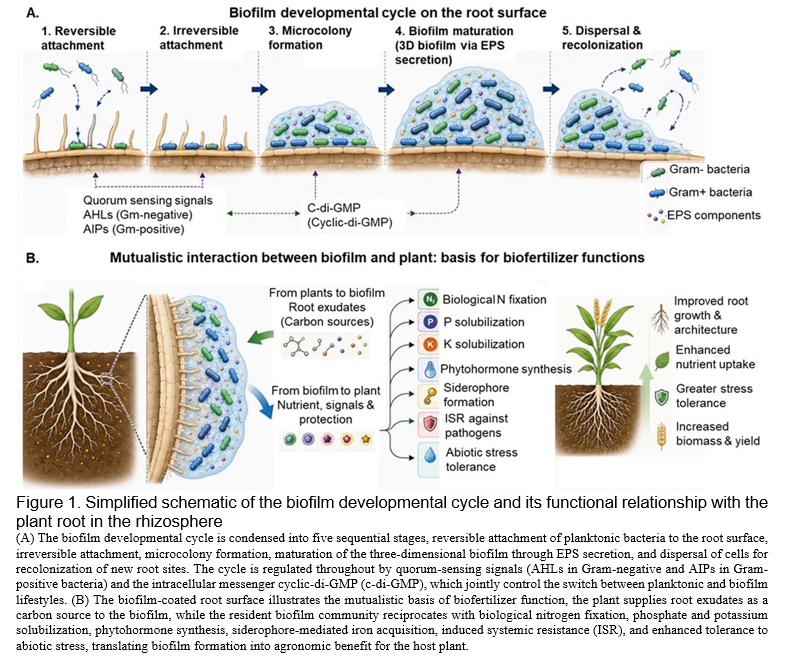
A critical regulatory mechanism governing biofilm formation is quorum sensing (QS), wherein bacteria communicate through diffusible signaling molecules — primarily N-acyl homoserine lactones (AHLs) in Gram-negative bacteria and autoinducing peptides (AIPs) in Gram-positive bacteria — that accumulate proportionally with cell density. Upon reaching threshold concentrations, QS signals trigger coordinated biofilm-related gene expression, including upregulation of EPS biosynthesis pathways, reduced flagella-mediated motility, and activation of secondary metabolite production (Xu et al., 2025). This cell-density-dependent regulation ensures that biofilm formation occurs under conditions favorable for community survival. The central role of c-di-GMP as an intracellular second messenger that promotes the sessile biofilm state while inhibiting the planktonic state has been well established in both Pseudomonas fluorescens and Bacillus subtilis, suggesting that modulation of c-di-GMP metabolism offers a promising strategy for optimizing biofilm yield in fermentation systems.
The biochemical composition and architecture of the EPS matrix vary substantially among biofilm-forming PGPR genera, reflecting divergent ecological strategies and evolutionary histories. In Bacillus subtilis, the EPS matrix consists principally of a complex exopolysaccharide encoded by the epsA-O operon and a secreted protein TasA, which together form a robust gel-like matrix that confers exceptional desiccation tolerance and root surface adhesion. In Pseudomonas aeruginosa and related fluorescent pseudomonads, the Pel, Psl, and alginate polysaccharides serve complementary structural and protective roles, with alginate being particularly associated with enhanced tolerance to oxidative stress. These genus-specific EPS characteristics directly influence the selection of appropriate fermentation and formulation strategies for each biofilm-forming PGPR, since EPS composition governs downstream processing parameters including viscosity, drying behavior, and carrier compatibility (Li et al., 2024; Sun et al., 2025).
Among biofilm-forming genera of agricultural significance, Bacillus, Pseudomonas, Rhizobium, Azospirillum, Azotobacter, and several cyanobacterial genera (Nostoc, Anabaena) stand out as the most well-characterized and widely applied (Bhattacharjee et al., 2020; Li et al., 2024). Bacillus velezensis SQR9 has been extensively studied as a model PGPR strain, with documented mechanisms including antimicrobial metabolite production, nitrogen uptake promotion, root architecture enhancement, and abiotic stress tolerance, all of which are facilitated by elaborate biofilm formation on root surfaces (Sun et al., 2025). The ecological resilience conferred by the EPS matrix is particularly relevant in agricultural contexts where microorganisms must survive desiccation, UV exposure, temperature fluctuations, and competitive pressure from established native microbiota (Table 1).
Table 1. Key biofilm-forming microorganisms used as biofertilizers
|
Microbial Genus/Species
|
PGP Mechanisms
|
Biofilm Features
|
Target Crop(s)
|
Key References
|
|
Bacillus velezensis / B. subtilis
|
Nitrogen fixation, IAA & gibberellin synthesis, phosphate solubilization, biocontrol
|
Robust EPS matrix; stable rhizosphere colonizer
|
Wheat, rice, maize, legumes
|
Sun et al., 2025; Rafique et al., 2024
|
|
Pseudomonas fluorescens / P. putida
|
Siderophore production, ACC deaminase, phosphate solubilization, ISR
|
Pellicle-forming; strong competitive rhizosphere colonizer
|
Vegetables, cereals, canola
|
Li et al., 2024; Ajijah et al., 2023
|
|
Rhizobium / Bradyrhizobium spp.
|
Symbiotic N2 fixation, phytohormone production
|
Biofilm facilitates root-hair attachment and nodule formation
|
Soybean, chickpea, alfalfa
|
Chaudhary et al., 2020; Ajijah et al., 2023
|
|
Azospirillum brasilense
|
N2 fixation, IAA production, root elongation
|
Aggregative biofilm; quorum sensing-regulated EPS
|
Rice, wheat, maize, sunflower
|
Li et al., 2024; Xu et al., 2025
|
|
Azotobacter chroococcum
|
Free-living N2 fixation, cyst formation, vitamin synthesis
|
Thick polysaccharide capsule protects against desiccation
|
Cotton, vegetables, cereals
|
Bhattacharjee et al., 2020; Chaudhary et al., 2020
|
|
Cyanobacteria (Anabaena, Nostoc)
|
N2 fixation, organic matter addition, EPS-mediated soil aggregation
|
Cyanobacterial-bacterial biofilm (CBB) enhances soil structure
|
Paddy rice, saline soils
|
Ajijah et al., 2023; Li et al., 2024
|
EPS = extracellular polymeric substances; IAA = indole-3-acetic acid; ACC = 1-aminocyclopropane-1-carboxylate; ISR = induced systemic resistance; CBB = cyanobacterial-bacterial biofilm; N2 = dinitrogen.
Multi-species biofilms, consisting of two or more microbial species, often outperform monoculture biofilms in agricultural applications. Within mixed-species communities, metabolic complementarity — such as the pairing of nitrogen-fixing cyanobacteria with phosphate-solubilizing bacteria — produces synergistic PGP effects that exceed the sum of individual contributions (Ajijah et al., 2023). Cyanobacterial-bacterial biofilm (CBB) systems, in which filamentous cyanobacteria provide structural scaffolding and nitrogenous inputs while associated heterotrophic bacteria contributes to phytohormones and phosphate solubilization, represent a particularly innovative multi-species formulation strategy with documented success in paddy rice systems (Bright et al., 2025).
Plant growth-promoting mechanisms of biofilm biofertilizers
Nutrient acquisition and cycling
Biological nitrogen fixation (BNF) represents the cornerstone PGP mechanism of free-living diazotrophs such as Azotobacter and Azospirillum, as well as symbiotic genera including Rhizobium and Bradyrhizobium. In the context of biofilms, the EPS matrix confers a microaerobic environment that protects the oxygen-sensitive nitrogenase complex from inactivation, thereby enhancing the efficiency of BNF compared to planktonic inoculants (Bhattacharjee et al., 2020; Li et al., 2024). This protective micro-niche effect is particularly significant in aerobic agricultural soils where dissolved oxygen concentrations would otherwise suppress nitrogenase activity in free-living diazotrophs. Quantitative studies using the acetylene reduction assay have demonstrated two- to threefold higher nitrogenase activity in biofilm-formulated Azospirillum brasilense compared to equivalent planktonic inoculants applied to wheat roots under controlled conditions (Rafique et al., 2024).
Phosphate solubilization is achieved through the exudation of organic acids (gluconic, oxalic, citric acids), proton release, and phosphatase enzyme activity. Potassium solubilization involves organic acid-mediated mineral weathering within the biofilm microenvironment, where the eDNA, lipids, and polysaccharide matrix facilitate sustained mineral contact and acid activity (Li et al., 2024). Zinc, iron, and silicon solubilization are additional nutrient mobilization functions documented in biofilm-forming PGPR, collectively enhancing the bioavailability of multiple essential micronutrients (Ajijah et al., 2023). The spatial confinement of organic acid-producing bacteria within the EPS matrix creates localized zones of reduced pH at the biofilm-soil interface that are considerably more acidic than the bulk soil pH, substantially enhancing the dissolution rate of sparingly soluble mineral phosphates such as rock phosphate, hydroxyapatite, and iron and aluminium phosphates (Taktek et al., 2017).
Phytohormone synthesis and stress mitigation
Biofilm-forming PGPR synthesizes a suite of phytohormones that directly modulate plant development. Indole-3-acetic acid (IAA), the most abundantly produced auxin, promotes lateral root proliferation, thereby increasing the root surface area available for nutrient and water absorption. Gibberellins stimulate shoot elongation and seed germination, while cytokinins delay leaf senescence and promote cell division in apical meristems. Of particular significance is the enzyme ACC (1-aminocyclopropane-1-carboxylate) deaminase, which cleaves the ethylene precursor ACC, reducing stress-induced ethylene levels in plants exposed to salinity, drought, and heavy metal contamination (Basu et al., 2021; Li et al., 2024). Within biofilms, the stable EPS-embedded community ensures the continuous delivery of these hormones to the rhizosphere over extended periods, unlike free-living inoculants, whose viability rapidly diminishes under field stress.
Volatile organic compounds (VOCs) produced by biofilm-forming PGPR represent an increasingly recognized class of plant growth regulators. 2,3-Butanediol and acetoin, produced by Bacillus and Pseudomonas species, trigger induced systemic tolerance (IST) to drought and salinity in Arabidopsis and crop plants, with biofilm-associated production rates consistently exceeding those of planktonic cultures owing to the close cell proximity and metabolic cooperation facilitated by the EPS matrix environment (Wu et al., 2018; Laller et al., 2023). Additionally, gamma-aminobutyric acid (GABA), tryptophan derivatives, and polyamines produced within the biofilm milieu have been shown to contribute to plant tolerance to abiotic stresses. These VOC-mediated plant-microbe interactions operate across relatively long distances through the soil gas phase, suggesting that the rhizosphere influence of biofilm biofertilizers extends beyond the immediate zone of root colonization (Figure 2).
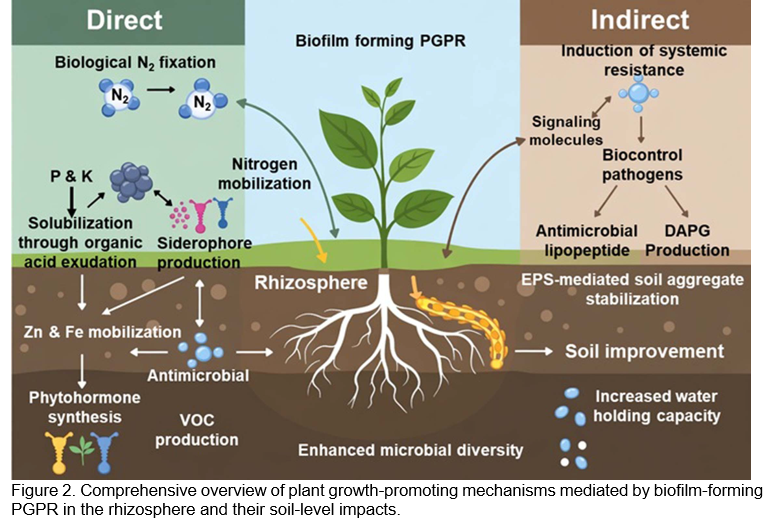
Direct mechanisms include biological nitrogen fixation (BNF), phosphate (P) and potassium (K) solubilization through organic acid exudation, zinc (Zn) and iron (Fe) mobilization via siderophore production, phytohormone synthesis (IAA, gibberellins, cytokinins, ACC deaminase activity), and volatile organic compound (VOC: 2,3-butanediol, acetoin) production. Indirect mechanisms include induction of systemic resistance (ISR) via jasmonate/ethylene signalling, biocontrol through antimicrobial lipopeptide and DAPG production, and EPS-mediated soil aggregate stabilization associated improvements in water-holding capacity, organic matter content, and soil microbial diversity.
Biocontrol and induced systemic resistance
An important indirect PGP mechanism is the suppression of soilborne phytopathogens through the production of bioactive secondary metabolites. Biofilm-forming Bacillus species produce lipopeptides such as iturin, surfactin, and fengycin, which disrupt fungal and oomycete cell membranes, suppressing root pathogens including Fusarium oxysporum, Rhizoctonia solani, and Pythium ultimum. Pseudomonas biofilms produce hydrogen cyanide (HCN), 2,4-diacetylphloroglucinol (DAPG), and siderophores that sequester iron, limiting pathogen proliferation in the rhizosphere (Wang et al., 2021). Furthermore, biofilm colonization of root surfaces triggers induced systemic resistance (ISR) in host plants, priming the plant immune system against a broad spectrum of pathogens and herbivores without directly activating costly metabolic defenses. This priming state, mediated by jasmonic acid and ethylene signaling pathways, provides systemic protection throughout the plant canopy from a localized rhizosphere inoculant, delivering a disproportionately large return on the metabolic investment of biofilm-mediated root colonization (Ajijah et al., 2023; Sun et al., 2025).
From laboratory development to pilot-scale production
Strain selection and laboratory characterization
The development of an effective biofilm biofertilizer begins with the rigorous screening of candidate microbial strains. Primary screening involves the isolation of rhizosphere-competent bacteria from the target crop's native soil environment, followed by in vitro assays for biofilm-forming capacity (crystal violet microtiter plate assay, confocal laser scanning microscopy), EPS production (carbazole-sulphuric acid and Congo red assays), and key PGP traits including IAA synthesis, phosphate solubilization index, nitrogen fixation (acetylene reduction assay), and siderophore production (chrome azurol S assay) (Rafique et al., 2024). Secondary screening under axenic conditions evaluates compatibility with target crop seeds and competitive fitness against native soil microbiota.
Genomic and metagenomic tools have substantially accelerated strain development. Whole-genome sequencing enables the identification of gene clusters encoding EPS biosynthesis (epsA-O operons in Bacillus; pel, psl, alg operons in Pseudomonas), nitrogen fixation (nif, vnf gene clusters), and secondary metabolite production, allowing researchers to predict and verify functional capabilities before greenhouse and field evaluation (Ajijah et al., 2023). Proteomics and metabolomics of biofilm versus planktonic states reveal the differential regulation of PGP pathways, identifying candidate genes for synthetic biology-based enhancement. The application of comparative genomics across multiple rhizosphere PGPR strains has identified conserved 'core' PGP gene sets alongside 'accessory' trait clusters that confer ecological specificity, enabling informed strain selection for target crop-soil combinations.
Greenhouse and controlled environment evaluation represents the critical bridge between in vitro characterization and field performance assessment. In pot trials conducted under controlled temperature and photoperiod conditions, biofilm-inoculated seedlings are compared against planktonic inoculant controls and uninoculated treatments for a suite of growth parameters, including root morphology indices (total root length, root surface area, root tip density), shoot biomass, chlorophyll content (SPAD index), and tissue nutrient concentrations. These data, when integrated with rhizosphere microbiome profiling by 16S rRNA amplicon sequencing, provide a mechanistic understanding of inoculant establishment dynamics that informs subsequent fermentation and formulation optimization (Rafique et al., 2024; Xu et al., 2025).
Medium optimization and laboratory fermentation
Optimal biomass and EPS production at the laboratory scale requires careful formulation of the medium. Carbon-to-nitrogen (C:N) ratio is a particularly critical parameter: low C:N ratios favor cell aggregation and EPS production in species such as Azospirillum brasilense, while higher C:N ratios generally promote planktonic growth (Burdman et al., 2000). Cost-effective medium components, including starchy agricultural waste substrates (potato mash, rice starch effluent, molasses), have been validated as suitable carbon sources for biofilm-forming PGPR in batch and fed-batch fermentation at volumes up to 10 L, achieving high biomass yields while minimizing production costs. Physicochemical parameters, including temperature (25–35°C), pH (6.5–7.5), dissolved oxygen tension, and agitation speed, must be individually optimized for each strain to maximize biofilm biomass without disrupting EPS integrity (Ajijah et al., 2023; Li et al., 2024). Response surface methodology (RSM), particularly using central composite design (CCD), has proven highly effective for simultaneous optimization of multiple fermentation parameters, identifying critical interactions between medium components (e.g., carbon/nitrogen sources) and culture conditions (e.g., pH, temperature) that univariate approaches overlook (Chen et al., 2022; Li et al., 2024).
Carrier material selection and formulation
The carrier material is the medium in which the biofilm-forming inoculant is embedded for storage, transport, and field application. An ideal carrier must be non-toxic to the microbial inoculant, possess high water-holding capacity, exhibit adequate pH buffering, support high viable cell density over the product shelf life, and be economically accessible for commercial production. Traditional carriers, including peat, lignite, and wood charcoal, have been extensively used; however, carrier-based formulations suffer from high contamination rates and rapid microbial population decline during storage — particularly beyond three to four months — especially under ambient tropical temperatures (Chaudhary et al., 2020; Das and Kim, 2024). The acidic nature of peat also necessitates neutralization with calcium carbonate before use, adding a processing step that can introduce variability in product quality.
Advanced carrier materials, including biochar, vermiculite, alginate beads, and biopolymer-based matrices, offer superior performance. Biochar derived from pyrolysis of agricultural residues (rice husk, sugarcane bagasse, coconut shell) has emerged as a particularly promising carrier owing to its porous structure that provides attachment sites for biofilm formation, its high cation exchange capacity that retains nutrients near the inoculant, and its capacity to persist in soil and improve soil physical properties even after microbial population decline (Ajeng et al., 2020; Fadiji et al., 2024). Microencapsulation technologies — in which biofilm biomass is encapsulated within alginate, chitosan, or cellulose nanofibre shells — protect the integrity of the EPS matrix during drying and storage, significantly extending shelf life. Nano-immobilization approaches, wherein PGPR biofilms are immobilized on nano-silica, nano-clay, or nano-hydroxyapatite supports, have demonstrated enhanced cell viability and improved nutrient release profiles compared to conventional carriers (Fadiji et al., 2024). Liquid formulations incorporating cell protectants such as glycerol, trehalose, and methylcellulose provide higher viable counts and greater consistency over six to twelve months, representing a significant advantage over carrier-based products in tropical storage contexts (Sharma et al., 2022).
Industrial mass-scale production
Bioreactor design and scale-up challenges
The transition from laboratory-scale flasks to industrial bioreactor systems introduces unique, often underappreciated challenges for biofilm-forming microorganisms. Conventional stirred-tank bioreactors (STRs), while widely used for liquid fermentation of planktonic cultures, generate hydrodynamic shear forces that disrupt the EPS matrix and dissociate the three-dimensional biofilm architecture, reducing both the viability and PGP functionality of the final product. The rheological complexity introduced by high-EPS biofilm cultures — including non-Newtonian flow behavior, elevated viscosity, and tendency toward impeller fouling — further complicates operational management of STRs at production volumes exceeding 1,000 L. Alternative bioreactor configurations, including fixed-bed biofilm reactors, fluidized-bed reactors, and rotating biological contactors (RBCs), are more appropriate for maintaining biofilm structural integrity at large scale, providing solid support surfaces for biofilm attachment while allowing controlled nutrient and oxygen delivery to the biofilm community (Oguntomi et al., 2025; Tang, 2026).
Fed-batch fermentation strategies have proven superior to batch processes for high-density biofilm biomass production, enabling incremental substrate feeding that maintains optimal C:N ratios and dissolved oxygen concentrations throughout the culture period while avoiding substrate inhibition. In a study, Bacillus subtilis CW-S was mass-produced as a commercial plant probiotic/biofertilizer through submerged fermentation using molasses and urea as low-cost substrates, with production optimized via Plackett–Burman and Central Composite Design approaches. Parameters validated at pilot (300 L) and industrial (3000 L) bioreactor scales yielded over 2.0 × 10⁹ CFU/mL, demonstrating successful scale-up for cost-effective biofilm-forming biofertilizer manufacturing (Abuhena et al., 2022).
Downstream processing and formulation at an industrial scale
Downstream processing of biofilm biomass encompasses harvesting (centrifugation or membrane filtration), concentration, stabilization, and formulation into commercially viable delivery formats. The high EPS content of biofilm cultures substantially increases the viscosity of harvest streams, necessitating specialized centrifuge and membrane filter designs capable of processing non-Newtonian fluids without compromising cell integrity. Spray drying, freeze-drying (lyophilization), and fluid-bed drying are the primary techniques employed to produce shelf-stable powder or granular formulations. Freeze-drying best preserves cell viability and EPS integrity but is costly and technically demanding at large scale, limiting its application to high-value specialty biofertilizer products. Spray drying, while cost-effective, exposes cells to thermal stress and atomization-induced shear, necessitating the incorporation of thermoprotectants (skim milk powder, trehalose, polyvinyl pyrrolidone) in the drying medium to maintain viability above the minimum threshold of 108 CFU/g required for regulatory compliance (Fadiji et al., 2024).
Industrial formulation types for biofilm biofertilizers include wettable powders (WP), soluble granules (SG), seed-coating slurries, and liquid suspension concentrates (SC). Seed coating with biofilm-forming PGPR is particularly advantageous, as it ensures immediate contact between the inoculant and the germinating root, facilitating early rhizosphere colonization before competitive exclusion by native soil microbiota. The incorporation of adhesive agents (carboxymethylcellulose, gum arabic, polyvinyl alcohol) into seed-coating formulations ensures uniform EPS-protected bacterial coverage of the seed surface while protecting cells from interactions with seed treatment pesticides. Quality control at the industrial scale mandates routine testing of viable cell count (minimum 108 CFU/g or CFU/mL), contamination assessment (absence of coliforms and Salmonella spp.), moisture content, pH stability, particle size distribution, and EPS bioassay at defined intervals throughout the product shelf life. The emerging application of flow cytometry and qPCR-based viability assays as rapid quality control tools offers significant time savings over conventional plate count methods, potentially accelerating both batch release decisions and product development cycles (Fadiji et al., 2024; Oguntomi et al., 2025; Tang 2026). A comparative evaluation of the major biofilm biofertilizer formulations based on essential production and performance metrics is presented in Table 2.
Table 2. A comparative evaluation of the major biofilm biofertilizer formulations based on key production and performance metrics
|
Parameter
|
Carrier-Based (Peat/Lignite)
|
Liquid Formulation
|
Biofilm-Encapsulated Granule
|
|
Viable cell count (CFU/g or mL)
|
≥ 107-108 CFU/g
|
≥ 108–109 CFU/mL
|
≥ 108–1010 CFU/g
|
|
Shelf life (at ambient temp.)
|
3–6 months
|
6–12 months
|
12–24 months (projected)
|
|
Contamination risk
|
High (open-carrier matrix)
|
Moderate
|
Low (EPS barrier)
|
|
Stress resilience of cells
|
Low (planktonic cells)
|
Moderate (with protectants)
|
High (biofilm EPS matrix)
|
|
Production scalability
|
Easy; low-cost infrastructure
|
Moderate; bioreactor required
|
Complex; multi-stage fermentation
|
|
Field performance consistency
|
Highly variable
|
Moderate
|
Potentially superior; less data available
|
|
Cost of production
|
Low
|
Moderate
|
Currently high; decreasing with R&D
|
Agricultural importance and field performance
The agronomic value of biofilm biofertilizers has been demonstrated across a wide range of crop systems and soil environments. Biofilm-forming PGPR applied to wheat (Triticum aestivum) under field conditions significantly increased grain yield, thousand-grain weight, and root biomass compared to unformulated PGPR and uninoculated controls, with the superior performance attributed to enhanced root colonization efficiency conferred by biofilm EPS (Rafique et al., 2024). In rice paddy systems, cyanobacterial-bacterial biofilm applications improved soil dehydrogenase activity — an indicator of soil biological health — and increased seedling vigour by augmenting available nitrogen and organic carbon inputs (Basu et al., 2021). Legume inoculation with Rhizobium biofilm formulations has consistently yielded higher nodule occupancy rates, nodule fresh weight, and nitrogen fixation per plant than planktonic Rhizobium suspensions, reflecting the importance of structured root-surface colonization in establishing effective symbiosis (Oguntomi et al., 2025).
At the soil ecosystem level, repeated applications of biofilm biofertilizers have been associated with measurable improvements in aggregate stability, water-holding capacity, and organic matter content, mediated by EPS-induced soil particle bridging and carbon input from microbial biomass turnover (Kumar et al., 2022). The polysaccharide components of bacterial EPS, particularly those enriched in uronic acids and neutral sugars, act as biological glues that bind mineral particles and organic matter fragments into water-stable macro-aggregates, improving soil aeration, infiltration, and resistance to erosion (Costa et al., 2018). A meta-analysis of biofertilizer field trials across cereal and legume crops estimated an average yield increase of 5–20% associated with PGPR inoculants, with biofilm formulations consistently outperforming planktonic counterparts in comparative studies (Schütz et al., 2018). From a sustainability perspective, partial substitution of synthetic nitrogen fertilizer with biofilm biofertilizers — even at 20–30% replacement rates — can meaningfully reduce greenhouse gas emissions and eutrophication potential, contributing to nationally determined contributions under the Paris Agreement climate framework (Shah et al., 2021).
In stress-prone environments, the advantage of biofilm biofertilizers over conventional inoculants is especially pronounced. Under salinity stress, biofilm-EPS acts as an extracellular ion buffer, adsorbing sodium ions within the polysaccharide matrix and reducing the osmotic and ionic burden on both bacterial cells and plant roots, enabling continued PGP activity in saline soils where planktonic inoculants typically fail to survive beyond the first few week’s post-application. Similarly, under drought conditions, the hygroscopic polysaccharide matrix retains water in the immediate vicinity of bacterial cells and plant roots, improving root-soil hydraulic contact and water use efficiency (Li et al., 2024). Heavy metal-contaminated soils present another domain where biofilm biofertilizers demonstrate marked advantage: the EPS matrix immobilizes heavy metal cations (Cd2+, Pb2+, Cr6+) through ion exchange and complexation reactions, reducing phytotoxic metal concentrations in the rhizosphere while simultaneously delivering PGP benefits to plants growing in contaminated substrates (Li et al., 2024). These multi-stress resilience attributes position biofilm biofertilizers as strategically important tools for climate-resilient agriculture in tropical and semi-arid regions, including the Indian subcontinent, where erratic monsoon rainfall, increasing soil salinity through irrigation with saline groundwater, and expanding heavy metal contamination from industrial activities represent compounding production constraints.
The economics of biofilm biofertilizer adoption represent an important dimension of their agricultural importance. Although the current retail price of biofilm-based formulations is higher than that of conventional biofertilizers owing to more complex production processes, the higher application efficacy and extended shelf life reduce the effective cost per unit of agronomic output. Farm-level economic analyses conducted in South Asia and sub-Saharan Africa have demonstrated that partial replacement of urea nitrogen with PGPR biofertilizers, even accounting for a price premium for biofilm formulations, reduces net fertilization cost per ton of grain when yield improvements of 10% or greater are reliably achieved (Raimi et al., 2021). As production volumes increase and process efficiencies improve with scale, the cost differential between biofilm and planktonic biofertilizer formulations is expected to narrow substantially over the coming decade.
Challenges and limitations
Despite their considerable promise, biofilm-based biofertilizers face a spectrum of biological, technological, regulatory, and socioeconomic challenges that constrain their mass adoption. Understanding these limitations in their mechanistic depth is essential for designing targeted research and development investments capable of delivering commercially viable products at the scale required to influence global agricultural practice.
At the biological level, the survival and activity of introduced biofilm-forming PGPR in the soil are subject to intense competitive exclusion by native rhizosphere microbiota that are better adapted to local edaphic conditions (Oguntomi et al., 2025). Even when introduced at high inoculation doses, exogenous PGPR populations typically decline by 1 to 3 orders of magnitude within the first 2 to 4 weeks post-application, with only a subset of inoculated cells persisting and establishing functionally active rhizosphere populations throughout the crop growing season. Genetic drift and phenotypic mutations during prolonged industrial fermentation can alter the expression of the PGP trait in originally characterized strains, necessitating regular genetic authentication of production cultures using multilocus sequence typing or whole-genome SNP comparisons. Furthermore, the physical disruption of EPS matrices during the drying and granulation steps of industrial formulation remains a persistent challenge, as biofilm structural integrity is critical to the superior field performance that distinguishes these products from conventional bioinoculants (Laller et al., 2023; Fadiji et al., 2024; Li et al., 2024). The loss of EPS matrix organization during processing effectively converts biofilm-formulated cells into planktonic cells delivered in a granular carrier — a formulation that confers no meaningful advantage over standard biofertilizer products.
At the production technology level, maintaining a stable, functionally active biofilm community in large-scale bioreactors is considerably more complex than producing planktonic cultures of equivalent biomass density. Shear stress in STRs, oxygen gradient formation in deep fixed-bed reactors, and difficulties in harvesting highly viscous biofilm biomass present significant engineering obstacles that require purpose-built equipment not available in conventional fermentation facilities designed for antibiotic or enzyme production. Contamination management is also more challenging in biofilm fermentations, as contaminating organisms that establish biofilm within the reactor are substantially more resistant to clean-in-place (CIP) procedures than planktonic contaminants (Fadiji et al., 2024; Oguntomi et al., 2025). The cost of multi-stage biofilm fermentation currently exceeds that of conventional biofertilizer production by a factor of two to three, presenting a significant barrier to competitive pricing relative to both chemical fertilizers and standard bioinoculants in price-sensitive developing country markets (Fadiji et al., 2024).
Regulatory inconsistency represents perhaps the most significant long-term commercial barrier. Quality standards for biofertilizers — including minimum viable cell counts, acceptable contaminant thresholds, shelf-life criteria, and claims permitted on product labels — vary substantially across national jurisdictions (Basu et al., 2021; Kumar et al., 2022). In India, biofertilizers are regulated under the Fertilizers (Control) Order (FCO), which specifies minimum viable counts, permitted carrier materials, and labelling requirements. However, these specifications were designed for conventional peat-based or liquid planktonic biofertilizers and do not adequately address the unique quality attributes of biofilm-encapsulated products, such as EPS content, biofilm architecture integrity, and stability of consortium composition. The absence of a specific international regulatory category for biofilm-based bioinoculants further complicates the approval process for novel products, forcing manufacturers to navigate complex and time-consuming registration procedures in each target market. Farmer-level constraints, including limited awareness of proper application timing, dosing, and storage requirements, together with the incompatibility of biofilm inoculants with commonly co-applied fungicide seed treatments, further diminish the realized agronomic benefit even when technically sound products successfully reach the marketplace (Basu et al., 2021; Fadiji et al., 2024). An overview of the main challenges associated with the development of biofilm biofertilizers, along with the relevant mitigation strategies, is provided in Table 3.
Table 3. Summary of principal challenges in biofilm biofertilizer development and corresponding mitigation strategies
|
Challenge
|
Underlying cause
|
Proposed strategy
|
|
Maintaining biofilm viability post-drying
|
EPS disruption during spray/freeze-drying
|
Cryoprotectant addition; lyophilization optimization; microencapsulation
|
|
Inconsistent field performance
|
Soil pH, temperature, microbiome competition variability
|
Soil-specific consortium design; omics-assisted strain matching
|
|
Scale-up bioreactor design
|
Shear stress disrupts biofilm architecture in stirred-tank reactors
|
Fixed-bed / rotating biological contactor bioreactors; low-shear fermentation
|
|
Regulatory fragmentation
|
No unified international quality standards for biofilm-based products
|
Harmonized FAO/WHO-aligned regulatory frameworks; certification bodies
|
|
Short shelf life in warm climates
|
High ambient temperature degrades microbial viability
|
Nano-encapsulation; thermoprotectant EPS engineering; cold-chain improvement
|
|
High production cost
|
Multi-stage biofilm fermentation is capital-intensive
|
Waste-substrate fermentation; public-private partnerships; automation
|
Emerging strategies and future prospects
The development of biofilm biofertilizers is increasingly driven by advances in synthetic biology, nanotechnology, artificial intelligence, and systems microbiology, offering pathways to overcome current limitations and enable reliable field-scale applications.
Synthetic biology enables targeted enhancement of biofilm formation and PGP functions through genome-editing approaches, such as CRISPR-Cas9. Engineering traits related to EPS production, stress tolerance, and regulatory pathways improve strain robustness and functional performance. In parallel, synthetic microbial consortia composed of complementary PGPR strains provide synergistic benefits, including enhanced nitrogen fixation, phosphorus solubilization, and biocontrol (Xu et al., 2025). Integration of systems genomics with machine learning further enables predictive selection of microbial consortia tailored to specific crops and environments, marking a shift from empirical to data-driven inoculant design.
Nanotechnology offers complementary advances in formulation and delivery. Nano-encapsulation using biopolymers such as alginate and chitosan enhances cell survival during processing and storage, extending shelf life under ambient conditions. Nanomaterial-based carriers improve viability retention and enable controlled microbial release in soils, enhancing rhizosphere colonization efficiency. Additionally, certain nanoparticles can stimulate biofilm formation and EPS production, potentially improving fermentation yields (Das and Kim 2023; Fernandes et al., 2026).
Advances in precision fermentation and digital technologies are improving the scalability of production. Automated bioreactors equipped with process analytical tools (PAT) and AI-driven optimization enable real-time control of fermentation conditions, reducing variability and costs. Digital twin models further facilitate virtual process optimization (Bright et al., 2025). The use of agro-industrial waste streams as fermentation substrates supports cost reduction while aligning production with circular bioeconomy principles (Das and Kim 2024), with life cycle assessments indicating substantial reductions in energy use and emissions compared to conventional fertilizers (Styles et al., 2018).
Integration with precision agriculture represents a key future direction. Sensor-based soil monitoring and drone-assisted applications can enable spatially targeted delivery of biofilm biofertilizers. Coupled with predictive models of microbiome dynamics, these approaches could support decision systems that optimize inoculant selection, timing, and application rates (Ambaru et al., 2025).
Finally, supportive policy frameworks are essential for scaling. Establishing quality standards for biofilm-based inoculants, updating regulatory systems, and strengthening public–private partnerships will be critical to accelerate adoption and ensure consistent product performance.
CONCLUSION
Biofilm-based biofertilizers represent a significant evolutionary advance over conventional planktonic bioinoculants, offering superior rhizosphere persistence, multi-functional plant growth-promoting activity, and enhanced resilience to environmental stresses that routinely undermine the performance of standard biofertilizer products. The scientific foundations underpinning biofilm-mediated plant-microbe interactions are now robust, with well-characterized EPS matrix functions, quorum sensing regulation, c-di-GMP signaling, and root colonization mechanisms providing a solid basis for rational product development. Laboratory-to-pilot-scale production has been demonstrated for several key genera including Bacillus, Pseudomonas, Azospirillum, Azotobacter, Rhizobium, and cyanobacterial-bacterial consortia, affirming technical feasibility across a range of bioreactor configurations and formulation platforms.
Notwithstanding this progress, substantial challenges remain in scaling biofilm formulations to cost-competitive industrial volumes, maintaining product viability and EPS integrity through downstream processing, achieving consistent field performance across heterogeneous soils and climatic zones, and navigating fragmented international regulatory frameworks that were not designed with biofilm-based products in mind. The convergence of synthetic biology for strain improvement, nanotechnology for formulation enhancement, precision fermentation for scalable manufacturing, and AI-driven agronomic decision support offers well-defined and increasingly accessible pathways to address each of these constraints. Realizing the full commercial and environmental potential of biofilm biofertilizers will ultimately require sustained interdisciplinary collaboration among molecular microbiologists, agricultural engineers, soil scientists, regulatory specialists, and policymakers, supported by coherent public-private investment frameworks that bridge the enduring translation gap between laboratory discovery and large-scale agronomic deployment.
REFERENCES
Abuhena, M., Al-Rashid, J., Azim, M.F., Khan, M.N.M., Kabir, M.G., Barman, N.C., Rasul, N.M., Akter, S. and Huq, M.A., 2022. Optimization of industrial (3000 L) production of Bacillus subtilis CW-S and its novel application for minituber and industrial-grade potato cultivation. Sci. Rep. 12: 11153.
Ajeng, A.A., Abdullah, R., Ling, T.C., Ismail, S., Lau, B.F., Ong, H.C., Chew, K.W., Show, P.L. and Chang, J.S., 2020. Bioformulation of biochar as a potential inoculant carrier for sustainable agriculture. Environ. Technol. Innov. 20:101168.
Ajijah, N., Fiodor, A., Pandey, A.K., Rana, A. and Pranaw, K., 2023. Plant growth-promoting bacteria (PGPB) with biofilm-forming ability: a multifaceted agent for sustainable agriculture. :112.
Ambaru, B., Manvitha, R. and Madas, R., 2025. Synergistic integration of remote sensing and soil metagenomics data: advancing precision agriculture through interdisciplinary approaches. Front. Sustain. Food Syst. 8:1499973.
Basu, A., Prasad, P., Das, S.N., Kalam, S., Sayyed, R.Z., Reddy, M.S. and El Enshasy, H., 2021. Plant growth promoting rhizobacteria (PGPR) as green bioinoculants: recent developments, constraints, and prospects. :1140.
Bhattacharjee, R.B., Singh, A. and Mukhopadhyay, S.N., 2008. Use of nitrogen-fixing bacteria as biofertiliser for non-legumes: prospects and challenges. :199-209.
Bright, J.P., Maheshwari, H.S., Thangappan, S., Perveen, K., Bukhari, N.A., Mitra, D., Sayyed, R. and Mastinu, A., 2025. Biofilmed-PGPR: next-generation bioinoculant for plant growth promotion in rice under changing climate. Rice Sci. 32:94-106.
Burdman, S., Jurkevitch, E., Soria-Díaz, M.E., Serrano, A.M.G. and Okon, Y., 2000. Extracellular polysaccharide composition of Azospirillum brasilense and its relation with cell aggregation. :259-264.
Chaudhary, T., Dixit, M., Gera, R., Shukla, A.K., Prakash, A., Gupta, G. and Shukla, P., 2020. Techniques for improving formulations of bioinoculants. :199.
Chen, J., Lan, X., Jia, R., Hu, L. and Wang, Y., 2022. Response surface methodology (RSM) mediated optimization of medium components for mycelial growth and metabolites production of Streptomyces alfalfae XN-04. :1854.
Costa, O.Y., Raaijmakers, J.M. and Kuramae, E.E., 2018. Microbial extracellular polymeric substances: ecological function and impact on soil aggregation. Front Microbiol 9:1636.
Das, S., Kim, P.J. 2023. Nano-biofertilizer for sustainable agriculture. Asia-Pacific Biofertilizers and Biopesticides Information Platform (APBB).
DOI: https://doi.org/10.56669/CDMA8114
Das, S., Kim, P.J., 2024. Biofertilizers from Agro-wastes: A Path towards sustainable agriculture. Asia-Pacific Biofertilizers and Biopesticides Information Platform (APBB).
DOI: https://doi.org/10.56669/RCPX9405
Fadiji, A.E., Xiong, C., Egidi, E. and Singh, B.K., 2024. Formulation challenges associated with microbial biofertilizers in sustainable agriculture and paths forward. J. Sustain. Agric. Environ. 3:e70006.
FAO (2025) Better land, soil and water management key to feeding 10 billion people, FAO warns. Food and Agriculture Organization of United Nations. https://www.fao.org/newsroom/detail/better-land--soil-and-water-management-key-to-feeding-10-billion-people--fao-warns/en
Fernandes, S. and Sharma, P., 2026. Advancements in nano-biofertilizer formulation: Potential significance for sustainable agriculture. J. Soil Sci. Plant Nutrition 26:1977-1995.
Grand View Research (2026). Biofertilizers Market (2025 – 2030). https://www.grandviewresearch.com/industry-analysis/biofertilizers-industry
Kumar, S., Sindhu, S.S. and Kumar, R., 2022. Biofertilizers: An ecofriendly technology for nutrient recycling and environmental sustainability. Curr. Res. Microb. Sci. 3:100094.
Laller, R., Khosla, P.K., Negi, N., Avinash, H., Thakur, N., Kashyap, S., Shukla, S.K. and Hussain, I., 2023. Bacterial volatiles as PGPRs: inducing plant defense mechanisms during stress periods. S. Afr. J. Bot. 159:131-139.
Li, Y., Narayanan, M., Shi, X., Chen, X., Li, Z. and Ma, Y., 2024. Biofilms formation in plant growth-promoting bacteria for alleviating agro-environmental stress. :167774.
Oguntomi, S.O., Mattedi, A., Marin, E., Beyenal, H. and Marsili, E., 2025. Biofilms at work: what limits efficient consortia for industrial production? Trends Biotechnol.
DOI: 10.1016/j.tibtech.2025.11.024
Rafique, M., Naveed, M., Mumtaz, M.Z., Niaz, A., Alamri, S., Siddiqui, M.H., Waheed, M.Q., Ali, Z., Naman, A., Rehman, S.U. and Brtnicky, M., 2024. Unlocking the potential of biofilm-forming plant growth-promoting rhizobacteria for growth and yield enhancement in wheat (Triticum aestivum L.). :15546.
Raimi, A., Roopnarain, A. and Adeleke, R., 2021. Biofertilizer production in Africa: Current status, factors impeding adoption and strategies for success. Sci. Afr.11:.e00694.
Schütz, L., Gattinger, A., Meier, M., Müller, A., Boller, T., Mäder, P. and Mathimaran, N., 2018. Improving crop yield and nutrient use efficiency via biofertilization—A global meta-analysis. Front. Plant Sci. 8:2204.
Shah, A., Nazari, M., Antar, M., Msimbira, L.A., Naamala, J., Lyu, D., Rabileh, M., Zajonc, J. and Smith, D.L., 2021. PGPR in agriculture: A sustainable approach to increasing climate change resilience. Front. Sustain. Food Syst. 5:667546.
Sharma, A., Kaushik, N., Sharma, A. and Djébali, N., 2022. Development of novel liquid formulation of Bacillus siamensis with antifungal and plant growth promoting activity. ACS Agric. Sci. Technol. 3:55-66.
Styles, D., Adams, P., Thelin, G., Vaneeckhaute, C., Chadwick, D. and Withers, P.J., 2018. Life cycle assessment of biofertilizer production and use compared with conventional liquid digestate management. Environ. Sci. Technol. 52:7468-7476.
Sun, X., Xu, Z., Zhang, N., Liu, Y., Xun, W., Miao, Y., Shao, J., Zhang, R. and Shen, Q., 2025. Bacillus velezensis SQR9: A model biofertilizer strain for beneficial plant root-rhizobacterium interaction. 69:11165-1176.
Taktek, S., St-Arnaud, M., Piché, Y., Fortin, J.A. and Antoun, H., 2017. Igneous phosphate rock solubilization by biofilm-forming mycorrhizobacteria and hyphobacteria associated with Rhizoglomus irregulare DAOM 197198. :13-22.
Tang, K.H.D., 2026. Engineering biofilm: a review of latest advances for environmental applications. Environ. Rev. 34:1-25.
Wang, H., Liu, R., You, M.P., Barbetti, M.J. and Chen, Y., 2021. Pathogen biocontrol using plant growth-promoting bacteria (PGPR): Role of bacterial diversity. Microorganisms 9:1988.
Wu, L., Li, X., Ma, L., Borriss, R., Wu, Z. and Gao, X., 2018. Acetoin and 2, 3-butanediol from Bacillus amyloliquefaciens induce stomatal closure in Arabidopsis thaliana and Nicotiana benthamiana. J. Exp. Bot. 69:5625-5635.
Xu, X., Dinesen, C., Pioppi, A., Kovács, Á.T. and Lozano-Andrade, C.N., 2025. Composing a microbial symphony: synthetic communities for promoting plant growth. .
Zhang, X., Davidson, E.A., Mauzerall, D.L., Searchinger, T.D., Dumas, P. and Shen, Y., 2015. Managing nitrogen for sustainable development. :51-59.

Biofilm-Based Biofertilizers: From Laboratory Development to Mass-Scale Production — Mechanisms, Challenges, and Future Prospects
ABSTRACT
The unsustainable reliance on synthetic chemical fertilizers has driven widespread soil degradation, water contamination, and greenhouse gas emissions, necessitating the development of ecologically sound alternatives. Biofilm-based biofertilizer, comprising beneficial plant growth-promoting microorganisms encapsulated within self-produced extracellular polymeric substances (EPS), represents a transformative next-generation approach in sustainable agriculture. Unlike conventional planktonic bio-inoculants, biofilm-forming bacteria and cyanobacteria exhibit markedly superior resilience to environmental stresses, enhanced root colonization efficiency, and amplified plant-growth promoting activity through mechanisms including biological nitrogen fixation, phosphate and potassium solubilization, phytohormone synthesis, siderophore production, and induction of systematic resistance. This review critically examines the continuum from laboratory-scale strain development and biofilm characterization to pilot-scale bioreactor optimization and industrial mass production, encompassing carrier material selection, formulation strategies, and quality control parameters. Key limitations, including scalability constraints, inconsistent field performance, short shelf life in tropical climates, and fragmented regulatory landscapes, are systematically evaluated alongside emerging solutions. The integration of nanotechnology, synthetic microbial consortia, omic-guided strain improvement, and precision fermentation offers a credible pathway to bridge the translational gap between bench innovation and commercial deployment.
Keywords: Biofilm biofertilizer; plant growth-promoting rhizobacteria; extracellular polymeric substances; sustainable agriculture; microbial inoculant; rhizosphere colonization
INTRODUCTION
Global food security faces mounting pressure as the world population is projected to exceed 9.7 billion by 2050, demanding a substantial increase in agricultural productivity (FAO, 2025). For several decades, this demand has been met primarily through the intensive application of synthetic nitrogen, phosphorus, and potassium fertilizers. However, this dependence has exacted severe ecological tolls: progressive depletion of soil organic matter, disruption of native soil microbial communities, nitrate leaching into freshwater systems, and significant contributions to nitrous oxide—a potent greenhouse gas (Zhang et al., 2015). The Haber-Bosch process, which accounts for the majority of nitrogen fertilizer consumed globally, alone consumes approximately 1–2% of global energy and releases substantial quantities of carbon dioxide. Consequently, the global scientific and policy communities have converged on the imperative to develop sustainable, biologically based alternatives that can complement or partially replace chemical inputs without compromising yield.
Biofertilizers, which consist of living microorganisms that enhance plant nutrient availability upon application to soil or seeds, have gained considerable traction over the past two decades. The global biofertilizer market, valued at approximately USD 1.38 billion in 2024, is projected to exceed USD 2.83 billion by 2030, reflecting a compound annual growth rate of approximately 12–13% (Grand View Research, 2026). Among the various categories of biofertilizers, those based on biofilm-forming bacteria and cyanobacteria have recently emerged as particularly promising, owing to their inherent stress tolerance, superior root colonization capacity, and multi-functional plant growth-promoting (PGP) traits. Classical biofertilizer formulations based on Rhizobium, Azospirillum, and phosphate-solubilizing bacteria have delivered inconsistent field results largely because planktonic cells introduced into non-sterile soil suffer rapid population decline through dessication, UV radiation, competitive exclusion, and predation. The emergence of biofilm-based formulations directly addresses this fundamental limitation (Li et al., 2024).
A biofilm is a structured community of microorganisms embedded in a self-secreted matrix of extracellular polymeric substances (EPS) comprising polysaccharides, proteins, nucleic acids (eDNA), and lipids. Within this matrix, cells demonstrate significantly altered physiological behavior compared to their free-living planktonic counterparts, including enhanced antibiotic resistance, protection from desiccation, improved nutrient acquisition, and cooperative metabolic activity (Li et al., 2024; Rafique et al., 2024). When applied as biofertilizers, biofilm-forming plant growth-promoting rhizobacteria (PGPR) achieve higher rates of root colonization and longer rhizosphere persistence than conventional inoculants, translating into more consistent and robust agronomic outcomes across diverse soil conditions.
The conceptual shift from single-organism planktonic inoculants to structured microbial biofilm communities reflects a broader recognition that soil microorganisms operate primarily as community members rather than isolated individuals. In nature, more than 99% of soil bacteria exist in biofilm or aggregate-associated states rather than as free-living planktonic cells. Engineering biofertilizer inoculants to mirror this natural sessile lifestyle, therefore, represents a fundamentally more ecologically coherent strategy than delivering planktonic cells into a structurally complex, competitive rhizosphere environment (Li et al., 2024). Despite these advantages, translating biofilm biofertilizer technology from laboratory discovery to mass-scale commercial production remains hindered by significant technical, biological, and regulatory challenges. This review systematically examines the biological foundations, production continuum, agricultural importance, limitations, and future directions of biofilm-based biofertilizers, with the objective of guiding both researchers and industry stakeholders toward viable commercial deployment.
Fundamentals of biofilm biology in PGP microorganisms
Biofilm formation is a highly regulated, multi-stage developmental process. It is initiated when planktonic bacteria sense surface-associated signals and transition to a sessile lifestyle via reversible attachment, driven by cell-surface hydrophobicity, flagella, and pili-mediated interactions. Irreversible attachment follows, accompanied by the upregulation of EPS biosynthesis genes, leading to microcolony development and the eventual maturation of a structured, three-dimensional biofilm community (Ajijah et al., 2023). Dispersal of cells from the mature biofilm into the surrounding environment enables recolonization of new niches, completing the developmental cycle. Each transition in this process is coordinated by a cascade of regulatory signals involving two-component systems, sigma factors, second messengers such as cyclic-di-GMP (c-di-GMP), and small regulatory RNAs, all of which represent potential targets for genetic manipulation to enhance biofilm productivity in industrial strains (Figure 1). Because the agronomic value of this process lies specifically in its outcome for the host plant, Figure 1 also depicts how the mature biofilm engages the root surface to deliver nutritional and protective benefits, directly linking biofilm developmental biology to biofertilizer function.
A critical regulatory mechanism governing biofilm formation is quorum sensing (QS), wherein bacteria communicate through diffusible signaling molecules — primarily N-acyl homoserine lactones (AHLs) in Gram-negative bacteria and autoinducing peptides (AIPs) in Gram-positive bacteria — that accumulate proportionally with cell density. Upon reaching threshold concentrations, QS signals trigger coordinated biofilm-related gene expression, including upregulation of EPS biosynthesis pathways, reduced flagella-mediated motility, and activation of secondary metabolite production (Xu et al., 2025). This cell-density-dependent regulation ensures that biofilm formation occurs under conditions favorable for community survival. The central role of c-di-GMP as an intracellular second messenger that promotes the sessile biofilm state while inhibiting the planktonic state has been well established in both Pseudomonas fluorescens and Bacillus subtilis, suggesting that modulation of c-di-GMP metabolism offers a promising strategy for optimizing biofilm yield in fermentation systems.
The biochemical composition and architecture of the EPS matrix vary substantially among biofilm-forming PGPR genera, reflecting divergent ecological strategies and evolutionary histories. In Bacillus subtilis, the EPS matrix consists principally of a complex exopolysaccharide encoded by the epsA-O operon and a secreted protein TasA, which together form a robust gel-like matrix that confers exceptional desiccation tolerance and root surface adhesion. In Pseudomonas aeruginosa and related fluorescent pseudomonads, the Pel, Psl, and alginate polysaccharides serve complementary structural and protective roles, with alginate being particularly associated with enhanced tolerance to oxidative stress. These genus-specific EPS characteristics directly influence the selection of appropriate fermentation and formulation strategies for each biofilm-forming PGPR, since EPS composition governs downstream processing parameters including viscosity, drying behavior, and carrier compatibility (Li et al., 2024; Sun et al., 2025).
Among biofilm-forming genera of agricultural significance, Bacillus, Pseudomonas, Rhizobium, Azospirillum, Azotobacter, and several cyanobacterial genera (Nostoc, Anabaena) stand out as the most well-characterized and widely applied (Bhattacharjee et al., 2020; Li et al., 2024). Bacillus velezensis SQR9 has been extensively studied as a model PGPR strain, with documented mechanisms including antimicrobial metabolite production, nitrogen uptake promotion, root architecture enhancement, and abiotic stress tolerance, all of which are facilitated by elaborate biofilm formation on root surfaces (Sun et al., 2025). The ecological resilience conferred by the EPS matrix is particularly relevant in agricultural contexts where microorganisms must survive desiccation, UV exposure, temperature fluctuations, and competitive pressure from established native microbiota (Table 1).
Table 1. Key biofilm-forming microorganisms used as biofertilizers
Microbial Genus/Species
PGP Mechanisms
Biofilm Features
Target Crop(s)
Key References
Bacillus velezensis / B. subtilis
Nitrogen fixation, IAA & gibberellin synthesis, phosphate solubilization, biocontrol
Robust EPS matrix; stable rhizosphere colonizer
Wheat, rice, maize, legumes
Sun et al., 2025; Rafique et al., 2024
Pseudomonas fluorescens / P. putida
Siderophore production, ACC deaminase, phosphate solubilization, ISR
Pellicle-forming; strong competitive rhizosphere colonizer
Vegetables, cereals, canola
Li et al., 2024; Ajijah et al., 2023
Rhizobium / Bradyrhizobium spp.
Symbiotic N2 fixation, phytohormone production
Biofilm facilitates root-hair attachment and nodule formation
Soybean, chickpea, alfalfa
Chaudhary et al., 2020; Ajijah et al., 2023
Azospirillum brasilense
N2 fixation, IAA production, root elongation
Aggregative biofilm; quorum sensing-regulated EPS
Rice, wheat, maize, sunflower
Li et al., 2024; Xu et al., 2025
Azotobacter chroococcum
Free-living N2 fixation, cyst formation, vitamin synthesis
Thick polysaccharide capsule protects against desiccation
Cotton, vegetables, cereals
Bhattacharjee et al., 2020; Chaudhary et al., 2020
Cyanobacteria (Anabaena, Nostoc)
N2 fixation, organic matter addition, EPS-mediated soil aggregation
Cyanobacterial-bacterial biofilm (CBB) enhances soil structure
Paddy rice, saline soils
Ajijah et al., 2023; Li et al., 2024
EPS = extracellular polymeric substances; IAA = indole-3-acetic acid; ACC = 1-aminocyclopropane-1-carboxylate; ISR = induced systemic resistance; CBB = cyanobacterial-bacterial biofilm; N2 = dinitrogen.
Multi-species biofilms, consisting of two or more microbial species, often outperform monoculture biofilms in agricultural applications. Within mixed-species communities, metabolic complementarity — such as the pairing of nitrogen-fixing cyanobacteria with phosphate-solubilizing bacteria — produces synergistic PGP effects that exceed the sum of individual contributions (Ajijah et al., 2023). Cyanobacterial-bacterial biofilm (CBB) systems, in which filamentous cyanobacteria provide structural scaffolding and nitrogenous inputs while associated heterotrophic bacteria contributes to phytohormones and phosphate solubilization, represent a particularly innovative multi-species formulation strategy with documented success in paddy rice systems (Bright et al., 2025).
Plant growth-promoting mechanisms of biofilm biofertilizers
Nutrient acquisition and cycling
Biological nitrogen fixation (BNF) represents the cornerstone PGP mechanism of free-living diazotrophs such as Azotobacter and Azospirillum, as well as symbiotic genera including Rhizobium and Bradyrhizobium. In the context of biofilms, the EPS matrix confers a microaerobic environment that protects the oxygen-sensitive nitrogenase complex from inactivation, thereby enhancing the efficiency of BNF compared to planktonic inoculants (Bhattacharjee et al., 2020; Li et al., 2024). This protective micro-niche effect is particularly significant in aerobic agricultural soils where dissolved oxygen concentrations would otherwise suppress nitrogenase activity in free-living diazotrophs. Quantitative studies using the acetylene reduction assay have demonstrated two- to threefold higher nitrogenase activity in biofilm-formulated Azospirillum brasilense compared to equivalent planktonic inoculants applied to wheat roots under controlled conditions (Rafique et al., 2024).
Phosphate solubilization is achieved through the exudation of organic acids (gluconic, oxalic, citric acids), proton release, and phosphatase enzyme activity. Potassium solubilization involves organic acid-mediated mineral weathering within the biofilm microenvironment, where the eDNA, lipids, and polysaccharide matrix facilitate sustained mineral contact and acid activity (Li et al., 2024). Zinc, iron, and silicon solubilization are additional nutrient mobilization functions documented in biofilm-forming PGPR, collectively enhancing the bioavailability of multiple essential micronutrients (Ajijah et al., 2023). The spatial confinement of organic acid-producing bacteria within the EPS matrix creates localized zones of reduced pH at the biofilm-soil interface that are considerably more acidic than the bulk soil pH, substantially enhancing the dissolution rate of sparingly soluble mineral phosphates such as rock phosphate, hydroxyapatite, and iron and aluminium phosphates (Taktek et al., 2017).
Phytohormone synthesis and stress mitigation
Biofilm-forming PGPR synthesizes a suite of phytohormones that directly modulate plant development. Indole-3-acetic acid (IAA), the most abundantly produced auxin, promotes lateral root proliferation, thereby increasing the root surface area available for nutrient and water absorption. Gibberellins stimulate shoot elongation and seed germination, while cytokinins delay leaf senescence and promote cell division in apical meristems. Of particular significance is the enzyme ACC (1-aminocyclopropane-1-carboxylate) deaminase, which cleaves the ethylene precursor ACC, reducing stress-induced ethylene levels in plants exposed to salinity, drought, and heavy metal contamination (Basu et al., 2021; Li et al., 2024). Within biofilms, the stable EPS-embedded community ensures the continuous delivery of these hormones to the rhizosphere over extended periods, unlike free-living inoculants, whose viability rapidly diminishes under field stress.
Volatile organic compounds (VOCs) produced by biofilm-forming PGPR represent an increasingly recognized class of plant growth regulators. 2,3-Butanediol and acetoin, produced by Bacillus and Pseudomonas species, trigger induced systemic tolerance (IST) to drought and salinity in Arabidopsis and crop plants, with biofilm-associated production rates consistently exceeding those of planktonic cultures owing to the close cell proximity and metabolic cooperation facilitated by the EPS matrix environment (Wu et al., 2018; Laller et al., 2023). Additionally, gamma-aminobutyric acid (GABA), tryptophan derivatives, and polyamines produced within the biofilm milieu have been shown to contribute to plant tolerance to abiotic stresses. These VOC-mediated plant-microbe interactions operate across relatively long distances through the soil gas phase, suggesting that the rhizosphere influence of biofilm biofertilizers extends beyond the immediate zone of root colonization (Figure 2).
Direct mechanisms include biological nitrogen fixation (BNF), phosphate (P) and potassium (K) solubilization through organic acid exudation, zinc (Zn) and iron (Fe) mobilization via siderophore production, phytohormone synthesis (IAA, gibberellins, cytokinins, ACC deaminase activity), and volatile organic compound (VOC: 2,3-butanediol, acetoin) production. Indirect mechanisms include induction of systemic resistance (ISR) via jasmonate/ethylene signalling, biocontrol through antimicrobial lipopeptide and DAPG production, and EPS-mediated soil aggregate stabilization associated improvements in water-holding capacity, organic matter content, and soil microbial diversity.
Biocontrol and induced systemic resistance
An important indirect PGP mechanism is the suppression of soilborne phytopathogens through the production of bioactive secondary metabolites. Biofilm-forming Bacillus species produce lipopeptides such as iturin, surfactin, and fengycin, which disrupt fungal and oomycete cell membranes, suppressing root pathogens including Fusarium oxysporum, Rhizoctonia solani, and Pythium ultimum. Pseudomonas biofilms produce hydrogen cyanide (HCN), 2,4-diacetylphloroglucinol (DAPG), and siderophores that sequester iron, limiting pathogen proliferation in the rhizosphere (Wang et al., 2021). Furthermore, biofilm colonization of root surfaces triggers induced systemic resistance (ISR) in host plants, priming the plant immune system against a broad spectrum of pathogens and herbivores without directly activating costly metabolic defenses. This priming state, mediated by jasmonic acid and ethylene signaling pathways, provides systemic protection throughout the plant canopy from a localized rhizosphere inoculant, delivering a disproportionately large return on the metabolic investment of biofilm-mediated root colonization (Ajijah et al., 2023; Sun et al., 2025).
From laboratory development to pilot-scale production
Strain selection and laboratory characterization
The development of an effective biofilm biofertilizer begins with the rigorous screening of candidate microbial strains. Primary screening involves the isolation of rhizosphere-competent bacteria from the target crop's native soil environment, followed by in vitro assays for biofilm-forming capacity (crystal violet microtiter plate assay, confocal laser scanning microscopy), EPS production (carbazole-sulphuric acid and Congo red assays), and key PGP traits including IAA synthesis, phosphate solubilization index, nitrogen fixation (acetylene reduction assay), and siderophore production (chrome azurol S assay) (Rafique et al., 2024). Secondary screening under axenic conditions evaluates compatibility with target crop seeds and competitive fitness against native soil microbiota.
Genomic and metagenomic tools have substantially accelerated strain development. Whole-genome sequencing enables the identification of gene clusters encoding EPS biosynthesis (epsA-O operons in Bacillus; pel, psl, alg operons in Pseudomonas), nitrogen fixation (nif, vnf gene clusters), and secondary metabolite production, allowing researchers to predict and verify functional capabilities before greenhouse and field evaluation (Ajijah et al., 2023). Proteomics and metabolomics of biofilm versus planktonic states reveal the differential regulation of PGP pathways, identifying candidate genes for synthetic biology-based enhancement. The application of comparative genomics across multiple rhizosphere PGPR strains has identified conserved 'core' PGP gene sets alongside 'accessory' trait clusters that confer ecological specificity, enabling informed strain selection for target crop-soil combinations.
Greenhouse and controlled environment evaluation represents the critical bridge between in vitro characterization and field performance assessment. In pot trials conducted under controlled temperature and photoperiod conditions, biofilm-inoculated seedlings are compared against planktonic inoculant controls and uninoculated treatments for a suite of growth parameters, including root morphology indices (total root length, root surface area, root tip density), shoot biomass, chlorophyll content (SPAD index), and tissue nutrient concentrations. These data, when integrated with rhizosphere microbiome profiling by 16S rRNA amplicon sequencing, provide a mechanistic understanding of inoculant establishment dynamics that informs subsequent fermentation and formulation optimization (Rafique et al., 2024; Xu et al., 2025).
Medium optimization and laboratory fermentation
Optimal biomass and EPS production at the laboratory scale requires careful formulation of the medium. Carbon-to-nitrogen (C:N) ratio is a particularly critical parameter: low C:N ratios favor cell aggregation and EPS production in species such as Azospirillum brasilense, while higher C:N ratios generally promote planktonic growth (Burdman et al., 2000). Cost-effective medium components, including starchy agricultural waste substrates (potato mash, rice starch effluent, molasses), have been validated as suitable carbon sources for biofilm-forming PGPR in batch and fed-batch fermentation at volumes up to 10 L, achieving high biomass yields while minimizing production costs. Physicochemical parameters, including temperature (25–35°C), pH (6.5–7.5), dissolved oxygen tension, and agitation speed, must be individually optimized for each strain to maximize biofilm biomass without disrupting EPS integrity (Ajijah et al., 2023; Li et al., 2024). Response surface methodology (RSM), particularly using central composite design (CCD), has proven highly effective for simultaneous optimization of multiple fermentation parameters, identifying critical interactions between medium components (e.g., carbon/nitrogen sources) and culture conditions (e.g., pH, temperature) that univariate approaches overlook (Chen et al., 2022; Li et al., 2024).
Carrier material selection and formulation
The carrier material is the medium in which the biofilm-forming inoculant is embedded for storage, transport, and field application. An ideal carrier must be non-toxic to the microbial inoculant, possess high water-holding capacity, exhibit adequate pH buffering, support high viable cell density over the product shelf life, and be economically accessible for commercial production. Traditional carriers, including peat, lignite, and wood charcoal, have been extensively used; however, carrier-based formulations suffer from high contamination rates and rapid microbial population decline during storage — particularly beyond three to four months — especially under ambient tropical temperatures (Chaudhary et al., 2020; Das and Kim, 2024). The acidic nature of peat also necessitates neutralization with calcium carbonate before use, adding a processing step that can introduce variability in product quality.
Advanced carrier materials, including biochar, vermiculite, alginate beads, and biopolymer-based matrices, offer superior performance. Biochar derived from pyrolysis of agricultural residues (rice husk, sugarcane bagasse, coconut shell) has emerged as a particularly promising carrier owing to its porous structure that provides attachment sites for biofilm formation, its high cation exchange capacity that retains nutrients near the inoculant, and its capacity to persist in soil and improve soil physical properties even after microbial population decline (Ajeng et al., 2020; Fadiji et al., 2024). Microencapsulation technologies — in which biofilm biomass is encapsulated within alginate, chitosan, or cellulose nanofibre shells — protect the integrity of the EPS matrix during drying and storage, significantly extending shelf life. Nano-immobilization approaches, wherein PGPR biofilms are immobilized on nano-silica, nano-clay, or nano-hydroxyapatite supports, have demonstrated enhanced cell viability and improved nutrient release profiles compared to conventional carriers (Fadiji et al., 2024). Liquid formulations incorporating cell protectants such as glycerol, trehalose, and methylcellulose provide higher viable counts and greater consistency over six to twelve months, representing a significant advantage over carrier-based products in tropical storage contexts (Sharma et al., 2022).
Industrial mass-scale production
Bioreactor design and scale-up challenges
The transition from laboratory-scale flasks to industrial bioreactor systems introduces unique, often underappreciated challenges for biofilm-forming microorganisms. Conventional stirred-tank bioreactors (STRs), while widely used for liquid fermentation of planktonic cultures, generate hydrodynamic shear forces that disrupt the EPS matrix and dissociate the three-dimensional biofilm architecture, reducing both the viability and PGP functionality of the final product. The rheological complexity introduced by high-EPS biofilm cultures — including non-Newtonian flow behavior, elevated viscosity, and tendency toward impeller fouling — further complicates operational management of STRs at production volumes exceeding 1,000 L. Alternative bioreactor configurations, including fixed-bed biofilm reactors, fluidized-bed reactors, and rotating biological contactors (RBCs), are more appropriate for maintaining biofilm structural integrity at large scale, providing solid support surfaces for biofilm attachment while allowing controlled nutrient and oxygen delivery to the biofilm community (Oguntomi et al., 2025; Tang, 2026).
Fed-batch fermentation strategies have proven superior to batch processes for high-density biofilm biomass production, enabling incremental substrate feeding that maintains optimal C:N ratios and dissolved oxygen concentrations throughout the culture period while avoiding substrate inhibition. In a study, Bacillus subtilis CW-S was mass-produced as a commercial plant probiotic/biofertilizer through submerged fermentation using molasses and urea as low-cost substrates, with production optimized via Plackett–Burman and Central Composite Design approaches. Parameters validated at pilot (300 L) and industrial (3000 L) bioreactor scales yielded over 2.0 × 10⁹ CFU/mL, demonstrating successful scale-up for cost-effective biofilm-forming biofertilizer manufacturing (Abuhena et al., 2022).
Downstream processing and formulation at an industrial scale
Downstream processing of biofilm biomass encompasses harvesting (centrifugation or membrane filtration), concentration, stabilization, and formulation into commercially viable delivery formats. The high EPS content of biofilm cultures substantially increases the viscosity of harvest streams, necessitating specialized centrifuge and membrane filter designs capable of processing non-Newtonian fluids without compromising cell integrity. Spray drying, freeze-drying (lyophilization), and fluid-bed drying are the primary techniques employed to produce shelf-stable powder or granular formulations. Freeze-drying best preserves cell viability and EPS integrity but is costly and technically demanding at large scale, limiting its application to high-value specialty biofertilizer products. Spray drying, while cost-effective, exposes cells to thermal stress and atomization-induced shear, necessitating the incorporation of thermoprotectants (skim milk powder, trehalose, polyvinyl pyrrolidone) in the drying medium to maintain viability above the minimum threshold of 108 CFU/g required for regulatory compliance (Fadiji et al., 2024).
Industrial formulation types for biofilm biofertilizers include wettable powders (WP), soluble granules (SG), seed-coating slurries, and liquid suspension concentrates (SC). Seed coating with biofilm-forming PGPR is particularly advantageous, as it ensures immediate contact between the inoculant and the germinating root, facilitating early rhizosphere colonization before competitive exclusion by native soil microbiota. The incorporation of adhesive agents (carboxymethylcellulose, gum arabic, polyvinyl alcohol) into seed-coating formulations ensures uniform EPS-protected bacterial coverage of the seed surface while protecting cells from interactions with seed treatment pesticides. Quality control at the industrial scale mandates routine testing of viable cell count (minimum 108 CFU/g or CFU/mL), contamination assessment (absence of coliforms and Salmonella spp.), moisture content, pH stability, particle size distribution, and EPS bioassay at defined intervals throughout the product shelf life. The emerging application of flow cytometry and qPCR-based viability assays as rapid quality control tools offers significant time savings over conventional plate count methods, potentially accelerating both batch release decisions and product development cycles (Fadiji et al., 2024; Oguntomi et al., 2025; Tang 2026). A comparative evaluation of the major biofilm biofertilizer formulations based on essential production and performance metrics is presented in Table 2.
Table 2. A comparative evaluation of the major biofilm biofertilizer formulations based on key production and performance metrics
Parameter
Carrier-Based (Peat/Lignite)
Liquid Formulation
Biofilm-Encapsulated Granule
Viable cell count (CFU/g or mL)
≥ 107-108 CFU/g
≥ 108–109 CFU/mL
≥ 108–1010 CFU/g
Shelf life (at ambient temp.)
3–6 months
6–12 months
12–24 months (projected)
Contamination risk
High (open-carrier matrix)
Moderate
Low (EPS barrier)
Stress resilience of cells
Low (planktonic cells)
Moderate (with protectants)
High (biofilm EPS matrix)
Production scalability
Easy; low-cost infrastructure
Moderate; bioreactor required
Complex; multi-stage fermentation
Field performance consistency
Highly variable
Moderate
Potentially superior; less data available
Cost of production
Low
Moderate
Currently high; decreasing with R&D
Agricultural importance and field performance
The agronomic value of biofilm biofertilizers has been demonstrated across a wide range of crop systems and soil environments. Biofilm-forming PGPR applied to wheat (Triticum aestivum) under field conditions significantly increased grain yield, thousand-grain weight, and root biomass compared to unformulated PGPR and uninoculated controls, with the superior performance attributed to enhanced root colonization efficiency conferred by biofilm EPS (Rafique et al., 2024). In rice paddy systems, cyanobacterial-bacterial biofilm applications improved soil dehydrogenase activity — an indicator of soil biological health — and increased seedling vigour by augmenting available nitrogen and organic carbon inputs (Basu et al., 2021). Legume inoculation with Rhizobium biofilm formulations has consistently yielded higher nodule occupancy rates, nodule fresh weight, and nitrogen fixation per plant than planktonic Rhizobium suspensions, reflecting the importance of structured root-surface colonization in establishing effective symbiosis (Oguntomi et al., 2025).
At the soil ecosystem level, repeated applications of biofilm biofertilizers have been associated with measurable improvements in aggregate stability, water-holding capacity, and organic matter content, mediated by EPS-induced soil particle bridging and carbon input from microbial biomass turnover (Kumar et al., 2022). The polysaccharide components of bacterial EPS, particularly those enriched in uronic acids and neutral sugars, act as biological glues that bind mineral particles and organic matter fragments into water-stable macro-aggregates, improving soil aeration, infiltration, and resistance to erosion (Costa et al., 2018). A meta-analysis of biofertilizer field trials across cereal and legume crops estimated an average yield increase of 5–20% associated with PGPR inoculants, with biofilm formulations consistently outperforming planktonic counterparts in comparative studies (Schütz et al., 2018). From a sustainability perspective, partial substitution of synthetic nitrogen fertilizer with biofilm biofertilizers — even at 20–30% replacement rates — can meaningfully reduce greenhouse gas emissions and eutrophication potential, contributing to nationally determined contributions under the Paris Agreement climate framework (Shah et al., 2021).
In stress-prone environments, the advantage of biofilm biofertilizers over conventional inoculants is especially pronounced. Under salinity stress, biofilm-EPS acts as an extracellular ion buffer, adsorbing sodium ions within the polysaccharide matrix and reducing the osmotic and ionic burden on both bacterial cells and plant roots, enabling continued PGP activity in saline soils where planktonic inoculants typically fail to survive beyond the first few week’s post-application. Similarly, under drought conditions, the hygroscopic polysaccharide matrix retains water in the immediate vicinity of bacterial cells and plant roots, improving root-soil hydraulic contact and water use efficiency (Li et al., 2024). Heavy metal-contaminated soils present another domain where biofilm biofertilizers demonstrate marked advantage: the EPS matrix immobilizes heavy metal cations (Cd2+, Pb2+, Cr6+) through ion exchange and complexation reactions, reducing phytotoxic metal concentrations in the rhizosphere while simultaneously delivering PGP benefits to plants growing in contaminated substrates (Li et al., 2024). These multi-stress resilience attributes position biofilm biofertilizers as strategically important tools for climate-resilient agriculture in tropical and semi-arid regions, including the Indian subcontinent, where erratic monsoon rainfall, increasing soil salinity through irrigation with saline groundwater, and expanding heavy metal contamination from industrial activities represent compounding production constraints.
The economics of biofilm biofertilizer adoption represent an important dimension of their agricultural importance. Although the current retail price of biofilm-based formulations is higher than that of conventional biofertilizers owing to more complex production processes, the higher application efficacy and extended shelf life reduce the effective cost per unit of agronomic output. Farm-level economic analyses conducted in South Asia and sub-Saharan Africa have demonstrated that partial replacement of urea nitrogen with PGPR biofertilizers, even accounting for a price premium for biofilm formulations, reduces net fertilization cost per ton of grain when yield improvements of 10% or greater are reliably achieved (Raimi et al., 2021). As production volumes increase and process efficiencies improve with scale, the cost differential between biofilm and planktonic biofertilizer formulations is expected to narrow substantially over the coming decade.
Challenges and limitations
Despite their considerable promise, biofilm-based biofertilizers face a spectrum of biological, technological, regulatory, and socioeconomic challenges that constrain their mass adoption. Understanding these limitations in their mechanistic depth is essential for designing targeted research and development investments capable of delivering commercially viable products at the scale required to influence global agricultural practice.
At the biological level, the survival and activity of introduced biofilm-forming PGPR in the soil are subject to intense competitive exclusion by native rhizosphere microbiota that are better adapted to local edaphic conditions (Oguntomi et al., 2025). Even when introduced at high inoculation doses, exogenous PGPR populations typically decline by 1 to 3 orders of magnitude within the first 2 to 4 weeks post-application, with only a subset of inoculated cells persisting and establishing functionally active rhizosphere populations throughout the crop growing season. Genetic drift and phenotypic mutations during prolonged industrial fermentation can alter the expression of the PGP trait in originally characterized strains, necessitating regular genetic authentication of production cultures using multilocus sequence typing or whole-genome SNP comparisons. Furthermore, the physical disruption of EPS matrices during the drying and granulation steps of industrial formulation remains a persistent challenge, as biofilm structural integrity is critical to the superior field performance that distinguishes these products from conventional bioinoculants (Laller et al., 2023; Fadiji et al., 2024; Li et al., 2024). The loss of EPS matrix organization during processing effectively converts biofilm-formulated cells into planktonic cells delivered in a granular carrier — a formulation that confers no meaningful advantage over standard biofertilizer products.
At the production technology level, maintaining a stable, functionally active biofilm community in large-scale bioreactors is considerably more complex than producing planktonic cultures of equivalent biomass density. Shear stress in STRs, oxygen gradient formation in deep fixed-bed reactors, and difficulties in harvesting highly viscous biofilm biomass present significant engineering obstacles that require purpose-built equipment not available in conventional fermentation facilities designed for antibiotic or enzyme production. Contamination management is also more challenging in biofilm fermentations, as contaminating organisms that establish biofilm within the reactor are substantially more resistant to clean-in-place (CIP) procedures than planktonic contaminants (Fadiji et al., 2024; Oguntomi et al., 2025). The cost of multi-stage biofilm fermentation currently exceeds that of conventional biofertilizer production by a factor of two to three, presenting a significant barrier to competitive pricing relative to both chemical fertilizers and standard bioinoculants in price-sensitive developing country markets (Fadiji et al., 2024).
Regulatory inconsistency represents perhaps the most significant long-term commercial barrier. Quality standards for biofertilizers — including minimum viable cell counts, acceptable contaminant thresholds, shelf-life criteria, and claims permitted on product labels — vary substantially across national jurisdictions (Basu et al., 2021; Kumar et al., 2022). In India, biofertilizers are regulated under the Fertilizers (Control) Order (FCO), which specifies minimum viable counts, permitted carrier materials, and labelling requirements. However, these specifications were designed for conventional peat-based or liquid planktonic biofertilizers and do not adequately address the unique quality attributes of biofilm-encapsulated products, such as EPS content, biofilm architecture integrity, and stability of consortium composition. The absence of a specific international regulatory category for biofilm-based bioinoculants further complicates the approval process for novel products, forcing manufacturers to navigate complex and time-consuming registration procedures in each target market. Farmer-level constraints, including limited awareness of proper application timing, dosing, and storage requirements, together with the incompatibility of biofilm inoculants with commonly co-applied fungicide seed treatments, further diminish the realized agronomic benefit even when technically sound products successfully reach the marketplace (Basu et al., 2021; Fadiji et al., 2024). An overview of the main challenges associated with the development of biofilm biofertilizers, along with the relevant mitigation strategies, is provided in Table 3.
Table 3. Summary of principal challenges in biofilm biofertilizer development and corresponding mitigation strategies
Challenge
Underlying cause
Proposed strategy
Maintaining biofilm viability post-drying
EPS disruption during spray/freeze-drying
Cryoprotectant addition; lyophilization optimization; microencapsulation
Inconsistent field performance
Soil pH, temperature, microbiome competition variability
Soil-specific consortium design; omics-assisted strain matching
Scale-up bioreactor design
Shear stress disrupts biofilm architecture in stirred-tank reactors
Fixed-bed / rotating biological contactor bioreactors; low-shear fermentation
Regulatory fragmentation
No unified international quality standards for biofilm-based products
Harmonized FAO/WHO-aligned regulatory frameworks; certification bodies
Short shelf life in warm climates
High ambient temperature degrades microbial viability
Nano-encapsulation; thermoprotectant EPS engineering; cold-chain improvement
High production cost
Multi-stage biofilm fermentation is capital-intensive
Waste-substrate fermentation; public-private partnerships; automation
Emerging strategies and future prospects
The development of biofilm biofertilizers is increasingly driven by advances in synthetic biology, nanotechnology, artificial intelligence, and systems microbiology, offering pathways to overcome current limitations and enable reliable field-scale applications.
Synthetic biology enables targeted enhancement of biofilm formation and PGP functions through genome-editing approaches, such as CRISPR-Cas9. Engineering traits related to EPS production, stress tolerance, and regulatory pathways improve strain robustness and functional performance. In parallel, synthetic microbial consortia composed of complementary PGPR strains provide synergistic benefits, including enhanced nitrogen fixation, phosphorus solubilization, and biocontrol (Xu et al., 2025). Integration of systems genomics with machine learning further enables predictive selection of microbial consortia tailored to specific crops and environments, marking a shift from empirical to data-driven inoculant design.
Nanotechnology offers complementary advances in formulation and delivery. Nano-encapsulation using biopolymers such as alginate and chitosan enhances cell survival during processing and storage, extending shelf life under ambient conditions. Nanomaterial-based carriers improve viability retention and enable controlled microbial release in soils, enhancing rhizosphere colonization efficiency. Additionally, certain nanoparticles can stimulate biofilm formation and EPS production, potentially improving fermentation yields (Das and Kim 2023; Fernandes et al., 2026).
Advances in precision fermentation and digital technologies are improving the scalability of production. Automated bioreactors equipped with process analytical tools (PAT) and AI-driven optimization enable real-time control of fermentation conditions, reducing variability and costs. Digital twin models further facilitate virtual process optimization (Bright et al., 2025). The use of agro-industrial waste streams as fermentation substrates supports cost reduction while aligning production with circular bioeconomy principles (Das and Kim 2024), with life cycle assessments indicating substantial reductions in energy use and emissions compared to conventional fertilizers (Styles et al., 2018).
Integration with precision agriculture represents a key future direction. Sensor-based soil monitoring and drone-assisted applications can enable spatially targeted delivery of biofilm biofertilizers. Coupled with predictive models of microbiome dynamics, these approaches could support decision systems that optimize inoculant selection, timing, and application rates (Ambaru et al., 2025).
Finally, supportive policy frameworks are essential for scaling. Establishing quality standards for biofilm-based inoculants, updating regulatory systems, and strengthening public–private partnerships will be critical to accelerate adoption and ensure consistent product performance.
CONCLUSION
Biofilm-based biofertilizers represent a significant evolutionary advance over conventional planktonic bioinoculants, offering superior rhizosphere persistence, multi-functional plant growth-promoting activity, and enhanced resilience to environmental stresses that routinely undermine the performance of standard biofertilizer products. The scientific foundations underpinning biofilm-mediated plant-microbe interactions are now robust, with well-characterized EPS matrix functions, quorum sensing regulation, c-di-GMP signaling, and root colonization mechanisms providing a solid basis for rational product development. Laboratory-to-pilot-scale production has been demonstrated for several key genera including Bacillus, Pseudomonas, Azospirillum, Azotobacter, Rhizobium, and cyanobacterial-bacterial consortia, affirming technical feasibility across a range of bioreactor configurations and formulation platforms.
Notwithstanding this progress, substantial challenges remain in scaling biofilm formulations to cost-competitive industrial volumes, maintaining product viability and EPS integrity through downstream processing, achieving consistent field performance across heterogeneous soils and climatic zones, and navigating fragmented international regulatory frameworks that were not designed with biofilm-based products in mind. The convergence of synthetic biology for strain improvement, nanotechnology for formulation enhancement, precision fermentation for scalable manufacturing, and AI-driven agronomic decision support offers well-defined and increasingly accessible pathways to address each of these constraints. Realizing the full commercial and environmental potential of biofilm biofertilizers will ultimately require sustained interdisciplinary collaboration among molecular microbiologists, agricultural engineers, soil scientists, regulatory specialists, and policymakers, supported by coherent public-private investment frameworks that bridge the enduring translation gap between laboratory discovery and large-scale agronomic deployment.
REFERENCES
Abuhena, M., Al-Rashid, J., Azim, M.F., Khan, M.N.M., Kabir, M.G., Barman, N.C., Rasul, N.M., Akter, S. and Huq, M.A., 2022. Optimization of industrial (3000 L) production of Bacillus subtilis CW-S and its novel application for minituber and industrial-grade potato cultivation. Sci. Rep. 12: 11153.
Ajeng, A.A., Abdullah, R., Ling, T.C., Ismail, S., Lau, B.F., Ong, H.C., Chew, K.W., Show, P.L. and Chang, J.S., 2020. Bioformulation of biochar as a potential inoculant carrier for sustainable agriculture. Environ. Technol. Innov. 20:101168.
Ajijah, N., Fiodor, A., Pandey, A.K., Rana, A. and Pranaw, K., 2023. Plant growth-promoting bacteria (PGPB) with biofilm-forming ability: a multifaceted agent for sustainable agriculture. :112.
Ambaru, B., Manvitha, R. and Madas, R., 2025. Synergistic integration of remote sensing and soil metagenomics data: advancing precision agriculture through interdisciplinary approaches. Front. Sustain. Food Syst. 8:1499973.
Basu, A., Prasad, P., Das, S.N., Kalam, S., Sayyed, R.Z., Reddy, M.S. and El Enshasy, H., 2021. Plant growth promoting rhizobacteria (PGPR) as green bioinoculants: recent developments, constraints, and prospects. :1140.
Bhattacharjee, R.B., Singh, A. and Mukhopadhyay, S.N., 2008. Use of nitrogen-fixing bacteria as biofertiliser for non-legumes: prospects and challenges. :199-209.
Bright, J.P., Maheshwari, H.S., Thangappan, S., Perveen, K., Bukhari, N.A., Mitra, D., Sayyed, R. and Mastinu, A., 2025. Biofilmed-PGPR: next-generation bioinoculant for plant growth promotion in rice under changing climate. Rice Sci. 32:94-106.
Burdman, S., Jurkevitch, E., Soria-Díaz, M.E., Serrano, A.M.G. and Okon, Y., 2000. Extracellular polysaccharide composition of Azospirillum brasilense and its relation with cell aggregation. :259-264.
Chaudhary, T., Dixit, M., Gera, R., Shukla, A.K., Prakash, A., Gupta, G. and Shukla, P., 2020. Techniques for improving formulations of bioinoculants. :199.
Chen, J., Lan, X., Jia, R., Hu, L. and Wang, Y., 2022. Response surface methodology (RSM) mediated optimization of medium components for mycelial growth and metabolites production of Streptomyces alfalfae XN-04. :1854.
Costa, O.Y., Raaijmakers, J.M. and Kuramae, E.E., 2018. Microbial extracellular polymeric substances: ecological function and impact on soil aggregation. Front Microbiol 9:1636.
Das, S., Kim, P.J. 2023. Nano-biofertilizer for sustainable agriculture. Asia-Pacific Biofertilizers and Biopesticides Information Platform (APBB).
DOI: https://doi.org/10.56669/CDMA8114
Das, S., Kim, P.J., 2024. Biofertilizers from Agro-wastes: A Path towards sustainable agriculture. Asia-Pacific Biofertilizers and Biopesticides Information Platform (APBB).
DOI: https://doi.org/10.56669/RCPX9405
Fadiji, A.E., Xiong, C., Egidi, E. and Singh, B.K., 2024. Formulation challenges associated with microbial biofertilizers in sustainable agriculture and paths forward. J. Sustain. Agric. Environ. 3:e70006.
FAO (2025) Better land, soil and water management key to feeding 10 billion people, FAO warns. Food and Agriculture Organization of United Nations. https://www.fao.org/newsroom/detail/better-land--soil-and-water-management-key-to-feeding-10-billion-people--fao-warns/en
Fernandes, S. and Sharma, P., 2026. Advancements in nano-biofertilizer formulation: Potential significance for sustainable agriculture. J. Soil Sci. Plant Nutrition 26:1977-1995.
Grand View Research (2026). Biofertilizers Market (2025 – 2030). https://www.grandviewresearch.com/industry-analysis/biofertilizers-industry
Kumar, S., Sindhu, S.S. and Kumar, R., 2022. Biofertilizers: An ecofriendly technology for nutrient recycling and environmental sustainability. Curr. Res. Microb. Sci. 3:100094.
Laller, R., Khosla, P.K., Negi, N., Avinash, H., Thakur, N., Kashyap, S., Shukla, S.K. and Hussain, I., 2023. Bacterial volatiles as PGPRs: inducing plant defense mechanisms during stress periods. S. Afr. J. Bot. 159:131-139.
Li, Y., Narayanan, M., Shi, X., Chen, X., Li, Z. and Ma, Y., 2024. Biofilms formation in plant growth-promoting bacteria for alleviating agro-environmental stress. :167774.
Oguntomi, S.O., Mattedi, A., Marin, E., Beyenal, H. and Marsili, E., 2025. Biofilms at work: what limits efficient consortia for industrial production? Trends Biotechnol.
DOI: 10.1016/j.tibtech.2025.11.024
Rafique, M., Naveed, M., Mumtaz, M.Z., Niaz, A., Alamri, S., Siddiqui, M.H., Waheed, M.Q., Ali, Z., Naman, A., Rehman, S.U. and Brtnicky, M., 2024. Unlocking the potential of biofilm-forming plant growth-promoting rhizobacteria for growth and yield enhancement in wheat (Triticum aestivum L.). :15546.
Raimi, A., Roopnarain, A. and Adeleke, R., 2021. Biofertilizer production in Africa: Current status, factors impeding adoption and strategies for success. Sci. Afr.11:.e00694.
Schütz, L., Gattinger, A., Meier, M., Müller, A., Boller, T., Mäder, P. and Mathimaran, N., 2018. Improving crop yield and nutrient use efficiency via biofertilization—A global meta-analysis. Front. Plant Sci. 8:2204.
Shah, A., Nazari, M., Antar, M., Msimbira, L.A., Naamala, J., Lyu, D., Rabileh, M., Zajonc, J. and Smith, D.L., 2021. PGPR in agriculture: A sustainable approach to increasing climate change resilience. Front. Sustain. Food Syst. 5:667546.
Sharma, A., Kaushik, N., Sharma, A. and Djébali, N., 2022. Development of novel liquid formulation of Bacillus siamensis with antifungal and plant growth promoting activity. ACS Agric. Sci. Technol. 3:55-66.
Styles, D., Adams, P., Thelin, G., Vaneeckhaute, C., Chadwick, D. and Withers, P.J., 2018. Life cycle assessment of biofertilizer production and use compared with conventional liquid digestate management. Environ. Sci. Technol. 52:7468-7476.
Sun, X., Xu, Z., Zhang, N., Liu, Y., Xun, W., Miao, Y., Shao, J., Zhang, R. and Shen, Q., 2025. Bacillus velezensis SQR9: A model biofertilizer strain for beneficial plant root-rhizobacterium interaction. 69:11165-1176.
Taktek, S., St-Arnaud, M., Piché, Y., Fortin, J.A. and Antoun, H., 2017. Igneous phosphate rock solubilization by biofilm-forming mycorrhizobacteria and hyphobacteria associated with Rhizoglomus irregulare DAOM 197198. :13-22.
Tang, K.H.D., 2026. Engineering biofilm: a review of latest advances for environmental applications. Environ. Rev. 34:1-25.
Wang, H., Liu, R., You, M.P., Barbetti, M.J. and Chen, Y., 2021. Pathogen biocontrol using plant growth-promoting bacteria (PGPR): Role of bacterial diversity. Microorganisms 9:1988.
Wu, L., Li, X., Ma, L., Borriss, R., Wu, Z. and Gao, X., 2018. Acetoin and 2, 3-butanediol from Bacillus amyloliquefaciens induce stomatal closure in Arabidopsis thaliana and Nicotiana benthamiana. J. Exp. Bot. 69:5625-5635.
Xu, X., Dinesen, C., Pioppi, A., Kovács, Á.T. and Lozano-Andrade, C.N., 2025. Composing a microbial symphony: synthetic communities for promoting plant growth. .
Zhang, X., Davidson, E.A., Mauzerall, D.L., Searchinger, T.D., Dumas, P. and Shen, Y., 2015. Managing nitrogen for sustainable development. :51-59.