ABSTRACT
This paper consolidates field and demonstration evidence on Vital N, a dry Azospirillum-based biofertilizer seed and root inoculant, under Philippine rice and corn production systems. The review synthesizes multi-location rice techno-demonstrations, corn efficacy testing, and recent PhilRice fertilizer derby results. Vital N is reported as a wettable powder containing dried Azospirillum sp. at approximately 10⁹ CFU/g, with a 100 g package sufficient to treat 20-40 kg rice seed or 18 kg corn seed for one hectare. Across 79 Region I rice demonstration farms, yields obtained with Vital N plus one-half the recommended inorganic fertilizer (1/2 RIF) were generally comparable to those from full RIF alone, while improving the net profit-to-cost ratio (NPCR). In Region VI dry-season rice trials, Vital N plus one-half nitrogen and full P and K increased mean yield over full inorganic fertilizer by 13.7% in rainfed sites and 16.9% in irrigated sites; the combined Vital N + Biozome treatment produced the highest mean yields and net income. In corn, Vital N significantly improved plant height, root weight, stover weight, and ear weight, with RIF + Vital N producing the highest ear weight without husk (3.64 kg per 15 plants). Recent PhilRice fertilizer derby data further showed that the Haltec program maintained or improved grain yield using reduced inorganic fertilizer rates. These results support Vital N as a practical nutrient-efficiency technology for increasing productivity and profitability while reducing dependence on synthetic nitrogen inputs.
Keywords: Vital N, Azospirillum, biofertilizer, nitrogen reduction, rice, corn, Philippines, nutrient-use efficiency
INTRODUCTION
Nitrogen fertilizer is one of the highest recurring costs in Philippine rice and corn production. Farmers often respond to yield targets by applying higher rates of inorganic fertilizer, yet nutrient losses, site-specific soil deficiencies, and rising input prices can limit economic returns. Biofertilizers based on plant-growth-promoting bacteria offer a complementary approach by improving nutrient acquisition, root development, and overall crop vigor while lowering the need for full synthetic fertilizer rates.
Azospirillum spp. are associative plant-growth-promoting bacteria that colonize the rhizosphere and root surfaces of many non-legume crops and have been widely studied as microbial inoculants or biofertilizers. Their effects are understood to result from multiple interacting mechanisms rather than biological nitrogen fixation alone. Although many strains can fix atmospheric nitrogen, direct transfer of fixed nitrogen may account for only part of the plant response. More consistently reported effects include the production of phytohormones such as indole-3-acetic acid, changes in root architecture, and improved water and mineral acquisition. Together, these mechanisms can improve nutrient-use efficiency and may help explain why inoculated crops can maintain performance when inorganic nitrogen rates are reduced, although the magnitude of the response can vary with the crop, bacterial strain, and environmental conditions (Bashan and de-Bashan, 2010; Fukami et al., 2018).
Vital N was developed as a convenient dry formulation of Azospirillum for seed and root inoculation. The product is intended for rice and crops grown after rice, including corn and vegetables. The available evidence base includes multi-location field demonstrations, formal efficacy testing in corn, and recent fertilizer derby evaluations. This paper synthesizes these results to evaluate the field performance and practical use of Vital N under Philippine conditions.
MATERIALS AND METHODS
This paper presents a structured synthesis of studies included in the Vital N literature package. The main rice evidence comes from (i) Region I on-farm demonstrations involving 79 rice sites under irrigated, rainfed, saline, tungro-prone, and zinc-deficient conditions; (ii) Region VI wet- and dry-season techno-demonstrations in selected rice areas; and (iii) PhilRice fertilizer derby results from the 2025 dry and wet seasons. The main evidence for corn comes from an efficacy test of glutinous white corn conducted from November 2002 to February 2003.
Treatments differed by study, but the common comparison was Vital N used as a seed or root inoculant with reduced inorganic nitrogen against locally recommended full inorganic fertilizer (RIF). In the rice demonstrations, Vital N was applied by dissolving 25 g of product in 1 L of water for pre-germinated seed or by dipping/spraying seedling roots before transplanting. In the corn efficacy trial, Vital N was used at 16.7 g per 3 kg corn seed. Corn data were analyzed by analysis of variance and Duncan's Multiple Range Test at the 5% level. Because the studies were conducted across different years, crops, sites, and protocols, this paper interprets the evidence as a consolidated field-performance review rather than a single pooled experiment.
Table 1. Common Vital N application approaches summarized from the submitted study package.
|
Crop/Study
|
Comparison treatment
|
Vital N application
|
Main evaluation parameters
|
|
Rice, Region I demonstrations
|
1/2 RIF + Vital N vs full RIF
|
Seed inoculation or seedling-root treatment; 100 g product sufficient for 20-40 kg rice seed
|
Yield, production cost, net returns, net profit-to-cost ratio (NPCR)
|
|
Rice, Region VI techno-demo
|
Vital N + 1/2 recommended N + full P and K; Vital N + Biozome + reduced inorganic fertilizer
|
25 g Vital N in 1 L water for pre-germinated seed or seedling roots
|
Yield, leaf color chart (LCC) readings, net income, return on investment (ROI)
|
|
Corn efficacy test
|
Control, full RIF, 1/2 RIF, Vital N, RIF + Vital N, 1/2 RIF + Vital N
|
16.7 g Vital N per 3 kg corn seed
|
Plant height, stover weight, root weight, ear weight
|
|
PhilRice fertilizer derby
|
Haltec Crop Labs program vs PhilRice standard and farmer practice
|
Haltec fertilizer program, including Vital N and reduced inorganic fertilizer rates
|
Grain yield, fertilizer rate/cost, production cost, net income
|
RESULTS AND DISCUSSION
Rice performance in Region I demonstration farms
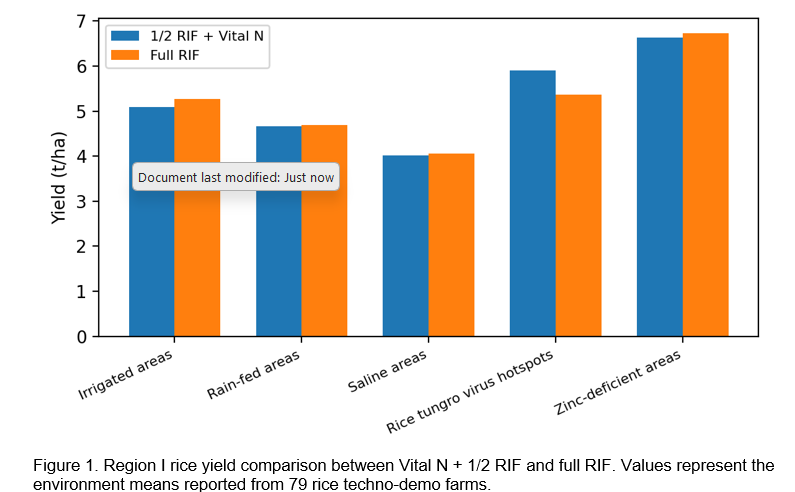
Across the 79 Region I rice demonstration farms, Vital N, combined with one-half of the recommended inorganic fertilizer, produced yields close to the full fertilizer standard while reducing production costs. The advantage was most evident in rainfed, saline, tungro-hotspot, and zinc-deficient conditions, where the net profit-to-cost ratio was higher with Vital N than with full RIF alone.
Table 2. Yield and profitability of Vital N + 1/2 RIF compared with full RIF in Region I rice demonstration farms.
PHP 62.73 = USD 1
|
Production condition
|
Vital N + 1/2 RIF yield (t/ha)
|
Full RIF yield (t/ha)
|
Vital N net returns (PhP/ha)
|
Full RIF net returns (PhP/ha)
|
Vital N NPCR
|
Full RIF NPCR
|
|
Irrigated areas
|
5.09
|
5.27
|
26,733
(USD 426.16)
|
26,443
(USD 421.54)
|
1.24
|
1.12
|
|
Rainfed areas
|
4.67
|
4.69
|
27,644
(USD 440.68)
|
25,991
(USD 414.33)
|
1.65
|
1.40
|
|
Saline areas
|
4.02
|
4.06
|
22,281
(USD 355.19)
|
20,825
(USD 331.98)
|
1.40
|
1.17
|
|
Rice tungro virus hotspots
|
5.91
|
5.37
|
33,456
(USD 533.33)
|
27,255
(USD 434.48)
|
1.48
|
1.15
|
|
Zinc-deficient areas
|
6.63
|
6.73
|
39,397
(USD 628.04)
|
38,524
(USD 614.12)
|
1.69
|
1.51
|
Region VI rice techno-demonstration results
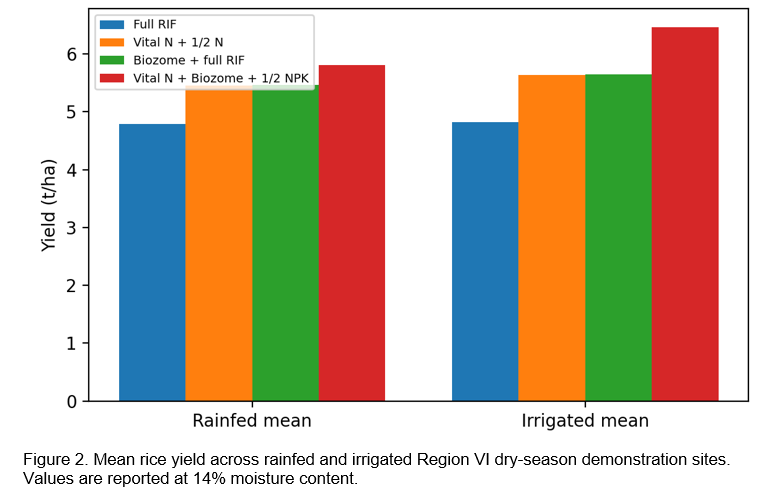
The Region VI dry-season techno-demonstration showed clear yield and income gains from Vital N under both rainfed and irrigated systems. Vital N + 1/2 recommended nitrogen and full P and K increased mean grain yield from 4.792 to 5.450 t/ha in rainfed sites and from 4.825 to 5.640 t/ha in irrigated sites. The highest performance was observed when Vital N was combined with Biozome and reduced inorganic fertilizer, producing 5.813 t/ha under rainfed conditions and 6.462 t/ha under irrigated conditions.
Table 3. Mean grain yield and economic results in Region VI dry-season rice techno-demonstrations.
|
Ecosystem
|
Full RIF yield
|
Vital N + 1/2 N yield
|
Biozome + full RIF yield
|
Vital N + Biozome + 1/2 NPK yield
|
Full RIF net income
|
Vital N net income
|
Biozome net income
|
Vital N + Biozome + 1/2 NPK net income
|
|
Rainfed mean
|
4.792
|
5.450
|
5.467
|
5.813
|
39,194
(USD 624.80)
|
49,236
(USD 784.89)
|
47,749
(USD 761.18)
|
53,963
(USD 860.24)
|
|
Irrigated mean
|
4.825
|
5.640
|
5.650
|
6.462
|
46,630
(USD 743.34)
|
58,942
(USD 939.61)
|
57,270
(USD 912.96)
|
70,120
(USD 1,117.81)
|
Corn efficacy testing
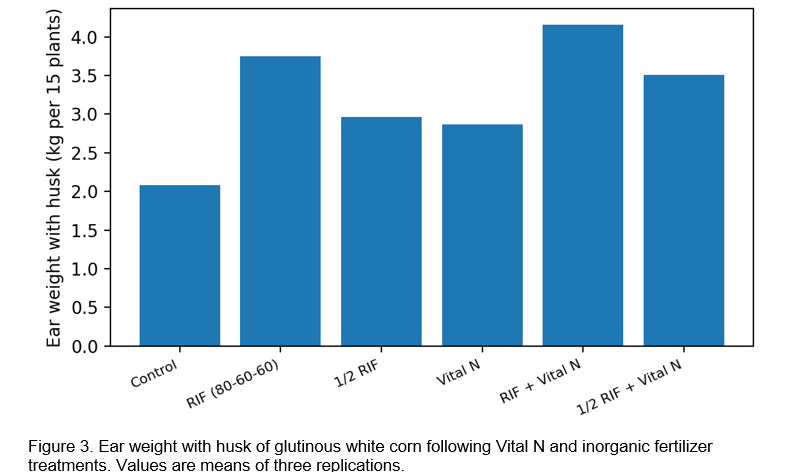
In the glutinous white corn efficacy test, Vital N significantly improved crop growth and yield-related traits. The highest plant height, root weight, stover weight, and ear weight occurred in the RIF + Vital N treatment. Importantly, 1/2 RIF + Vital N improved ear weight with husk by 18.3% over 1/2 RIF alone and increased ear weight without husk by 24.7%, indicating that Vital N remained useful even when the inorganic fertilizer rate was reduced.
Table 4. Corn growth and yield-related parameters as affected by Vital N biofertilizer.
|
Treatment
|
Plant height (cm)
|
Stover weight (g/15 plants)
|
Root weight (g/15 plants)
|
Ear weight with husk (g/15 plants)
|
Ear weight without husk (g/15 plants)
|
|
Control
|
145.2
|
1,856.7
|
422.5
|
2,083.3
|
1,730.0
|
|
RIF (80-60-60)
|
199.7
|
3,865.0
|
687.5
|
3,751.7
|
3,130.0
|
|
1/2 RIF
|
172.3
|
3,150.0
|
605.0
|
2,966.7
|
2,336.7
|
|
Vital N
|
176.5
|
2,668.3
|
557.5
|
2,866.7
|
2,233.3
|
|
RIF + Vital N
|
228.3
|
4,391.7
|
752.5
|
4,158.3
|
3,636.7
|
|
1/2 RIF + Vital N
|
205.5
|
3,766.7
|
672.5
|
3,508.3
|
2,913.3
|
Recent PhilRice fertilizer derby observations
The recent PhilRice fertilizer derby data provides an updated field indication of performance under managed comparison conditions. In the 2025 wet season, the Haltec Crop Labs program produced 4.35 t/ha grain yield using 45-14-29 kg NPK/ha, compared with the PhilRice standard of 4.25 t/ha using 90-28-58 kg NPK/ha. The Haltec program also had lower production costs and higher net income. In the 2025 dry season summary, Haltec produced 5.00 t/ha dry grain yield compared with 4.33 t/ha for the PhilRice standard.
Table 5. PhilRice fertilizer derby results involving Haltec Crop Labs program.
|
Season
|
Entry
|
Grain yield (t/ha)
|
Inorganic fertilizer applied (kg NPK/ha)
|
Production or fertilizer cost (PhP/ha)
|
Net income (PhP/ha)
|
|
PhilRice 2025 WS
|
Haltec Crop Labs, Inc.
|
4.35
|
45-14-29
|
61,649
(USD 982.77)
|
20,975.37
(USD 334.38)
|
|
PhilRice 2025 WS
|
PhilRice standard
|
4.25
|
90-28-58
|
67,114
(USD 1,069.89)
|
13,610.96
(USD 216.98)
|
|
PhilRice 2025 DS
|
Haltec Crop Labs, Inc.
|
5.00
|
not stated
|
15,630
(USD 249.16)
|
|
|
PhilRice 2025 DS
|
PhilRice standard
|
4.33
|
not stated
|
14,930
(USD 238.00)
|
|
ENVIRONMENTAL AND AGRONOMIC IMPLICATIONS OF VITAL N
A key environmental implication of the Vital N results is the potential to maintain crop productivity while reducing reliance on full synthetic nitrogen rates. In both Region I and Region VI rice data, Vital N was used with one-half the recommended nitrogen yet maintained or improved yields and economic returns. Environmental outcomes were not directly measured in these studies; however, reducing nitrogen input can lower fertilizer-related production costs and may reduce nutrient losses associated with excess fertilization.
Agronomically, the corn efficacy test suggests that Vital N supports stronger root and vegetative growth, thereby improving nutrient capture and crop vigor. These findings are consistent with the intended role of Azospirillum inoculants as plant-growth-promoting biofertilizers. The technology is also simple to deploy because it can be applied directly to moistened seed or seedling roots before planting.
CONCLUSION
The available field evidence from the Philippines supports the use of Vital N as a practical Azospirillum-based biofertilizer for rice and corn. In rice, Vital N used with reduced inorganic nitrogen produced yields comparable to or higher than those from full inorganic fertilizer while improving net returns and NPCR in several production environments. In corn, seed inoculation with Vital N significantly increased plant height, root biomass, stover biomass, and ear weight, particularly when combined with recommended fertilizer rates or one-half RIF. Recent PhilRice fertilizer derby data indicate that the Haltec program can sustain competitive yields with reduced inorganic fertilizer application.
For practical application, the amount of Vital N is primarily determined by the amount of seed or seedling-root material that must be adequately covered with the inoculant rather than by a fixed crop-specific biological dose. In the rice studies summarized here, a 100 g package was reported to treat approximately 20-40 kg of seed, while the Region VI demonstrations used a suspension of 25 g Vital N in 1 L of water for pre-germinated seed or seedling-root treatment. In the corn efficacy trial, 16.7 g was applied per 3 kg of seed, equivalent to approximately 100 g per 18 kg of corn seed. For crops not evaluated in the studies summarized here, the authors propose using the tested rice suspension concentration (25 g/L; equivalent to 100 g in 4 L of water) as a practical starting point for suspension-based treatment, preparing only the volume required to thoroughly coat seeds or wet seedling roots. The required volume will depend on the quantity, size, and surface area of the planting material. This is practical application guidance based on the tested rice concentration and the principle of adequate inoculant coverage; it should not be interpreted as an experimentally optimized crop-specific rate for vegetables or other crops. The available data also do not establish separate Vital N application quantities for irrigated, rainfed, saline, tungro-hotspot, or zinc-deficient environments; those comparisons describe field response under the study fertilizer programs rather than environment-specific inoculant dosing.
Overall, Vital N is well-positioned as a nutrient-use-efficiency tool for integrated soil fertility management. Standardized reporting of inoculant concentration, coverage method, amount of planting material treated, inorganic fertilizer rate, and economic outcomes across future demonstrations and extension use would improve comparability across crops and production environments and support broader farmer adoption.
REFERENCES
Bashan, Y., & de-Bashan, L. E. (2010). How the plant growth-promoting bacterium Azospirillum promotes plant growth - a critical assessment. Advances in Agronomy, 108, 77-136. https://doi.org/10.1016/S0065-2113(10)08002-8.
Department of Agriculture, Regional Field Unit I. (2008). On-farm trial on the use of bio-fertilizers on inbred and hybrid rice. Ilocos Agriculture Resources Research and Development Consortium.
Department of Agriculture, Regional Field Unit VI. (2010). Micronutrient Fertilizer (Biozome) and Biofertilizer (Vital N) Techno Demo in Selected Rice Areas in Western Visayas, Dry Season 2009-2010. Terminal Report.
Efficacy Testing Laboratory Report. (2003). Efficacy Testing of Vital N Bio-Fertilizer with Corn as Test Crop.
Fukami, J., Cerezini, P., & Hungria, M. (2018). Azospirillum: Benefits that go far beyond biological nitrogen fixation. AMB Express, 8, 73. https://doi.org/10.1186/s13568-018-0608-1.
Philippine Rice Research Institute. (2026). Result of the 2025 Wet Season Fertilizer Derby. PhilRice Los Baños.
Philippine Rice Research Institute. (2025). Fertilizer Derby 2025 Dry Season: Summary of Yield and Fertilizer Cost.
Philippine Rice Research Institute and Arnichem Corporation. (n.d.). Promotion Program for PhilRice's Growth-Enhancing, Yield-Boosting, Farmer-Friendly and Sustainable Agriculture Technologies for Increasing Farmers' Incomes.

Field Performance Evaluation of Vital N Azospirillum Biofertilizer in Rice and Corn under Philippine Conditions
ABSTRACT
This paper consolidates field and demonstration evidence on Vital N, a dry Azospirillum-based biofertilizer seed and root inoculant, under Philippine rice and corn production systems. The review synthesizes multi-location rice techno-demonstrations, corn efficacy testing, and recent PhilRice fertilizer derby results. Vital N is reported as a wettable powder containing dried Azospirillum sp. at approximately 10⁹ CFU/g, with a 100 g package sufficient to treat 20-40 kg rice seed or 18 kg corn seed for one hectare. Across 79 Region I rice demonstration farms, yields obtained with Vital N plus one-half the recommended inorganic fertilizer (1/2 RIF) were generally comparable to those from full RIF alone, while improving the net profit-to-cost ratio (NPCR). In Region VI dry-season rice trials, Vital N plus one-half nitrogen and full P and K increased mean yield over full inorganic fertilizer by 13.7% in rainfed sites and 16.9% in irrigated sites; the combined Vital N + Biozome treatment produced the highest mean yields and net income. In corn, Vital N significantly improved plant height, root weight, stover weight, and ear weight, with RIF + Vital N producing the highest ear weight without husk (3.64 kg per 15 plants). Recent PhilRice fertilizer derby data further showed that the Haltec program maintained or improved grain yield using reduced inorganic fertilizer rates. These results support Vital N as a practical nutrient-efficiency technology for increasing productivity and profitability while reducing dependence on synthetic nitrogen inputs.
Keywords: Vital N, Azospirillum, biofertilizer, nitrogen reduction, rice, corn, Philippines, nutrient-use efficiency
INTRODUCTION
Nitrogen fertilizer is one of the highest recurring costs in Philippine rice and corn production. Farmers often respond to yield targets by applying higher rates of inorganic fertilizer, yet nutrient losses, site-specific soil deficiencies, and rising input prices can limit economic returns. Biofertilizers based on plant-growth-promoting bacteria offer a complementary approach by improving nutrient acquisition, root development, and overall crop vigor while lowering the need for full synthetic fertilizer rates.
Azospirillum spp. are associative plant-growth-promoting bacteria that colonize the rhizosphere and root surfaces of many non-legume crops and have been widely studied as microbial inoculants or biofertilizers. Their effects are understood to result from multiple interacting mechanisms rather than biological nitrogen fixation alone. Although many strains can fix atmospheric nitrogen, direct transfer of fixed nitrogen may account for only part of the plant response. More consistently reported effects include the production of phytohormones such as indole-3-acetic acid, changes in root architecture, and improved water and mineral acquisition. Together, these mechanisms can improve nutrient-use efficiency and may help explain why inoculated crops can maintain performance when inorganic nitrogen rates are reduced, although the magnitude of the response can vary with the crop, bacterial strain, and environmental conditions (Bashan and de-Bashan, 2010; Fukami et al., 2018).
Vital N was developed as a convenient dry formulation of Azospirillum for seed and root inoculation. The product is intended for rice and crops grown after rice, including corn and vegetables. The available evidence base includes multi-location field demonstrations, formal efficacy testing in corn, and recent fertilizer derby evaluations. This paper synthesizes these results to evaluate the field performance and practical use of Vital N under Philippine conditions.
MATERIALS AND METHODS
This paper presents a structured synthesis of studies included in the Vital N literature package. The main rice evidence comes from (i) Region I on-farm demonstrations involving 79 rice sites under irrigated, rainfed, saline, tungro-prone, and zinc-deficient conditions; (ii) Region VI wet- and dry-season techno-demonstrations in selected rice areas; and (iii) PhilRice fertilizer derby results from the 2025 dry and wet seasons. The main evidence for corn comes from an efficacy test of glutinous white corn conducted from November 2002 to February 2003.
Treatments differed by study, but the common comparison was Vital N used as a seed or root inoculant with reduced inorganic nitrogen against locally recommended full inorganic fertilizer (RIF). In the rice demonstrations, Vital N was applied by dissolving 25 g of product in 1 L of water for pre-germinated seed or by dipping/spraying seedling roots before transplanting. In the corn efficacy trial, Vital N was used at 16.7 g per 3 kg corn seed. Corn data were analyzed by analysis of variance and Duncan's Multiple Range Test at the 5% level. Because the studies were conducted across different years, crops, sites, and protocols, this paper interprets the evidence as a consolidated field-performance review rather than a single pooled experiment.
Table 1. Common Vital N application approaches summarized from the submitted study package.
Crop/Study
Comparison treatment
Vital N application
Main evaluation parameters
Rice, Region I demonstrations
1/2 RIF + Vital N vs full RIF
Seed inoculation or seedling-root treatment; 100 g product sufficient for 20-40 kg rice seed
Yield, production cost, net returns, net profit-to-cost ratio (NPCR)
Rice, Region VI techno-demo
Vital N + 1/2 recommended N + full P and K; Vital N + Biozome + reduced inorganic fertilizer
25 g Vital N in 1 L water for pre-germinated seed or seedling roots
Yield, leaf color chart (LCC) readings, net income, return on investment (ROI)
Corn efficacy test
Control, full RIF, 1/2 RIF, Vital N, RIF + Vital N, 1/2 RIF + Vital N
16.7 g Vital N per 3 kg corn seed
Plant height, stover weight, root weight, ear weight
PhilRice fertilizer derby
Haltec Crop Labs program vs PhilRice standard and farmer practice
Haltec fertilizer program, including Vital N and reduced inorganic fertilizer rates
Grain yield, fertilizer rate/cost, production cost, net income
RESULTS AND DISCUSSION
Rice performance in Region I demonstration farms
Across the 79 Region I rice demonstration farms, Vital N, combined with one-half of the recommended inorganic fertilizer, produced yields close to the full fertilizer standard while reducing production costs. The advantage was most evident in rainfed, saline, tungro-hotspot, and zinc-deficient conditions, where the net profit-to-cost ratio was higher with Vital N than with full RIF alone.
Table 2. Yield and profitability of Vital N + 1/2 RIF compared with full RIF in Region I rice demonstration farms.
PHP 62.73 = USD 1
Production condition
Vital N + 1/2 RIF yield (t/ha)
Full RIF yield (t/ha)
Vital N net returns (PhP/ha)
Full RIF net returns (PhP/ha)
Vital N NPCR
Full RIF NPCR
Irrigated areas
5.09
5.27
26,733
(USD 426.16)
26,443
(USD 421.54)
1.24
1.12
Rainfed areas
4.67
4.69
27,644
(USD 440.68)
25,991
(USD 414.33)
1.65
1.40
Saline areas
4.02
4.06
22,281
(USD 355.19)
20,825
(USD 331.98)
1.40
1.17
Rice tungro virus hotspots
5.91
5.37
33,456
(USD 533.33)
27,255
(USD 434.48)
1.48
1.15
Zinc-deficient areas
6.63
6.73
39,397
(USD 628.04)
38,524
(USD 614.12)
1.69
1.51
Region VI rice techno-demonstration results
The Region VI dry-season techno-demonstration showed clear yield and income gains from Vital N under both rainfed and irrigated systems. Vital N + 1/2 recommended nitrogen and full P and K increased mean grain yield from 4.792 to 5.450 t/ha in rainfed sites and from 4.825 to 5.640 t/ha in irrigated sites. The highest performance was observed when Vital N was combined with Biozome and reduced inorganic fertilizer, producing 5.813 t/ha under rainfed conditions and 6.462 t/ha under irrigated conditions.
Table 3. Mean grain yield and economic results in Region VI dry-season rice techno-demonstrations.
Ecosystem
Full RIF yield
Vital N + 1/2 N yield
Biozome + full RIF yield
Vital N + Biozome + 1/2 NPK yield
Full RIF net income
Vital N net income
Biozome net income
Vital N + Biozome + 1/2 NPK net income
Rainfed mean
4.792
5.450
5.467
5.813
39,194
(USD 624.80)
49,236
(USD 784.89)
47,749
(USD 761.18)
53,963
(USD 860.24)
Irrigated mean
4.825
5.640
5.650
6.462
46,630
(USD 743.34)
58,942
(USD 939.61)
57,270
(USD 912.96)
70,120
(USD 1,117.81)
Corn efficacy testing
In the glutinous white corn efficacy test, Vital N significantly improved crop growth and yield-related traits. The highest plant height, root weight, stover weight, and ear weight occurred in the RIF + Vital N treatment. Importantly, 1/2 RIF + Vital N improved ear weight with husk by 18.3% over 1/2 RIF alone and increased ear weight without husk by 24.7%, indicating that Vital N remained useful even when the inorganic fertilizer rate was reduced.
Table 4. Corn growth and yield-related parameters as affected by Vital N biofertilizer.
Treatment
Plant height (cm)
Stover weight (g/15 plants)
Root weight (g/15 plants)
Ear weight with husk (g/15 plants)
Ear weight without husk (g/15 plants)
Control
145.2
1,856.7
422.5
2,083.3
1,730.0
RIF (80-60-60)
199.7
3,865.0
687.5
3,751.7
3,130.0
1/2 RIF
172.3
3,150.0
605.0
2,966.7
2,336.7
Vital N
176.5
2,668.3
557.5
2,866.7
2,233.3
RIF + Vital N
228.3
4,391.7
752.5
4,158.3
3,636.7
1/2 RIF + Vital N
205.5
3,766.7
672.5
3,508.3
2,913.3
Recent PhilRice fertilizer derby observations
The recent PhilRice fertilizer derby data provides an updated field indication of performance under managed comparison conditions. In the 2025 wet season, the Haltec Crop Labs program produced 4.35 t/ha grain yield using 45-14-29 kg NPK/ha, compared with the PhilRice standard of 4.25 t/ha using 90-28-58 kg NPK/ha. The Haltec program also had lower production costs and higher net income. In the 2025 dry season summary, Haltec produced 5.00 t/ha dry grain yield compared with 4.33 t/ha for the PhilRice standard.
Table 5. PhilRice fertilizer derby results involving Haltec Crop Labs program.
Season
Entry
Grain yield (t/ha)
Inorganic fertilizer applied (kg NPK/ha)
Production or fertilizer cost (PhP/ha)
Net income (PhP/ha)
PhilRice 2025 WS
Haltec Crop Labs, Inc.
4.35
45-14-29
61,649
(USD 982.77)
20,975.37
(USD 334.38)
PhilRice 2025 WS
PhilRice standard
4.25
90-28-58
67,114
(USD 1,069.89)
13,610.96
(USD 216.98)
PhilRice 2025 DS
Haltec Crop Labs, Inc.
5.00
not stated
15,630
(USD 249.16)
PhilRice 2025 DS
PhilRice standard
4.33
not stated
14,930
(USD 238.00)
ENVIRONMENTAL AND AGRONOMIC IMPLICATIONS OF VITAL N
A key environmental implication of the Vital N results is the potential to maintain crop productivity while reducing reliance on full synthetic nitrogen rates. In both Region I and Region VI rice data, Vital N was used with one-half the recommended nitrogen yet maintained or improved yields and economic returns. Environmental outcomes were not directly measured in these studies; however, reducing nitrogen input can lower fertilizer-related production costs and may reduce nutrient losses associated with excess fertilization.
Agronomically, the corn efficacy test suggests that Vital N supports stronger root and vegetative growth, thereby improving nutrient capture and crop vigor. These findings are consistent with the intended role of Azospirillum inoculants as plant-growth-promoting biofertilizers. The technology is also simple to deploy because it can be applied directly to moistened seed or seedling roots before planting.
CONCLUSION
The available field evidence from the Philippines supports the use of Vital N as a practical Azospirillum-based biofertilizer for rice and corn. In rice, Vital N used with reduced inorganic nitrogen produced yields comparable to or higher than those from full inorganic fertilizer while improving net returns and NPCR in several production environments. In corn, seed inoculation with Vital N significantly increased plant height, root biomass, stover biomass, and ear weight, particularly when combined with recommended fertilizer rates or one-half RIF. Recent PhilRice fertilizer derby data indicate that the Haltec program can sustain competitive yields with reduced inorganic fertilizer application.
For practical application, the amount of Vital N is primarily determined by the amount of seed or seedling-root material that must be adequately covered with the inoculant rather than by a fixed crop-specific biological dose. In the rice studies summarized here, a 100 g package was reported to treat approximately 20-40 kg of seed, while the Region VI demonstrations used a suspension of 25 g Vital N in 1 L of water for pre-germinated seed or seedling-root treatment. In the corn efficacy trial, 16.7 g was applied per 3 kg of seed, equivalent to approximately 100 g per 18 kg of corn seed. For crops not evaluated in the studies summarized here, the authors propose using the tested rice suspension concentration (25 g/L; equivalent to 100 g in 4 L of water) as a practical starting point for suspension-based treatment, preparing only the volume required to thoroughly coat seeds or wet seedling roots. The required volume will depend on the quantity, size, and surface area of the planting material. This is practical application guidance based on the tested rice concentration and the principle of adequate inoculant coverage; it should not be interpreted as an experimentally optimized crop-specific rate for vegetables or other crops. The available data also do not establish separate Vital N application quantities for irrigated, rainfed, saline, tungro-hotspot, or zinc-deficient environments; those comparisons describe field response under the study fertilizer programs rather than environment-specific inoculant dosing.
Overall, Vital N is well-positioned as a nutrient-use-efficiency tool for integrated soil fertility management. Standardized reporting of inoculant concentration, coverage method, amount of planting material treated, inorganic fertilizer rate, and economic outcomes across future demonstrations and extension use would improve comparability across crops and production environments and support broader farmer adoption.
REFERENCES
Bashan, Y., & de-Bashan, L. E. (2010). How the plant growth-promoting bacterium Azospirillum promotes plant growth - a critical assessment. Advances in Agronomy, 108, 77-136. https://doi.org/10.1016/S0065-2113(10)08002-8.
Department of Agriculture, Regional Field Unit I. (2008). On-farm trial on the use of bio-fertilizers on inbred and hybrid rice. Ilocos Agriculture Resources Research and Development Consortium.
Department of Agriculture, Regional Field Unit VI. (2010). Micronutrient Fertilizer (Biozome) and Biofertilizer (Vital N) Techno Demo in Selected Rice Areas in Western Visayas, Dry Season 2009-2010. Terminal Report.
Efficacy Testing Laboratory Report. (2003). Efficacy Testing of Vital N Bio-Fertilizer with Corn as Test Crop.
Fukami, J., Cerezini, P., & Hungria, M. (2018). Azospirillum: Benefits that go far beyond biological nitrogen fixation. AMB Express, 8, 73. https://doi.org/10.1186/s13568-018-0608-1.
Philippine Rice Research Institute. (2026). Result of the 2025 Wet Season Fertilizer Derby. PhilRice Los Baños.
Philippine Rice Research Institute. (2025). Fertilizer Derby 2025 Dry Season: Summary of Yield and Fertilizer Cost.
Philippine Rice Research Institute and Arnichem Corporation. (n.d.). Promotion Program for PhilRice's Growth-Enhancing, Yield-Boosting, Farmer-Friendly and Sustainable Agriculture Technologies for Increasing Farmers' Incomes.