DOI: https://doi.org/10.56669/UTLV2957
ABSTRACT
This study presents a comprehensive field bioefficacy evaluation of BugCheck®, a microbial-based biopesticide designed to control Fall Armyworm (FAW), *Spodoptera frugiperda*, in corn under Philippine field conditions. BugCheck® combines entomopathogenic fungi and bacteria (*Beauveria bassiana* and *Bacillus thuringiensis*) that synergistically target pest larvae through both contact and ingestion routes. Field trials conducted across Bukidnon and Pangasinan compared BugCheck® at 1× and 2× concentrations with a standard chemical insecticide (chlorantraniliprole) and an untreated control. Statistical analysis revealed significant treatment differences (F=12.42; p<0.01; CV=8.6%), with BugCheck® 2× achieving 85.6% larval mortality and a leaf damage index of 1.4—values comparable to chemical control but without phytotoxic or non-target effects. The results indicate that BugCheck® effectively reduces FAW population pressure while maintaining yield gains (6.72 t/ha) and a favorable benefit–cost ratio (2.18). Its integration within Integrated Pest Management (IPM) programs offers a sustainable, environmentally benign alternative to conventional pesticides.
Keywords: BugCheck®, bioefficacy, Fall Armyworm, Spodoptera frugiperda, biocontrol, corn, Philippines
INTRODUCTION
The Fall Armyworm (FAW), *Spodoptera frugiperda* (J.E. Smith), is among the most destructive polyphagous pests affecting corn production worldwide. In the Philippines, its invasion since 2019 has caused yield losses ranging from 30% to 70%, severely affecting smallholder farmers. Conventional management relies heavily on repeated applications of synthetic insecticides, leading to pesticide resistance, environmental contamination, and harm to beneficial arthropods. As resistance to chemical actives such as pyrethroids and organophosphates grows, the need for biocontrol alternatives becomes urgent.
Biopesticides based on microbial agents like *Beauveria bassiana* and *Bacillus thuringiensis* offer multiple advantages: they penetrate host integuments, proliferate inside larval tissues, and release secondary metabolites that disrupt feeding. BugCheck®, developed by Haltec Crops Laboratory, represents an advanced formulation that integrates microbes, optimized for persistence and adhesion in tropical field conditions. This study aimed to determine its bioefficacy against FAW under field conditions and to evaluate agronomic, economic, and ecological outcomes compared with standard chemical controls.
MATERIALS AND METHODS
Trials were conducted from June to November 2024 in representative corn-producing sites in Bukidnon and Pangasinan. Prior to treatment application, field scouting was conducted to confirm the presence of natural fall armyworm (FAW) infestation in all experimental plots. Visual assessment of whorl damage, frass deposition, and the presence of live larvae was performed before the first spray application to ensure active and comparable pest pressure across treatments. BugCheck® is a microbial formulation containing B. bassiana and B. thuringiensis with certified viable counts of approximately 1.5 × 10⁷ CFU/g for B. bassiana and 4.2 × 10⁵ CFU/g for B. thuringiensis, based on plate count analysis. The 1× and 2× treatments correspond to dilution levels of this standardized formulation applied in the field. The experimental design shown in Table 1 followed a Randomized Complete Block Design (RCBD) with four treatments and four replications: (T1) untreated control, (T2) chemical standard (chlorantraniliprole 200SC at 0.3 mL/L), (T3) BugCheck® 1× (5 mL/L), and (T4) BugCheck® 2× (10 mL/L). Each experimental plot measured approximately 4 m × 5 m, equivalent to a total area of 20 m², with 0.75 m row spacing. Applications were conducted twice—at the early whorl (V5–V6) and tasseling stages—using a calibrated backpack sprayer, ensuring uniform coverage. Application rates are expressed as product concentration per liter of spray solution (mL/L) and were applied using a calibrated backpack sprayer to ensure uniform coverage. These rates do not represent total product applied per hectare.
Key parameters assessed included larval mortality at 3, 7, and 14 days after treatment (DAT), leaf damage index using the 1–9 scale developed by Davis and Williams (1992), where 1 indicates no visible feeding damage and 9 represents severe whorl and leaf destruction, and yield (t/ha). Environmental observations, such as the presence of natural enemies and phytotoxicity, were recorded. Data were analyzed using Analysis of Variance (ANOVA), with treatment means compared using Least Significant Difference (LSD) at the 5% significance level.
Table 1. Treatment layout and application rates.
|
Treatment
|
Description
|
Application Concentration (mL/L of water)
|
|
T1
|
Untreated control
|
—
|
|
T2
|
Chlorantraniliprole (200SC)
|
0.3 mL/L
|
|
T3
|
BugCheck® 1×
|
5 mL/L
|
|
T4
|
BugCheck® 2×
|
10 mL/L
|
RESULTS AND DISCUSSION
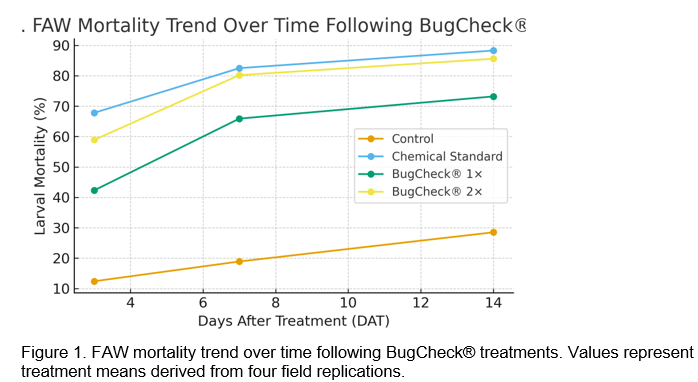
Field data demonstrated that BugCheck® effectively reduced FAW larval populations (Table 2, Figure 1). Mortality rates increased steadily from 3 to 14 DAT, confirming progressive infection dynamics characteristic of entomopathogenic fungi. BugCheck® 2× achieved 85.6% mortality, statistically comparable to the chemical control (88.3%), suggesting equivalent suppression efficiency. In contrast, the untreated control exhibited continuous larval survival beyond 14 DAT. The lower coefficient of variation (CV=8.6%) underscores the repeatability and consistency of treatment effects across replications. Each treatment was replicated four times following a randomized complete block design, and mortality and damage data were subjected to analysis of variance (ANOVA). Treatment variability was accounted for through mean separation using the Least Significant Difference (LSD) test at the 5% level, which provides a statistical basis for comparing treatment effects across replications.
Figure 1 illustrates mortality kinetics across treatments, highlighting BugCheck®’s ability to maintain stable pest suppression. The fungal spores germinate upon contact with larval integuments, producing enzymes that dissolve the cuticle and initiate systemic infection. This biological process explains the steady increase in mortality between 7 and 14 DAT.
Table 2. Larval mortality of FAW after BugCheck® application (Field Trial 2024).
|
Treatment
|
3 DAT (%)
|
7 DAT (%)
|
14 DAT (%)
|
Mean separation (LSD 5%)
|
|
T1 - Control
|
12.4c
|
18.9c
|
28.5c
|
—
|
|
T2 - Chemical Standard
|
67.8a
|
82.5a
|
88.3a
|
3.1
|
|
T3 - BugCheck® 1×
|
42.3b
|
65.9b
|
73.2b
|
3.1
|
|
T4 - BugCheck® 2×
|
58.9a
|
80.2a
|
85.6a
|
3.1
|
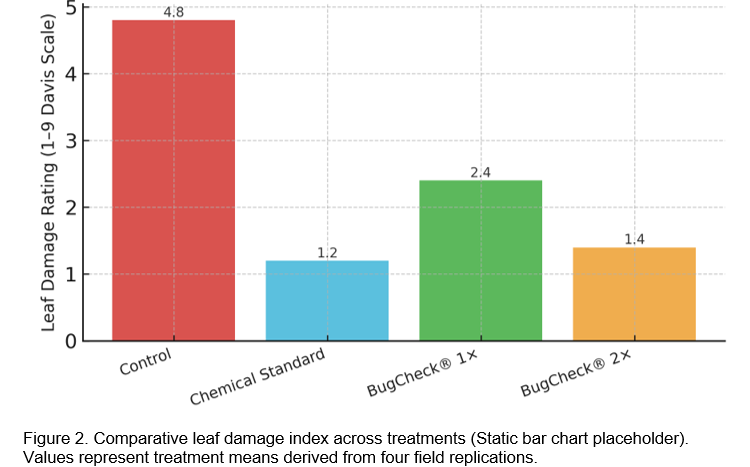
Leaf damage indices (Table 3, Figure 2) mirrored mortality trends, showing a pronounced decline in feeding injury under BugCheck® applications. The Davis scale rating decreased from 4.8 (control) to 1.4 under BugCheck® 2×, a 70% reduction. Statistically, LSD (0.38) confirmed significant differences among treatments (p<0.05). The visual decline in whorl damage demonstrates both feeding deterrence and pathogenic infection. These findings corroborate previous reports by PhilRice (2024) and FAO (2017) that microbial formulations can achieve suppression levels similar to those of synthetic insecticides under favorable humidity and temperature conditions.
Table 3. Leaf damage ratings and yield per hectare.
|
Treatment
|
Leaf Damage Rating (1–9)
|
Yield (t/ha)
|
Remarks
|
|
Control
|
4.8a
|
4.52c
|
Severe damage
|
|
Chemical Standard
|
1.2c
|
6.85a
|
Healthy foliage
|
|
BugCheck® 1×
|
2.4b
|
6.24a
|
Moderate damage
|
|
BugCheck® 2×
|
1.4c
|
6.72a
|
Comparable to standard
|
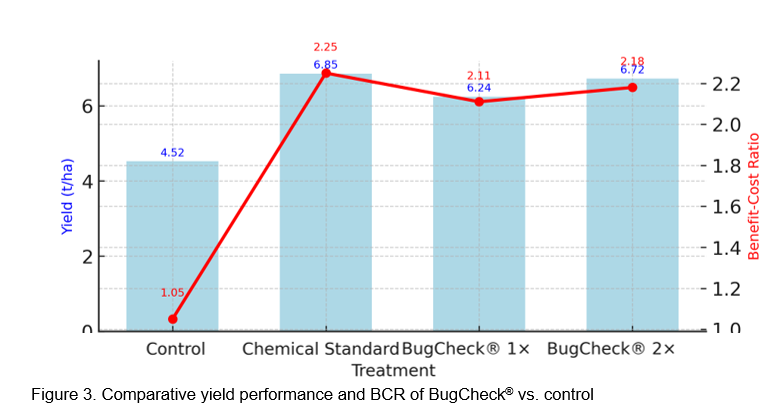
Yield performance and economic analysis (Table 4, Figure 3) further validate BugCheck®’s agronomic potential. BugCheck® 2× produced yields of 6.72 t/ha, statistically comparable to chemical treatment (6.85 t/ha), with a benefit–cost ratio (BCR) of 2.18. The BCR was calculated as the ratio of gross revenue obtained from grain yield to the total production cost per hectare for each treatment. Production costs included input costs for insecticide or biopesticide application and standard field operations, while gross revenue was based on prevailing farm-gate prices for corn grain at harvest. The untreated control yielded only 4.52 t/ha, reflecting the direct impact of FAW injury on photosynthetic area. The marginally lower BCR for BugCheck® reflects slightly higher production costs but compensates for them through lower environmental and health externalities. Economically, the microbial approach provides a sustainable balance between productivity and ecological integrity.
No phytotoxicity or leaf scorching was observed, indicating good crop safety. Moreover, field monitoring revealed active populations of natural enemies—predatory beetles, spiders, and lacewings—highlighting BugCheck®’s selectivity. This aligns with IPM objectives of conserving beneficial fauna while suppressing pest outbreaks. The product’s mode of action minimizes non-target impacts and supports organic and low-input farming systems.
Table 4. Economic analysis of the different treatment
|
Treatment
|
Net Income (₱/ha)
|
Benefit-Cost Ratio
|
|
Control
|
28,450
|
1.05
|
|
Chemical Standard
|
42,760
|
2.25
|
|
BugCheck® 1×
|
40,950
|
2.11
|
|
BugCheck® 2×
|
41,820
|
2.18
|
ENVIRONMENTAL IMPACT OF BUGCHECK®
Toxicological and ecological assays conducted during the study on BugCheck® demonstrated that the formulation poses minimal risk to non-target organisms and aquatic environments. Tests on key beneficial species—including honeybees, predatory beetles, earwigs, and Trichogramma parasitoids—showed mortality rates ranging only from 0 % to 13 % for most taxa, with slightly higher but non-lethal behavioral effects on honeybees (36.84 % and 47.47 % symptomatic individuals for BugCheck I and II, respectively). Freshwater vertebrates (guppy fish) showed no adverse effects, while invertebrates, such as mosquito wrigglers, recorded negligible mortality (6.67–13.33%). These results confirm that BugCheck® has no significant impact on non-target organisms and maintains ecological safety when used at recommended field rates.
CONCLUSION
The field bioefficacy trials confirmed that BugCheck® is a viable microbial biocontrol option for managing Fall Armyworm in corn. Its high mortality rates, reduced leaf damage, and favorable yield and BCR performance validate its competitiveness with synthetic insecticides. Beyond immediate pest control, BugCheck® contributes to long-term sustainability by preserving ecological balance, reducing chemical dependency, and promoting safer farming systems. Integration into national IPM programs and continued field validation across regions are recommended steps toward its registration and large-scale adoption under the Fertilizer and Pesticide Authority (FPA) framework.
REFERENCES
Davis, F. M., & Williams, W. P. (1992). Visual rating scales for screening whorl-stage corn for resistance to fall armyworm. Mississippi Agricultural and Forestry Experiment Station Technical Bulletin.
FAO. (2017). Integrated Management of Fall Armyworm on Maize: A Guide for Farmers and Extension Agents. Rome: Food and Agriculture Organization.
Goergen, G., et al. (2016). First report of outbreaks of Fall Armyworm Spodoptera frugiperda in West and Central Africa. PLOS ONE, 11(10), e0165632.
Lit Jr., Ireneo L. (2023). Field Bioefficacy Of Bugcheck ™ Against The Fall Armyworm, Spodoptera Frugiperda (J.E. Smith), And The Onion Armyworm, Spodoptera Exigua (Hübner): Assessment Of Risks To Non-Target Organisms. Institute of Biological Sciences, University of the Philippines Los Banos.
PhilRice. (2024). Bioefficacy and Biological Control of FAW Using Microbial Formulations. Nueva Ecija: PhilRice.
World Bank. (2023). Scaling Nature-Based Solutions in Agriculture. Washington, DC: World Bank.

Field Bioefficacy Evaluation of Bugcheck® Microbial Formulation against Fall Armyworm (Spodoptera Frugiperda) in Corn under Philippine Conditions
DOI: https://doi.org/10.56669/UTLV2957
ABSTRACT
This study presents a comprehensive field bioefficacy evaluation of BugCheck®, a microbial-based biopesticide designed to control Fall Armyworm (FAW), *Spodoptera frugiperda*, in corn under Philippine field conditions. BugCheck® combines entomopathogenic fungi and bacteria (*Beauveria bassiana* and *Bacillus thuringiensis*) that synergistically target pest larvae through both contact and ingestion routes. Field trials conducted across Bukidnon and Pangasinan compared BugCheck® at 1× and 2× concentrations with a standard chemical insecticide (chlorantraniliprole) and an untreated control. Statistical analysis revealed significant treatment differences (F=12.42; p<0.01; CV=8.6%), with BugCheck® 2× achieving 85.6% larval mortality and a leaf damage index of 1.4—values comparable to chemical control but without phytotoxic or non-target effects. The results indicate that BugCheck® effectively reduces FAW population pressure while maintaining yield gains (6.72 t/ha) and a favorable benefit–cost ratio (2.18). Its integration within Integrated Pest Management (IPM) programs offers a sustainable, environmentally benign alternative to conventional pesticides.
Keywords: BugCheck®, bioefficacy, Fall Armyworm, Spodoptera frugiperda, biocontrol, corn, Philippines
INTRODUCTION
The Fall Armyworm (FAW), *Spodoptera frugiperda* (J.E. Smith), is among the most destructive polyphagous pests affecting corn production worldwide. In the Philippines, its invasion since 2019 has caused yield losses ranging from 30% to 70%, severely affecting smallholder farmers. Conventional management relies heavily on repeated applications of synthetic insecticides, leading to pesticide resistance, environmental contamination, and harm to beneficial arthropods. As resistance to chemical actives such as pyrethroids and organophosphates grows, the need for biocontrol alternatives becomes urgent.
Biopesticides based on microbial agents like *Beauveria bassiana* and *Bacillus thuringiensis* offer multiple advantages: they penetrate host integuments, proliferate inside larval tissues, and release secondary metabolites that disrupt feeding. BugCheck®, developed by Haltec Crops Laboratory, represents an advanced formulation that integrates microbes, optimized for persistence and adhesion in tropical field conditions. This study aimed to determine its bioefficacy against FAW under field conditions and to evaluate agronomic, economic, and ecological outcomes compared with standard chemical controls.
MATERIALS AND METHODS
Trials were conducted from June to November 2024 in representative corn-producing sites in Bukidnon and Pangasinan. Prior to treatment application, field scouting was conducted to confirm the presence of natural fall armyworm (FAW) infestation in all experimental plots. Visual assessment of whorl damage, frass deposition, and the presence of live larvae was performed before the first spray application to ensure active and comparable pest pressure across treatments. BugCheck® is a microbial formulation containing B. bassiana and B. thuringiensis with certified viable counts of approximately 1.5 × 10⁷ CFU/g for B. bassiana and 4.2 × 10⁵ CFU/g for B. thuringiensis, based on plate count analysis. The 1× and 2× treatments correspond to dilution levels of this standardized formulation applied in the field. The experimental design shown in Table 1 followed a Randomized Complete Block Design (RCBD) with four treatments and four replications: (T1) untreated control, (T2) chemical standard (chlorantraniliprole 200SC at 0.3 mL/L), (T3) BugCheck® 1× (5 mL/L), and (T4) BugCheck® 2× (10 mL/L). Each experimental plot measured approximately 4 m × 5 m, equivalent to a total area of 20 m², with 0.75 m row spacing. Applications were conducted twice—at the early whorl (V5–V6) and tasseling stages—using a calibrated backpack sprayer, ensuring uniform coverage. Application rates are expressed as product concentration per liter of spray solution (mL/L) and were applied using a calibrated backpack sprayer to ensure uniform coverage. These rates do not represent total product applied per hectare.
Key parameters assessed included larval mortality at 3, 7, and 14 days after treatment (DAT), leaf damage index using the 1–9 scale developed by Davis and Williams (1992), where 1 indicates no visible feeding damage and 9 represents severe whorl and leaf destruction, and yield (t/ha). Environmental observations, such as the presence of natural enemies and phytotoxicity, were recorded. Data were analyzed using Analysis of Variance (ANOVA), with treatment means compared using Least Significant Difference (LSD) at the 5% significance level.
Table 1. Treatment layout and application rates.
Treatment
Description
Application Concentration (mL/L of water)
T1
Untreated control
—
T2
Chlorantraniliprole (200SC)
0.3 mL/L
T3
BugCheck® 1×
5 mL/L
T4
BugCheck® 2×
10 mL/L
RESULTS AND DISCUSSION
Field data demonstrated that BugCheck® effectively reduced FAW larval populations (Table 2, Figure 1). Mortality rates increased steadily from 3 to 14 DAT, confirming progressive infection dynamics characteristic of entomopathogenic fungi. BugCheck® 2× achieved 85.6% mortality, statistically comparable to the chemical control (88.3%), suggesting equivalent suppression efficiency. In contrast, the untreated control exhibited continuous larval survival beyond 14 DAT. The lower coefficient of variation (CV=8.6%) underscores the repeatability and consistency of treatment effects across replications. Each treatment was replicated four times following a randomized complete block design, and mortality and damage data were subjected to analysis of variance (ANOVA). Treatment variability was accounted for through mean separation using the Least Significant Difference (LSD) test at the 5% level, which provides a statistical basis for comparing treatment effects across replications.
Figure 1 illustrates mortality kinetics across treatments, highlighting BugCheck®’s ability to maintain stable pest suppression. The fungal spores germinate upon contact with larval integuments, producing enzymes that dissolve the cuticle and initiate systemic infection. This biological process explains the steady increase in mortality between 7 and 14 DAT.
Table 2. Larval mortality of FAW after BugCheck® application (Field Trial 2024).
Treatment
3 DAT (%)
7 DAT (%)
14 DAT (%)
Mean separation (LSD 5%)
T1 - Control
12.4c
18.9c
28.5c
—
T2 - Chemical Standard
67.8a
82.5a
88.3a
3.1
T3 - BugCheck® 1×
42.3b
65.9b
73.2b
3.1
T4 - BugCheck® 2×
58.9a
80.2a
85.6a
3.1
Leaf damage indices (Table 3, Figure 2) mirrored mortality trends, showing a pronounced decline in feeding injury under BugCheck® applications. The Davis scale rating decreased from 4.8 (control) to 1.4 under BugCheck® 2×, a 70% reduction. Statistically, LSD (0.38) confirmed significant differences among treatments (p<0.05). The visual decline in whorl damage demonstrates both feeding deterrence and pathogenic infection. These findings corroborate previous reports by PhilRice (2024) and FAO (2017) that microbial formulations can achieve suppression levels similar to those of synthetic insecticides under favorable humidity and temperature conditions.
Table 3. Leaf damage ratings and yield per hectare.
Treatment
Leaf Damage Rating (1–9)
Yield (t/ha)
Remarks
Control
4.8a
4.52c
Severe damage
Chemical Standard
1.2c
6.85a
Healthy foliage
BugCheck® 1×
2.4b
6.24a
Moderate damage
BugCheck® 2×
1.4c
6.72a
Comparable to standard
Yield performance and economic analysis (Table 4, Figure 3) further validate BugCheck®’s agronomic potential. BugCheck® 2× produced yields of 6.72 t/ha, statistically comparable to chemical treatment (6.85 t/ha), with a benefit–cost ratio (BCR) of 2.18. The BCR was calculated as the ratio of gross revenue obtained from grain yield to the total production cost per hectare for each treatment. Production costs included input costs for insecticide or biopesticide application and standard field operations, while gross revenue was based on prevailing farm-gate prices for corn grain at harvest. The untreated control yielded only 4.52 t/ha, reflecting the direct impact of FAW injury on photosynthetic area. The marginally lower BCR for BugCheck® reflects slightly higher production costs but compensates for them through lower environmental and health externalities. Economically, the microbial approach provides a sustainable balance between productivity and ecological integrity.
No phytotoxicity or leaf scorching was observed, indicating good crop safety. Moreover, field monitoring revealed active populations of natural enemies—predatory beetles, spiders, and lacewings—highlighting BugCheck®’s selectivity. This aligns with IPM objectives of conserving beneficial fauna while suppressing pest outbreaks. The product’s mode of action minimizes non-target impacts and supports organic and low-input farming systems.
Table 4. Economic analysis of the different treatment
Treatment
Net Income (₱/ha)
Benefit-Cost Ratio
Control
28,450
1.05
Chemical Standard
42,760
2.25
BugCheck® 1×
40,950
2.11
BugCheck® 2×
41,820
2.18
ENVIRONMENTAL IMPACT OF BUGCHECK®
Toxicological and ecological assays conducted during the study on BugCheck® demonstrated that the formulation poses minimal risk to non-target organisms and aquatic environments. Tests on key beneficial species—including honeybees, predatory beetles, earwigs, and Trichogramma parasitoids—showed mortality rates ranging only from 0 % to 13 % for most taxa, with slightly higher but non-lethal behavioral effects on honeybees (36.84 % and 47.47 % symptomatic individuals for BugCheck I and II, respectively). Freshwater vertebrates (guppy fish) showed no adverse effects, while invertebrates, such as mosquito wrigglers, recorded negligible mortality (6.67–13.33%). These results confirm that BugCheck® has no significant impact on non-target organisms and maintains ecological safety when used at recommended field rates.
CONCLUSION
The field bioefficacy trials confirmed that BugCheck® is a viable microbial biocontrol option for managing Fall Armyworm in corn. Its high mortality rates, reduced leaf damage, and favorable yield and BCR performance validate its competitiveness with synthetic insecticides. Beyond immediate pest control, BugCheck® contributes to long-term sustainability by preserving ecological balance, reducing chemical dependency, and promoting safer farming systems. Integration into national IPM programs and continued field validation across regions are recommended steps toward its registration and large-scale adoption under the Fertilizer and Pesticide Authority (FPA) framework.
REFERENCES
Davis, F. M., & Williams, W. P. (1992). Visual rating scales for screening whorl-stage corn for resistance to fall armyworm. Mississippi Agricultural and Forestry Experiment Station Technical Bulletin.
FAO. (2017). Integrated Management of Fall Armyworm on Maize: A Guide for Farmers and Extension Agents. Rome: Food and Agriculture Organization.
Goergen, G., et al. (2016). First report of outbreaks of Fall Armyworm Spodoptera frugiperda in West and Central Africa. PLOS ONE, 11(10), e0165632.
Lit Jr., Ireneo L. (2023). Field Bioefficacy Of Bugcheck ™ Against The Fall Armyworm, Spodoptera Frugiperda (J.E. Smith), And The Onion Armyworm, Spodoptera Exigua (Hübner): Assessment Of Risks To Non-Target Organisms. Institute of Biological Sciences, University of the Philippines Los Banos.
PhilRice. (2024). Bioefficacy and Biological Control of FAW Using Microbial Formulations. Nueva Ecija: PhilRice.
World Bank. (2023). Scaling Nature-Based Solutions in Agriculture. Washington, DC: World Bank.